
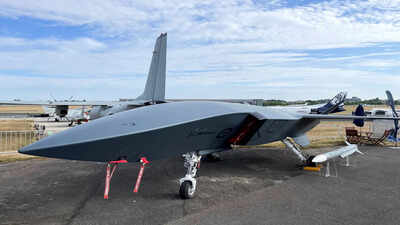
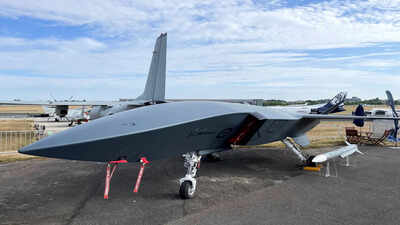
Germany has told Boeing that it will not directly buy the company’s MQ-28 Ghost Bat drone wingman, as Berlin readjusts its plans for a Collaborative Combat Aircraft programme. A Boeing spokesperson said the German ministry of defence had informed the company of the decision but did not give details as to why.The ministry on its part said it does not give information on potential projects, citing procurement and public contracting law and the requirement that such matters first go to parliament.The decision comes as Germany moves ahead with plans to acquire F-35 fighter jets from the US, despite initial resistance to the purchase. However, Berlin appears to be taking a more cautious approach to its next-generation uncrewed combat aircraft.Designed to fly alongside crewed fighter jets and carry out strike missions, these drone wingmen are intended to extend the reach and combat capabilities of conventional aircraft while reducing risks to pilots. Germany had aimed to field the capability by 2029, potentially making it the first European country to do so. That timeline, however, now appears uncertain. Berlin is expected to defer the introduction of the capability until the early 2030s, with flight testing scheduled to begin in 2027. This would give Boeing and other contenders an opportunity to compete for the programme.Several companies are positioning themselves as alternatives. Germany’s Helsing is pitching its CA-1 Europa, which the company says will be ready for operations by 2029. A partnership between Airbus and US firm Kratos is offering the U740 Valkyrie. The companies announced its first flight on Monday and said they remained on track to deliver a combat-ready uncrewed aircraft by 2029. General Atomics Aeronautical Systems could also offer a platform from its Gambit family. A company spokesperson said it had held repeated discussions with Germany about its offering.
The strategic cost of buying foreign weapons
Germany’s decision comes amid a broader debate over how defence procurement intersects with diplomacy, national security and strategic autonomy. Governments must weigh the advantages of acquiring advanced foreign weapons against the risks of becoming dependent on overseas suppliers. Recent debates surrounding the US-led F-35 programme illustrate how political disagreements and export restrictions can affect access to military technology.A weapons purchase involves far more than the initial acquisition of hardware. Buyers often depend on suppliers for spare parts, software updates, ammunition, maintenance and upgrades throughout a platform’s service life. Export approvals, sanctions and restrictions on technology transfers can also determine how freely a country can operate, modify or upgrade its equipment.Turkey’s removal from the F-35 programme in July 2019 remains one of the clearest examples of these risks.Ankara was an original partner in the programme but proceeded with its purchase of Russia’s S-400 air defence system despite Washington’s objections. The US argued that operating the Russian system alongside the F-35 could expose sensitive information about the fighter’s capabilities. Turkey subsequently lost its planned F-35 deliveries as well as its role in the programme’s industrial supply chain.European countries have acquired the F-35 for its stealth capabilities, advanced sensors and interoperability with allied forces. European companies also participate in its manufacturing and support networks. However, participation in the programme does not give buyers complete control over the aircraft’s development or upgrades.Britain’s efforts to integrate additional weapons onto the F-35, for instance, depend on software updates managed through the US-led programme. Delays can therefore disrupt national plans to introduce new capabilities. Meanwhile, claims that the F-35 has a remote kill switch have not been substantiated. On October 8, Reuters reported that Portugal was seriously considering the F-35, alongside European alternatives, to replace its F-16 fleet.
The implications for India
For India, these questions are closely linked to its long-standing pursuit of strategic autonomy. New Delhi sources military equipment from Russia, the United States, France, Israel and other countries while seeking to expand domestic manufacturing and access to advanced technology.India operates several American-origin platforms, including C-17 and C-130J transport aircraft, P-8I maritime patrol aircraft, Apache attack helicopters, Chinook heavy-lift helicopters, MH-60R naval helicopters and M777 howitzers. Defence cooperation with Washington has also expanded to include proposals for co-production and technology transfer.However, the history of US sanctions against India underscores the potential risks of geopolitical differences. Sanctions followed India’s 1998 nuclear tests, while the possibility of punitive measures under the US Countering America’s Adversaries Through Sanctions Act (CAATSA) became a concern after New Delhi purchased Russia’s S-400 air defence system.India’s circumstances differ significantly from Turkey’s, nevertheless, they highlight a common challenge: advanced military equipment can deepen a country’s dependence on the supplier for critical technology, maintenance and future upgrades.New Delhi has sought to manage that risk by diversifying its sources of military hardware, strengthening domestic production and pressing for technology transfer. The broader lesson from Germany’s reassessment of its drone-wingman programme and the disputes surrounding the F-35 is that defence procurement is not simply a question of which weapon offers the best performance. It is also about who controls the technology, who can restrict its use and how much strategic freedom the buyer retains over the life of the system.