
Businesses today operate in a rapidly changing, technology-driven global economy, making the choice of an executive MBA one of the most important career decisions professionals can make. Across sectors, there is a need for leaders who can blend domain expertise, cross-functional business understanding, digital fluency and the ability to manoeuvre through this rapid-paced transformation. According to Krishnendu Dasgupta, Senior Vice President – Head of Marketing, Tata Play, “In the last 10 years, the way organisations look at candidates for leadership roles has changed. Beyond functional knowledge, organisations look at the ability to solve complex problems and succeed in uncertain, unstructured environments.”As companies adopt AI-led workflows, expand beyond borders, and navigate economic uncertainty, professionals with functional depth find themselves competing with peers who possess broader managerial capabilities. For working professionals who wish to upskill and gain multiple perspectives required for decision making at senior levels, pursuing a part -time Executive MBA is an apt choice.The Future of Jobs Report 20251 states that the skills gap is one of the barriers to business growth amid evolving global macrotrends, with 63% of employers acknowledging it as a key challenge to future-proofing their operations. Years in a function build depth but not breadth. For instance, a finance leader elevated to CFO must command operations, people strategy, and board-level communication simultaneously. A supply chain head stepping into a business unit role needs P&L ownership and cross-functional decision-making that their previous role never demanded. This gap between specialist mastery and general management fluency is what separates capable professionals from effective leaders.
What do participants look for in an executive MBA
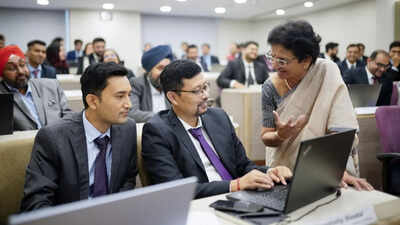
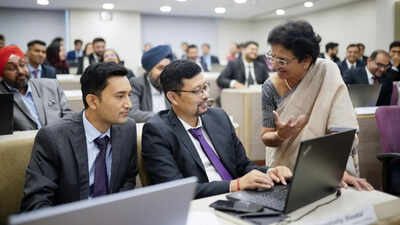
Yukti Sehgal, a CA and Director at Surya Telecom Private Limited, already in a leadership role, decided to pursue an Executive MBA to fill the gap between functional expertise and decision making with general management perspective. She says, “Joining PGPGM (Executive), the on-campus, weekend programme at SPJIMR has been the best decision for me. Practical insights and high-calibre faculty gave me a new lens to view the business.” An executive MBA helps mid-career professionals develop the cross-functional leadership skills that experience alone cannot provide. Rishabh Sharma, working with Maruti Suzuki India Ltd., believes that doing an Executive MBA enabled him to move from a sourcing role to Department Head (Corporate Strategy). Executive MBAs are offered in online, hybrid, and on-campus formats by various institutes. An on-campus programme has advantages as the learning experience is built both within and beyond the classroom. The peer group interaction with an experienced cohort is also stronger, creating an academic environment that is rooted in practical business challenges and applied leadership. Given the array of executive management programmes available today, choosing an appropriate one requires careful evaluation.
How to choose an executive MBA programme
- Programme structure and flexibility: It is challenging to balance work, academics, and personal commitments for two years. An Executive MBA should be comprehensive, yet structured in a way that allows you to give your best to both. Weekend sessions are easier to manage as compared to weekday evenings and allow executives to partake in the on-campus experience without taking leave from work.
- Curriculum relevance and pedagogy: The B-school curriculum should keep pace with the rapidly evolving business environment. In addition to incorporating the emerging concepts, focus on application of concepts is important. The most effective management programmes transcend theoretical frameworks and focus on experiential, application-led learning. Neha Markanda, Chief Business Officer, Sharechat, opines that “For leadership roles, skill development and behavioural aspects are very important, in addition to updated conceptual knowledge. An Executive MBA should encourage First Principles thinking and ability to manage disruptions.”
Prof Preeta George, Associate Dean, Executive Education, SP Jain Institute of Management and Research (SPJIMR) emphasises the importance of application oriented learning, highlighting that, “The unique programme design of the 2-year, AICTE approved, Post Graduate Programme in General Management (PGPGM-Executive) involves on-campus sessions on alternate weekends followed by application assignments on the intervening weekends, helping participants absorb and parallely apply their learning on the job. Most of our faculty bring extensive industry experience into the classroom, and the same faculty teach at both the Mumbai and the Delhi campus of the Institute.”
- Faculty and reputation of the B-school: Executive MBA programmes derive value from renowned faculty who are attuned to industry realities and can connect academics to real-world business situations. Institutional accreditations, industry recognition and ranking of the school are also important considerations. In addition to global accreditations, regulatory approvals from AICTE ensure wider acceptability.
SPJIMR has been awarded the global triple crown accreditation (AACSB, AMBA and EQUIS). SPJIMR is also ranked in top 5 B-schools of India as per the MBA Universe ranking 20262 and its PGPGM (Executive) programme is recognised by AICTE.
- Alumni of the programme: Alumni profiles and career trajectories are good indicators of programme quality and impact. A strong alumni network can provide significant career benefits in the short term as well as long term.
Programmes such as PGPGM (Executive) showcase how executive education in India is meeting the aspirational needs of experienced professionals by bringing together academic rigour, workplace relevance and flexibility. Dhawani Khatri, Sourcing Specialist at Ralph Lauren, credits PGPGM (Executive) with strengthening her leadership and problem solving skills. Shashank Parini, feels his move to a Senior Consultant role at Ernst & Young is a reflection of the learnings he gleaned from PGPGM’s faculty, contemporary curriculum as well as highly experienced peers in his cohort. For professionals wanting to move from functional expertise to enterprise leadership, a suitable executive programme can serve as a catalyst for long-term career growth.
Reference –
- https://www.weforum.org/press/2025/01/future-of-jobs-report-2025-78-million-new-job-opportunities-by-2030-but-urgent-upskilling-needed-to-prepare-workforces/
- https://www.mbauniverse.com/mba-ranking
Disclaimer: This article has been produced on behalf of Bhartiya Vidya Bhavan (S P Jain Institute of Management and Research) by Times Internet’s Spotlight team.