
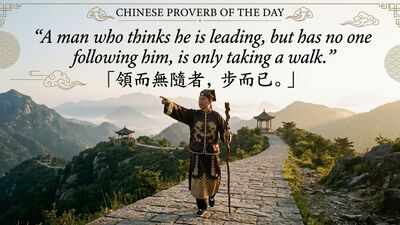
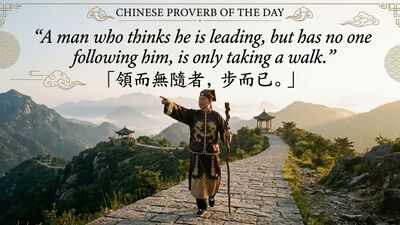
There is a quiet, almost funny cruelty to this saying. Picture someone striding ahead, chin up, certain they are leading the way. Then they glance over their shoulder and find nobody there. Not a single person followed. In that instant, the grand march turns into a lonely stroll. The proverb uses that small, embarrassing image to make a big point. A leader is not someone with a title or a strong opinion about where everyone should go. A leader is someone other people actually choose to follow. Everything else is just walking.
Chinese proverb of the day
“A man who thinks he is leading, but has no one following him, is only taking a walk”
What is the meaning of this proverb
Strip it down and the message is simple. Leadership is decided by the people behind you, not by what you think of yourself.It is easy to confuse a few things with leadership. Having a title. Being the loudest in the room. Walking out front. The proverb gently pokes holes in all of that. None of it counts for anything if nobody is actually coming along. You can give orders into thin air all day. Until people choose to move with you, you are not leading them anywhere.That word choose is the heart of it. Real followers are not forced. They decide to trust your direction and come too. The leadership writer most linked to this quote put it bluntly. Leadership, he said, is influence, nothing more and nothing less. If you cannot influence people to move, then whatever you are doing, it is not leading.
A title is not the same as leadership
This is where the proverb stings, because most of us have seen the gap it describes up close.Think of the boss everyone obeys but nobody respects. People do the bare minimum, follow the rules to the letter, and quietly roll their eyes the moment the door shuts. That manager has authority. They have a position. What they do not have is a single genuine follower. By the proverb’s measure, they are taking a very well paid walk.Now think of the opposite, the person with no official rank who somehow pulls a whole group along with them. The colleague everyone turns to. The friend who always ends up organising things. The volunteer the others actually listen to. They may hold no title at all, yet they are leading in the truest sense, because people willingly follow. The proverb says the title was never the point. The following was.
When walking alone does not mean you are lost
It is worth adding a fair note, because the proverb can be read too harshly.Sometimes a real leader is out ahead and, for a while, alone. The reformer who sees a problem before anyone else. The inventor whose idea sounds mad until it works. The person who stands up first when something is wrong, while everyone else stays seated. In the early days, these people often have no followers at all, and the crowd may even think they are foolish. That does not mean they are only taking a walk. It can mean they are simply early.So the proverb is best read with a little wisdom. Having no followers today does not automatically prove you are wrong. But it is still a signal worth taking seriously. A leader who stays out front alone forever, with nobody ever catching up, has to ask an honest question. Am I ahead of the crowd, or am I just wandering off on my own? The difference is whether people eventually start to move with you.
How to check whether you are really leading
The beauty of this proverb is that it hands you a built in test. You just have to be brave enough to use it.
- Look behind you, honestly. The simplest check is the one the proverb gives you. Are people actually moving with you, or are you just out front giving instructions nobody truly believes in?
- Earn influence rather than assume it. A title buys you compliance. Trust, respect and a clear sense of direction are what buy you real followers. Pour your energy into the second kind.
- Listen at least as much as you direct. People follow leaders who seem to understand them. If you have no clue what the people around you actually want or fear, you are walking half blind, crowd or no crowd.
- If nobody is following, get curious instead of cross. Treat it as useful feedback, not betrayal. Maybe the direction is unclear, maybe the trust is not there yet. Fix that, rather than blaming people for not falling in line.
Others who said it their own way
The link between leaders and followers has been chewed over for centuries, in many forms.
- The blunt modern summary that leadership is influence, nothing more and nothing less. It is really this whole proverb squeezed into six words.
- The saying often called an African proverb, that if you want to go fast, go alone, but if you want to go far, go together. Leadership, in that light, is the art of taking people with you.
- The ancient Chinese thinker Lao Tzu, who wrote that the best leader is one whose people barely feel led at all, so that when the work is done they say they did it themselves. The truest leading, in his view, is almost invisible.
Different voices, one shared truth. Leadership lives in the relationship, not in the badge.
Leadership is not a title, and this proverb explains why
What makes this proverb land is how cheerfully it deflates us. We all like to imagine we are leading, in our families, our jobs, our little corners of the world. The saying simply invites us to turn around and check. It does not lecture. It just paints the picture of a person marching proudly along with nobody behind them, and lets the embarrassment do the teaching.The good news is that the fix is always within reach. Leadership is not handed out with a job title and it cannot be demanded. It is given, freely, by people who decide you are worth following. Earn that, and you are leading. Skip it, and no matter how confident your stride, you are still, in the end, just taking a walk.