
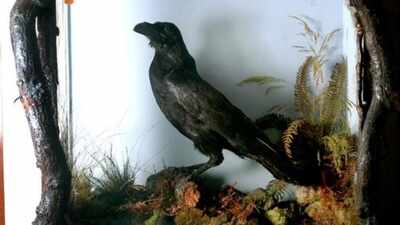
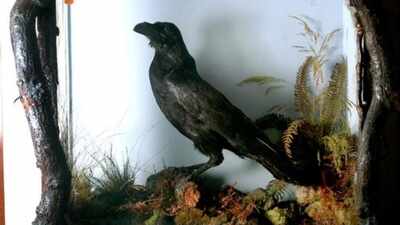
Imagine having a pet so mischievous, noisy and downright troublesome that it terrorises your children, bites your visitors, bullies the family dog and occasionally helps itself to things it absolutely should not be eating. Now imagine loving that pet so much that, when it dies, you have its body preserved and eventually give it a place in literary history. Sounds like something out of a rather eccentric Victorian novel, right? Well, it was the real-life experience of one of England’s most celebrated writers, Charles Dickens!Charles Dickens’ love for animals could fill a book all by itself, but his favorite might just have been a raven named Grip. Long before Edgar Allan Poe’s mysterious raven became one of literature’s most recognisable symbols, Dickens had this feathered companion of his own. The bird was intelligent, talkative, unpredictable, and apparently quite fond of causing all sorts of domestic chaos! Its personality was so memorable that Dickens turned it into a character in his 1841 novel Barnaby Rudge!However, if you thought Grip’s literary legacy ended there, you’d be mistaken. The bird’s fictional incarnation caught the attention of Poe, who went on to write The Raven, one of the most celebrated poems in American literature. And the real Grip? More than 180 years after its death, it remains preserved in a library in Philadelphia.
Who was Grip, Charles Dickens’ pet raven ?
Charles Dickens, best known for literary classics such as Oliver Twist and Great Expectations, was an enthusiastic animal lover. His household included dogs, cats, horses, birds, and even an eagle. But few of his animal companions left behind a legacy quite like Grip. According to the Free Library of Philadelphia, where the bird’s preserved remains are displayed, Grip was an unusually intelligent and talkative raven.Grip was much more than a quirky pet: he was smart, talkative, mischievous, and, apparently, a bit of a glutton for trouble. It had an extensive vocabulary, wandered freely around the Dickens household, and was notorious for its unruly behaviour. Dickens eventually poured all of Grip’s character into his novel Barnaby Rudge, where the raven becomes an unforgettable supporting cast member, noisily shadowing its human.It’s no exaggeration to say that without Dickens and his pet, Poe’s famed Raven might never have existed, or at least not quite in the form that has haunted so many generations. There’s even a direct line: Poe read Barnaby Rudge, was thoroughly amused by Dickens’ version of Grip, and suggested the bird should have had more to do. Not long after, he published The Raven, giving the world another iconic, mysterious, talking corvid.Meanwhile, Grip’s story didn’t end with literature. When Dickens died, Grip’s taxidermied remains were auctioned off, passing through several hands before being donated to the Free Library of Philadelphia, where it still draws crowds today. The library, perhaps fittingly, houses the only complete manuscript of The Raven too; so between Dickens’ pet and Poe’s poem, there’s a whole little gothic ecosystem preserved in a single building.More interestingly, Dickens owned several ravens over the years, and successive birds were also named Grip. In the 1849 preface to Barnaby Rudge, he even discussed two particularly memorable birds that helped shape the character.
Grip’s legacy beyond the years
What really makes Grip’s legacy interesting is how it stands as a testament to the role real life plays in artistic inspiration. The raven was nothing short of a chaos agent in the Dickens household: always biting, always stirring up trouble (its fate, tragically, was tied to a bout of Victorian-era lead poisoning). And yet, even in death, it refused to disappear from Dickens’ life or from literary memory. It reminds us that even the most frustrating companions can become muses, and sometimes the line between reality and fiction is as thin as a raven’s feather.Now, more than 180 years after its death, Grip is still on display: still attracting writers, readers, and the plain curious. Not many pets can claim to have inspired characters in two different corners of the literary world. From infamous household terror to immortal literary troublemaker, Grip’s story is almost as colorful as the novels it helped shape.