
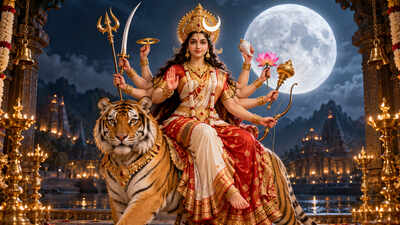
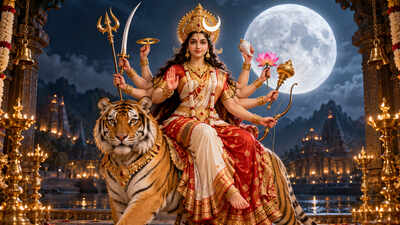
Count the hands on a Chandraghanta image, and you’ll stop at ten. Shailputri and Brahmacharini, worshipped on the two preceding days, have two each. The jump is deliberate, and it speaks to the life of a householder. This year, Chandraghanta is worshipped on Tuesday, 13 October, the day of Tritiya (the third lunar day), and red is the colour associated with the day.
Why the hands multiply
Two hands feel contained, almost quiet. Ten suggest movement in many directions at once. A life filled with responsibilities doesn’t arrive in neat compartments. It arrives all at once, like rivers meeting at a single point, and the form of the Mother grows to match. Yet she isn’t shown struggling. She is shown steady, and that is the teaching.
What eight of the hands hold
In Indian homes, it is often said that a woman has ten hands, given how much she handles: children, her husband, relatives, the kitchen, the household’s upkeep, and often a job outside the home. The saying is less about praise than about acknowledging her capacity.Chandraghanta makes this idea visible. Eight of her hands hold:
- A trident
- A lotus
- A mace
- A kamandal (a water vessel)
- A sword
- A bow
- An arrow
- A rosary
The trident, mace, and sword are direct and forceful. The lotus is softer, yet firm. The kamandal and rosary stand for steadiness and continuity. The bow and arrow quietly imply aim, because responsibility is about direction as much as effort.The remaining two hands are held in mudras, or symbolic gestures. One forms the Abhaya Mudra, which offers reassurance and protection. The other forms the Gyan Mudra, the gesture of knowledge. Heavy duties require more than power. Protection without knowledge becomes blind force, while knowledge without protection remains fragile. In her, both stand together.
An eye for the decision that can’t wait
Chandraghanta has two natural eyes and a third eye. The third eye is interpreted as intuition, the sixth sense, or that sudden knowing of what to do when there is no time for a long internal debate. Household life often demands this. Decisions don’t wait.Her mount changes, too. After walking on foot as Brahmacharini and, in some tellings, riding a bull, she now rides a lion or, in some depictions, a tiger. You don’t manage a lion through nervousness. It takes clarity and command. When life turns fierce, you needn’t become fierce in the midst of chaos. You can remain steady and in control, like a storm cloud that holds thunder but moves with purpose.This is also where the teaching of courage on Day 3 fits. We fight battles with circumstances, with people, and, most often, with our own minds. Her lion doesn’t flee a fight. Don’t run from fear. Face it.
Two half-moons, one full
Her name comes from the crescent moon on her forehead, shaped like a bell, and the dhyana verse (the meditation verse recited to visualise her) describes her with a crescent. Shiva, too, wears a crescent on his head. A popular devotional interpretation holds that when the two come together, they form a full moon. It offers a view of marriage: You are half, I am half, and together we’re complete. Treat this as a cherished interpretation handed down through devotion, rather than a direct scriptural statement.It isn’t a demand for perfection from either partner. It is a picture of union. When the bell rings at the altar this Tuesday, listen to it as the sound her name evokes, and notice how long it takes to fade.