


Nag Panchami is probably one of the most famous snake festivals celebrated annually across India. But how Samastipur in Bihar celebrates Nag Panchami is not for the faint hearted! A quiet riverside town in Bihar, Samastipur transforms into one of India’s most extraordinary religious gatherings on this auspicious day which celebrates snakes. At Singhia Ghat, hundreds of devotees gather but not alone. They can be seen carrying ‘live’ snakes either draped around their necks (like Lord Shiva), or in their arms or hands.And just to witness this scene, thousands of spectators gather around, with their eyes refusing to believe what they are seeing. All in awe and amazement. The striking visuals often go viral on social media, and this time too a number of reels have emerged on social media showcasing a centuries-old tradition rooted in mythology and faith. While the spectacle may appear weird to outsiders, for locals it is an act of devotion.Let’s find out more about this centuries-old tradition:A festival older than time Nag Panchami is celebrated across India on the fifth day (Panchami) of the bright fortnight of the Hindu month of Shravan/Sawan. It usually falls in July or August every year. And this is the day that honours Nagas, the divine serpent beings. Ancient agrarian communities revered snakes because they controlled rodents and maintained nature.There are several legends surrounding the origin of the festival. Among these, the most popular ones come from the Indian epic, the Mahabharata. It is said that Sage Astika once stopped King Janamejaya’s snake sacrifice (Sarpa Satra), saving the serpent race from extinction.Another famous tale talks about Lord Krishna defeating the poisonous serpent Kaliya in the Yamuna River. Serpents are also closely associated with Lord Shiva, who wears a cobra around his neck as a symbol of fearlessness.Why is Samastipur’s Nag Panchami mela so unique?
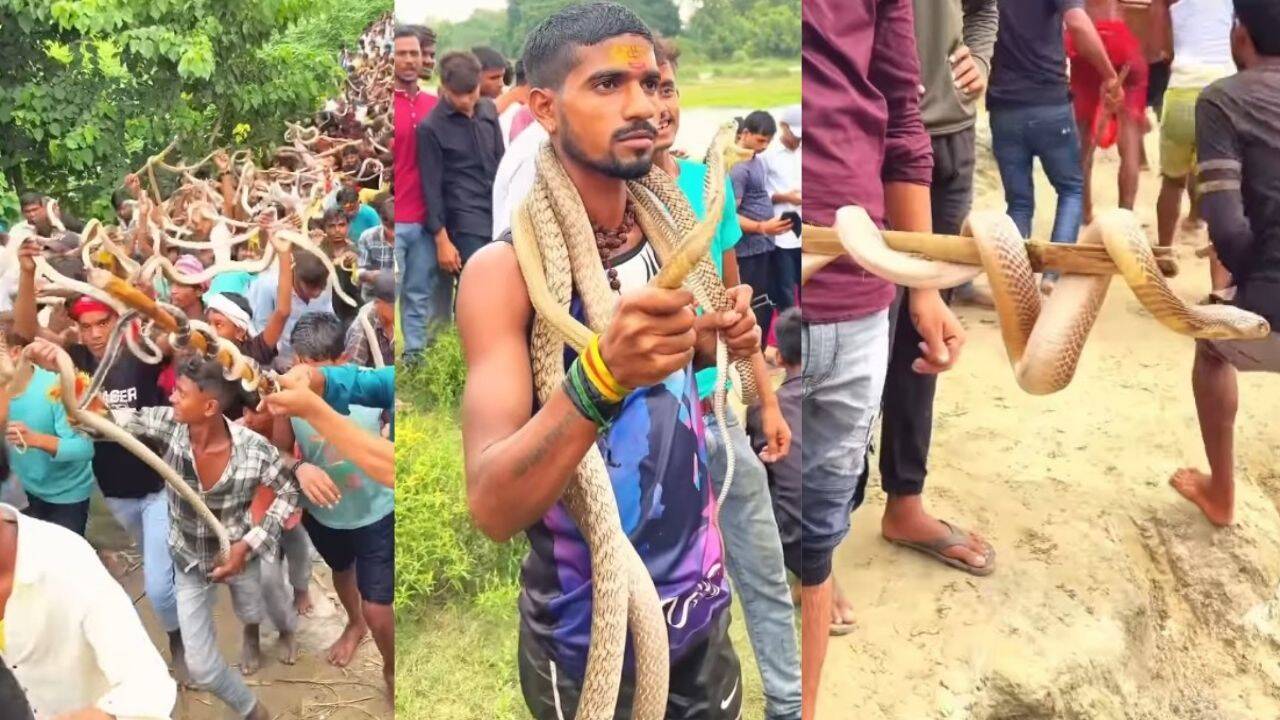
Nag Panchami mela
While snake worship takes place across India, Samastipur’s mela stands apart because live snakes are central to the celebration.The fair, believed to be several centuries old. It attracts devotees and spectators from across the Mithila region of Bihar and outside. Rituals start with prayers at local temples dedicated to Mata Vishhari (or Bishahari or Vishahari), a regional goddess associated with protection against snake bites.Devotees then proceed towards the Budhi Gandak River, where religious ceremonies continue throughout the day.Devotees carry live snakesBut the most fascinating part of the festival is the procession of worshippers carrying live snakes. And more surprising is the fact that participants belong to all age groups, including kids, women and elderly. All can be seen with live snakes around their neck or arms as symbols of faith. None seem to be afraid of these snakes and these videos have now become one of Bihar’s most recognisable cultural traditions.Opinion of wildlife expertsIndia’s Wildlife (Protection) Act, 1972 protects native snakes, including cobras. Experts caution that capturing or handling wild snakes can stress the animals and pose risks to both humans and wildlife.How to reach SamastipurReaching Samastipur is easy as the town enjoys good connectivity.By air: The nearest airport is Darbhanga Airport, which is about 80 km away. It has regular flights from Delhi, Mumbai, Bengaluru and Hyderabad. Another alternative is Jay Prakash Narayan International Airport in Patna.By train: Samastipur Junction is one of Bihar’s major railway hubs and is well connected to Delhi, Kolkata, Patna, Guwahati, Lucknow and other cities.By road: Samastipur is well-connected by state highways with Patna, Darbhanga, Muzaffarpur and Begusarai.Before taking pictures and videos, seek permission and respect local customs.