
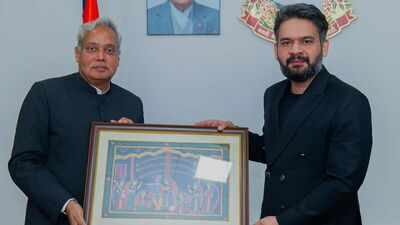
NEW DELHI: Nepal PM Balendra Shah on Monday ended his self-imposed bar on one-on-one meetings with Kathmandu-based foreign envoys, receiving Indian ambassador Naveen Srivastava first and Chinese ambassador Zhang Maoming hours later at Singha Durbar in a diplomatic reset after months of a distancing that had increasingly come into question in Kathmandu and beyond. Shah is scheduled to meet US Embassy chargé d’affaires Scott Urbom on Tuesday extending the outreach beyond Nepal’s two neighbours.Shah and Srivastava discussed bilateral ties, mutual interests, development partnership and cooperation, with Shah stressing the need to deepen Nepal’s “historic relationship” with India. PMO said on social media that the talks focused on “further strengthening Nepal-India relations”, bilateral cooperation and development partnership.Srivastava said on X that he conveyed “warm greetings from Prime Minister Modi ji” and described the meeting as an “engaging & productive exchange” to deepen the “robust, multi-faceted India-Nepal partnership”. Neither side disclosed whether specific issues such as the boundary dispute, power trade or Shah’s proposed India visit figured in the talks.The India-first sequencing was significant. A senior foreign ministry official had told a Kathmandu-based daily before the meetings, “The Indian ambassador is told to come first, followed by the Chinese ambassador,” adding that the timing reflected govt’s foreign-policy priority. The two meetings had initially been planned about two weeks ago but were deferred after communal violence in Sunsari and other districts.Monday’s exchanges also contrasted with friction during Shah’s first weeks in office. His administration strictly enforced customs duties on low-value goods brought from India and protested to both New Delhi and Beijing over resumption of the Kailash Mansarovar pilgrimage through Lipulekh, which Nepal claims. Shah also refused to meet Indian foreign secretary Vikram Misri on protocol grounds. Misri’s planned May 11-12 Kathmandu visit was subsequently postponed.The reset came with Shah’s first India visit as PM still pending. Modi invited him soon after the latter took office on March 27 and Shah accepted, but no date has been fixed. India formally reiterated on July 28 that the invitation remained open.RSP president Rabi Lamichhane had received unusually high-profile treatment during his five-day India visit in June. BJP welcomed Lamichhane with a floral shower at its headquarters, where party president Nitin Nabin received him, before he met PM Modi, home minister Amit Shah, external affairs minister S Jaishankar and NSA Ajit Doval. The reception drew attention because Shah’s govt had described Lamichhane’s trip as “a purely personal trip”.. The stakes for the Himalayan nation extend beyond protocol: India accounts for over 60% of Nepal’s trade and almost all its third-country transit, while Shah’s govt has simultaneously sought greater Chinese investment, technology and tourism. Foreign minister Shisir Khanal has described India as a major potential market for Nepal’s electricity and China as an important source of tourists.