
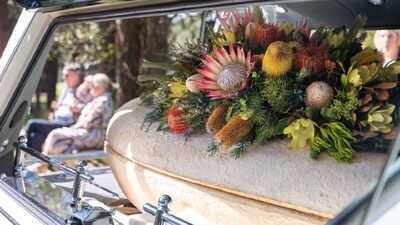
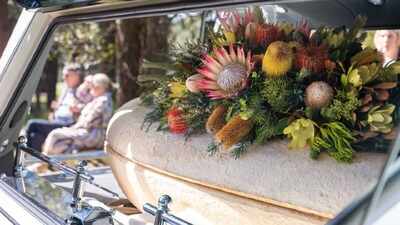
On a quiet Friday in the Blue Mountains, a small group gathered for what would turn out to be a quiet but historic moment in Australia. A woman named Carolyn, in her seventies was laid to rest in a mushroom coffin, which is the first of its kind in Australia.Per the South China Morning Post, Carolyn’s family wanted to keep her last name private. Friends and relatives said their goodbyes at Faulconbridge and then watched as she was buried in Springwood Cemetery, surrounded by tall trees and winter sunlight. For them, this wasn’t just about honoring Carolyn; it was about making her last gesture in the world part of the planet’s natural cycle.Carolyn’s husband, Donald, said the decision fit her perfectly. She was always thinking of others, always reaching out to help. The family didn’t want her life to end with something that would just sit underground for decades or centuries. They loved the idea of her body and her coffin breaking down quickly, giving nutrients back to the earth, exactly what she’d want.This one act, while deeply personal, is now getting attention far beyond her local cemetery. People all over Australia are starting to ask: What does it mean to have a “green death”? Instead of just focusing on the rituals, can we make the very end of life support the living world?
What’s a mushroom coffin?
If you hear “mushroom coffin,” you might picture something carved out of giant toadstools, but that’s not how it works. The coffin is mostly made from mycelium: the branching, thread-like part of fungi that spreads beneath the ground. This network, woven through with upcycled hemp fibers, forms the main structure. In Carolyn’s case, her family chose the Loop Living Cocoon, which is grown, not built, not assembled, but actually cultivated, in special molds. Once the fungus and hemp are settled in, the mycelium weaves the plant fibers together to make something sturdy enough to serve as a coffin. It takes about a week to grow each one.Loop Biotech, the Dutch company behind this product, says their coffin is the first in the world grown from mushrooms. Their idea is simple: don’t put anything in the ground that stays there forever. Let it return to the soil, just like every fallen leaf or branch.
How long does it take for the coffin to break down?
Now, you might be wondering: if you put something like this in the ground, how long before it’s gone? People designing these coffins have a pretty clear answer. Under the right conditions, the Loop Living Cocoon breaks down in about a month and a half — so, roughly 45 days. The fungus wakes up once it’s in the soil, breaking down the coffin and helping to decompose what’s inside even faster, feeding microbes and enriching the ground.Of course, every cemetery is a little different. Some soils are sandy and dry, others rich and damp. Not every coffin will vanish in exactly 45 days. Nature doesn’t work on a timer. Still, this is a world away from a standard wooden or metal coffin, which can hang around for decades and sometimes much longer. Even biodegradable coffins made from wood or cardboard generally take longer to break down than these mushroom versions.
Why the mushroom coffin?
The family’s reasons were straightforward, but powerful. Carolyn loved the bush. She took long walks and always left the smallest possible mark behind. So her family wanted her burial to match her life. They didn’t want novelty. They wanted something that could return her body and even the container itself to the earth, nurturing it instead of leaving something behind.These coffins are lined with natural materials: soft moss is the standard, but customers can choose things like wool, organic cotton, or hemp. They’re actually pleasant to touch, and if you reach inside, you’ll notice they don’t have any chemical or sharp “manufactured” smell. The company intends for their coffins to work for natural or traditional burials, and even for cremation, although the real environmental benefit kicks in with natural burial: the coffin goes back to the earth, and nothing harmful is left behind.
Is this allowed in Australia?
Cemeteries and funeral rules are different in every state, but Australian authorities are clearly opening up to new and greener options. In New South Wales, for example, cemetery regulators already list biodegradable coffins alongside the usual wood and metal. They even mention burial suits that use mushrooms to help the body break down.It’s possible to get permission for “no coffin” burials, too, in some circumstances, although rules can be complicated and bureaucratic. Carolyn’s family weren’t breaking new ground with the law; they’re part of a shift happening all over Australia, slowly but surely. People are considering how even their last act can be something positive for the planet.
Why are people looking for ‘green’ funerals?
There’s a growing sense that the way we die, like the way we live, matters for the planet. Traditional funerals can leave a surprisingly large footprint. Cremation, which is how three-quarters of Australians are laid to rest, sends a lot of greenhouse gases into the air. Burials can mean plastic, metal and chemical preservatives left underground, unchanged for generations.That’s why people are considering other options: natural burial, “aquamation” (which uses water and heat to break down a body instead of fire), and even human composting. The mushroom coffin is unique in this lineup. It’s not just passive; it actively helps break things down, speeding up the entire process and even supporting soil health. Fungi are nature’s recyclers. Mycelium built the first living soils on Earth, and it’s still out there, breaking down what’s dead to feed what’s alive.
A new chapter for bidding goodbye
Carolyn’s burial is just one story, but it lands at a moment when a lot of people are rethinking old traditions. For generations, funerals have focused on preservation: preserving memory, preserving remains, preserving culture. But now, some people are asking: what if the end of a life could also feed life? What if the last gift you give isn’t a headstone, but healthy earth?On that chilly Blue Mountains morning, this family didn’t say goodbye and then walk away from a coffin that would stay sealed in the ground. They said goodbye knowing Carolyn was on her way to joining the cycle. Nothing left behind but nutrients and memories.