
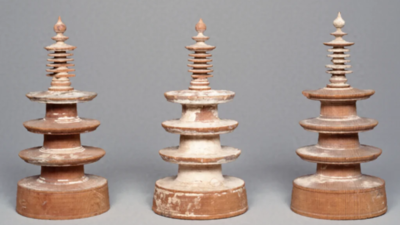
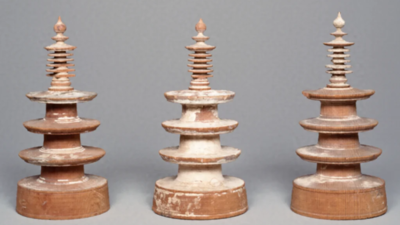
A miniature wooden pagoda commissioned by a Japanese empress around 770 CE has sold for $40,960 at Christie’s, fetching nearly 2.8 times its highest estimate. The object, which contains an ancient printed Buddhist prayer, offers a glimpse into an early chapter of printing history.A wooden pagoda small enough to hold in one’s hands has survived for more than 1,250 years, carrying within it a printed Buddhist prayer from eighth-century Japan. The historic object has now attracted a substantial sum at auction, selling for $40,960 against an estimate of $10,000 to $15,000.The object, known as a Hyakumanto pagoda with printed dharani, was offered by Christie’s in its Fine Printed Books, Manuscripts, and Science sale. According to the auction house’s catalogue, it dates to Japan’s Nara Period, around 770 CE, and is associated with an extraordinary royal commission: the production of one million miniature pagodas by Empress Shotoku.The sale price was nearly 2.8 times the upper end of the estimate, reflecting the historical significance of an object that brings together religious devotion, early printing and an ambitious project commissioned more than a millennium ago.
The story behind Japan’s million miniature pagodas
According to Christie’s, the pagoda belongs to a series known as Hyakumanto, a Japanese term referring to one million pagodas. Empress Shotoku commissioned the miniature wooden structures during the eighth century, with the intention of distributing them among Buddhist temples across Japan.Historical accounts associate the commission with the suppression of a rebellion in 764 CE and the empress’s prayers for the protection of the realm. Christie’s notes that accounts of the commission’s motivation vary, but the project was rooted in Buddhist religious practice.Each pagoda was designed to house a small scroll called a dharani – a Buddhist charm or invocation. These prayers were printed on paper and placed inside a hollow cavity in the wooden structure.The prayers were associated with the Buddhist belief that religious merit could be gained through practices such as copying sacred texts and constructing repositories for them. The commission therefore served a religious purpose while also representing a remarkable undertaking in the production of printed material.The scale of the project was striking for its time. Rather than commissioning a single sacred object, the empress ordered a vast series of miniature pagodas, each containing a printed prayer.
What makes this tiny pagoda historically significant?
The example sold at Christie’s is a three-tier wooden pagoda measuring 212 mm, or about 21.2 cm, in height. It has a detachable finial, which covers the cavity containing the printed prayer, and comes with a fitted, inscribed wooden box.The accompanying dharani features a standard layout of 31 columns, with five characters in each column. Christie’s catalogue notes that the text has some old restoration, mainly around the margins, affecting about ten characters.Its significance extends beyond its age. Christie’s describes the object as an example of the earliest authenticated physical printing, while acknowledging a competing claim from Korea. The precise printing method used for the prayers remains uncertain: historians have debated whether they were produced using woodblocks or metal plates.The pagodas are associated with some of the earliest reliably dated examples of printing. They predate Johannes Gutenberg’s movable-type printing in Europe by several centuries. However, they should not be described as definitively the world’s oldest printed material, since earlier examples have been identified or proposed elsewhere in East Asia.
A religious project that became part of printing history
The Hyakumanto commission reflects the role Buddhism played in the development and use of early printing in East Asia. Printed texts were often produced for religious and ritual purposes, rather than primarily for reading in the modern sense.An educational resource developed by Keio University on the history of Japanese books and printing explains that early printed texts were used in religious rites and valued for their symbolic and ritual significance.The prayers inside the pagodas were based on Buddhist scripture. Their purpose was linked to religious merit and spiritual protection, making the objects both devotional offerings and carefully produced containers for sacred texts.The project also demonstrates the scale at which printing could be organised in eighth-century Japan. Producing a million miniature pagodas and their associated prayers required a substantial coordinated effort, long before printing transformed the production and circulation of books in Europe.
From an eighth-century commission to a modern auction
The pagoda’s recent sale brings renewed attention to an object that connects religious history with the evolution of printing. While its exact journey across the centuries cannot be established from the available catalogue information alone, Christie’s records an earlier appearance at its New York auction on June 12, 2015, as lot 49.The object was subsequently offered in the auction house’s Fine Printed Books, Manuscripts, and Science sale, which closed on October 13, 2026. It realised $40,960 against an estimate of $10,000 to $15,000.The result was nearly 2.8 times the upper estimate and more than four times the lower estimate. Christie’s states that estimates exclude the buyer’s premium and applicable taxes, so the reported result should not automatically be interpreted as the buyer’s total cost.More than 1,250 years after it was made, the miniature pagoda remains a tangible link to a period when printing was already being used to reproduce religious texts on a remarkable scale. Its significance lies not only in the price it achieved, but also in what it preserves: evidence of an early printing tradition, a major Buddhist commission and the enduring relationship between technology and religious practice.