
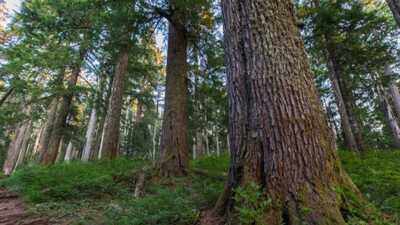
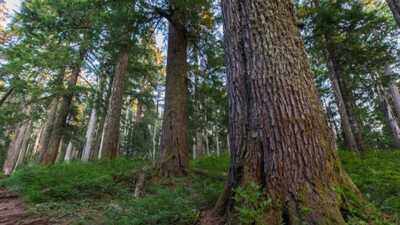
Walking through an old-growth forest, you will notice a huge number of tall trees stretching up to the sky in addition to smaller trees growing under the canopy. For many years, it was thought that tall trees would eventually outcompete smaller trees by intercepting almost all of the light coming from the sun. According to the researchers at Kyoto University, published in the Journal of Ecology, it has revealed why trees of very different heights are able to coexist in mature forests. Analyzing data on over 2,000 trees growing in 12 different forest plots in Japan, they found that survival of trees depends not only on their height but on the light-use efficiency as well.
Why taller trees do not always win
At the beginning of a forest development process, growing taller is an important advantage as it allows capturing more sunlight before other shorter trees growing beneath the canopy. It causes the death of many trees due to the intense competition between trees for light. However, scientists discovered that in mature forests there are not only tall trees but trees of various sizes.
Scientists studied more than 2,000 trees
To find out the answer to this puzzle, researchers made the map of over 2,000 individual trees of about 50 different species living in 12 different Japanese forest plots of various ages. Using three-dimensional tree crown mapping and measuring light distribution, scientists analyzed the amount of intercepted sunlight and its use by each tree. This method gave scientists the possibility to evaluate the competition in the forest in a much more accurate way.
It is not only about capturing light
Researchers divided the tree growth into two main components: light interception efficiency and light use efficiency. The first parameter shows the amount of sunlight captured by the tree whereas the second one characterizes how effectively the tree converts light into its biomass (leaves, branches and stems). Tall trees have a higher light interception efficiency, but the species adapted to living under canopy have much higher light use efficiency.
Shade-tolerant trees have their own advantage
Instead of capturing the sunlight, many small tree species developed an ability to survive in shaded areas of the forest. The shade-tolerant species do not need much light for growth and they can photosynthesize very effectively in the dark environment. Due to this feature, they are capable of continuing their growth under canopy of taller trees without dying.
Older forests become more balanced
Scientists found out that in young forests there is intensive competition for sunlight where height is the biggest advantage. In contrast, mature forests become much more balanced in terms of competition. Multiple canopy levels emerge where species occupy their places under different light conditions. This helps trees of different heights and species to live together in forests for decades or even centuries.
Why this discovery is important
This discovery helps us understand how forests are able to balance their competition processes and maintain their diversity. Scientists think that the discovery may be used for improving climate models to estimate forest productivity and carbon storage more accurately. Furthermore, this knowledge may be useful in developing new forestry and conservation practices in the conditions of climate change. Scientists are planning to expand their analysis to forests of different climate zones (tropical and warm temperate).