
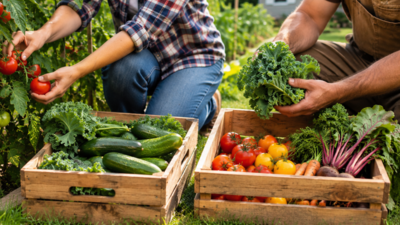
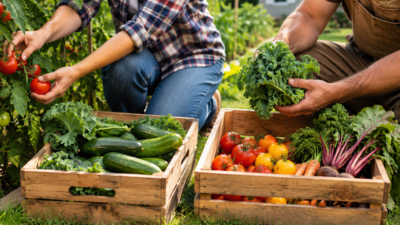
When Jean-Marie and Cory Buxton bought a one-acre property in Corvallis, Oregon, in 2018, they saw an opportunity to do more with the land than simply maintain a lawn. The couple removed a portion of the grass, planted organic vegetables and created a fruit orchard, turning their backyard into a food-growing initiative for people facing food insecurity. What started as a family effort has since expanded into a network involving local farmers, backyard gardeners, private donors and Oregon State University. Through their initiative, called The Farmette Project, the Buxtons have helped distribute 10 tons of free fresh produce to food banks, free food stands and Native American communities by the 2025 growing season.
How an Oregon couple turned their lawn into a food-producing garden
The idea took shape when the Buxtons moved to Oregon’s Willamette Valley and noticed the contrast between the region’s agricultural abundance and the limited access to fresh produce in some nearby communities. While the valley produced plenty of fruits and vegetables, some communities along the Oregon coast faced difficulties accessing fresh food because of their local growing conditions.Jean-Marie, who had previously worked in social services and volunteered on a Native American reservation in South Dakota, was particularly interested in improving access to nutritious food. During her earlier volunteering, she had seen families receive food supplies that lacked the freshness and quality she believed they deserved.The couple decided to put their available land to use. They removed around one-third of their lawn to grow organic crops and dedicated another third to a fruit orchard. Their sons and a friend helped prepare the soil, spread compost and turn the grassy property into a productive growing space.Jean-Marie named the initiative The Farmette Project, with the aim of growing and distributing fresh food to people who needed it.
The backyard garden grew into a wider food network
The project initially focused on growing vegetables on the family’s property. During its first growing season, the garden produced around 1,700 pounds of tomatoes, providing more than enough for the intended recipients and several local food banks.However, the Buxtons soon realised that they could collect food from other sources rather than depend entirely on their own harvest. Jean-Marie approached private donors, commercial farms and Oregon State University to ask for surplus fruits and vegetables.The network gradually expanded as local growers and residents began contributing. An Oregon State University professor allowed the project to collect tomatoes from the outside rows of a university research plot. Other residents offered fruit from their gardens, including figs and blueberries.Local volunteers also joined the effort, helping harvest and collect produce that might otherwise have gone unused. The project now brings together different growers and donors across the Willamette Valley, creating a supply of fresh food that extends well beyond the family’s original garden.
How the project delivered 10 tons of free fresh produce
By the 2025 growing season, The Farmette Project had reached its goal of delivering 10 tons of free fresh produce. That is equivalent to approximately 20,000 pounds of fruits and vegetables.The food is distributed through local food banks, free food stands and partner organisations serving Native American communities. The Buxtons coordinate deliveries during the summer harvest, with the distribution season lasting around 12 weeks.Their work also involves transporting produce from different growing locations to distribution centres. Cory shares responsibility for growing, harvesting and collecting fruits and vegetables from across the Willamette Valley, including taking supplies to a partner distribution centre on the Oregon coast.The initiative has also helped connect growers who have more produce than they can use with communities that have limited access to fresh fruits and vegetables. Some of the receiving communities have even introduced canning classes to help residents preserve the seasonal harvest for later use.
How Jean-Marie finances the initiative through handmade soaps
The Farmette Project operates largely through the couple’s volunteer efforts and self-funding. Neither Jean-Marie nor Cory takes a salary for their work on the initiative, according to their account to Points of Light.Jean-Marie uses her experience as a soap maker, developed over around 25 years, to sell handmade soaps and crafts. The money helps cover the project’s expenses and allows her to purchase additional produce, including items such as melons and berries, at discounted prices.The project also works with farmers who offer matching arrangements, allowing money spent on produce to go further. In some cases, every dollar contributed towards purchasing food is matched by participating growers.During the peak summer season, the initiative can demand as much as 160 hours of work each month. This includes coordinating with growers, organising volunteers, collecting produce and arranging deliveries.
The couple wants to continue the project
Reaching the 10-ton milestone has not marked the end of the Buxtons’ work. They intend to continue distributing fresh produce and strengthen relationships with the communities and organisations they serve.For Jean-Marie, one of the most meaningful aspects has been building relationships with Native American communities and ensuring that families and elders have access to fresh food. She has also emphasised the importance of respecting recipients’ privacy and dignity rather than making the assistance about the people delivering it.