
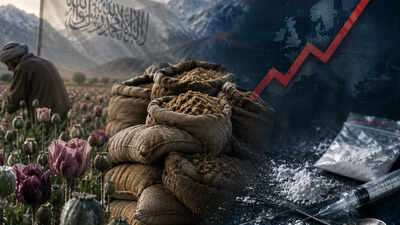
Wars have been fought over land, over succession, over a woman said to have launched a thousand ships toward Troy. Opium got its own war twice, in 1839 and again in 1856, but not the kind that name suggests. Britain went to war for the right to keep selling opium into China, after the Qing government tried to ban it and started burning British stockpiles in Canton harbour. China lost both wars, and lost control of its own opium market for the following century.Afghanistan has just tried to stage the same fight, but in reverse. In April 2022, Mullah Haibatullah Akhundzada announced a religious decree banning opium poppy cultivation across the country, not a foreign power forcing a drug in, but the government in power trying to force it out of an economy that had run on it for decades.
CJP Jantar Mantar Protest Updates
Following the decree, opium poppy cultivation fell by 95 percent by 2023, from 233,000 hectares in 2022 to roughly 10,800, according to the UN Office on Drugs and Crime’s annual opium survey. Afghanistan had supplied 80 to 90 percent of the world’s opium before the ban, and an estimated 95 percent of the heroin sold in Europe.That collapse in cultivation was widely reported. What’s gone largely unreported is that it hasn’t produced anything like a matching collapse in heroin availability. To understand why, we need to look at how the ban was actually engineered.The most detailed account of this comes from a May 2025 technical report commissioned by the EU Drugs Agency (EUDA), authored by David Mansfield, the researcher who has tracked Afghanistan’s drug economy longer than almost anyone, working with satellite-imagery firm Alcis.
The ban’s timing
The Taliban announced the ban roughly two weeks before the 2022 poppy harvest, and granted farmers a two-month “grace period” to bring in the crop that had already been planted the previous autumn. The result was that 2022 turned out to be the third-largest opium harvest on record, even as the ban was being announced.
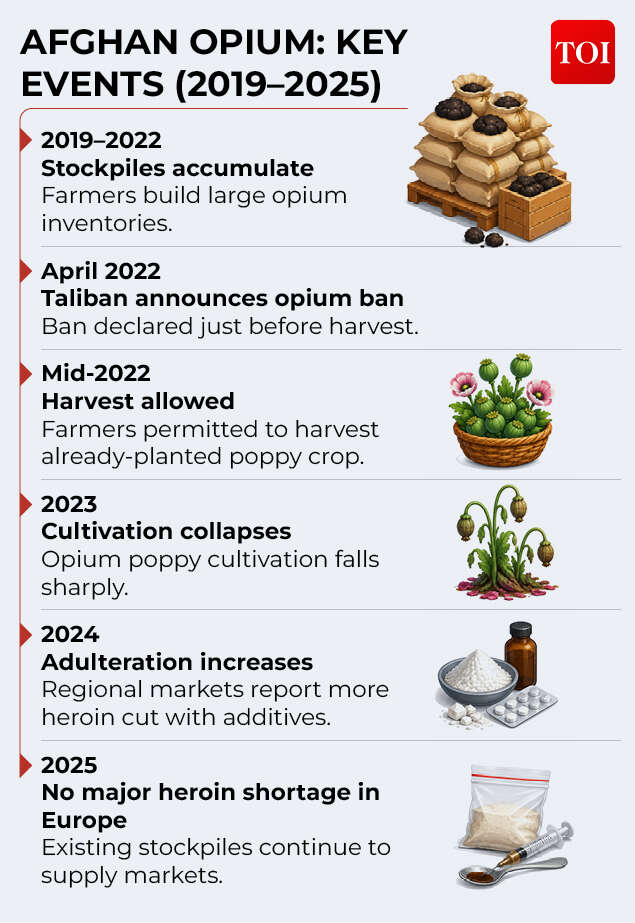
Key events in Afghan Opium ban
Opium prices then rose sharply: from around $60–75 a kilogram before the Taliban takeover to roughly $1,000–1,035 a kilogram by December 2023, according to Mansfield’s field pricing data, almost a fifteen-fold increase.Since the ban was announced just before harvest rather than after it, and because opium is easy to store and doesn’t spoil, farmers with land and the ability to hold stock had every incentive to withhold their crop rather than sell it. They had anticipated the price rise that followed, and positioned themselves to take advantage of it.The Taliban’s first opium ban in 2000–2001, which was announced three months after that year’s harvest, when opium was selling at roughly $30 a kilogram and most farmers had no surplus to hold back. That earlier ban produced a genuine, near-immediate supply shock. This one did not.
Where is the missing heroin
Based on satellite mapping of landholding sizes and yields in the former desert areas of southern and southwestern Afghanistan, reports indicate that farmers there alone could have accumulated an opium inventory of over 13,700 tonnes between 2019 and 2022. Add to this the plausible retention by farmers in the traditional surface-irrigated areas, and the total potential inventory rises to roughly 16,550 tonnes.That is the largest and best-documented estimate of Afghan opium stockpiles to date, and it’s substantially higher than UNODC’s own assumption that most of each year’s crop is sold within twelve months.This is one of the major reasons why opium and heroin continue to trade openly inside Afghanistan, why opiate seizures on Afghanistan’s borders with Pakistan, Iran and Tajikistan have continued largely unabated, and why there is no evidence of a heroin shortage in Europe till late 2025.Nearly all coverage of the ban treats it as a single national policy with a single outcome. The data doesn’t support that. In the northeastern province of Badakhshan, a former Northern Alliance stronghold where Taliban authority has always been comparatively thin, poppy cultivation has persisted through both years of the ban.When provincial authorities attempted a more aggressive eradication campaign in spring 2024, it triggered armed resistance from local communities. The authorities subsequently scaled back enforcement and delayed crop destruction until after harvest, rather than risk wider unrest in a province they don’t fully control.
The real risk isn’t a shortage
The mechanism most likely to matter for consumers outside Afghanistan is not supply drying up. It’s what happens to the product as opium gets more expensive to convert.Profitability in selling opium now depends on using stock bought before the price rise, improving conversion efficiency, or — increasingly — adulterating the finished product.
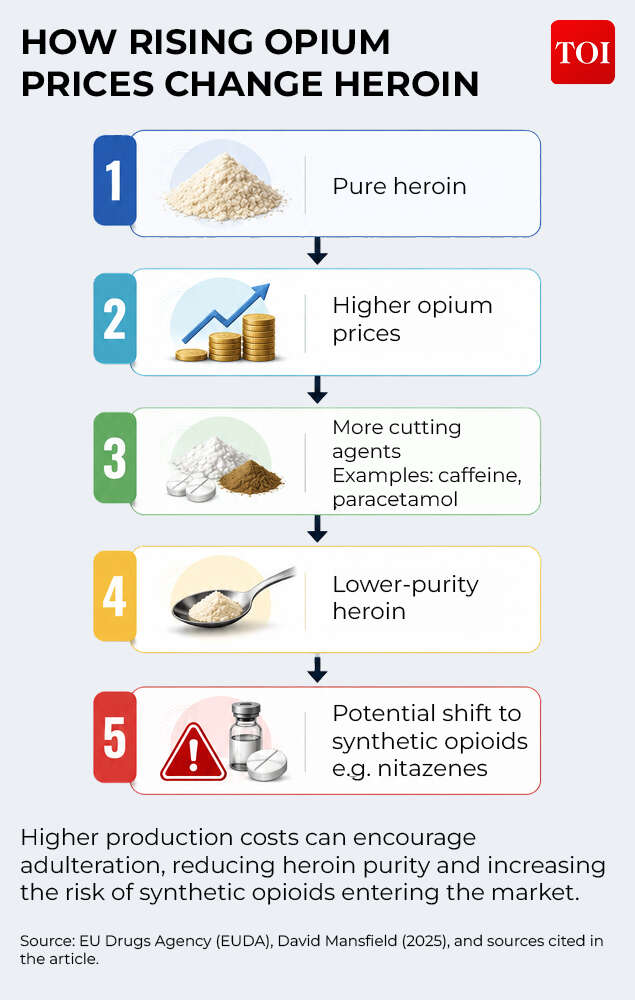
Opium adulteration
That adulteration is now well documented in regional markets: heroin sold in south-western Afghanistan is marketed under names like “Indian” (higher purity) and “Iranian” (lower purity, sold at a third to a half the price), and Badakhshan’s heroin hydrochloride is openly sold in graded batches of 40, 60 or 80 percent purity. Traders reportedly commission specific blends of caffeine, paracetamol and unidentified powders — locally called masalas, or “spices” — to bulk out cheaper products.Heroin destined for European markets was reported to be comparatively unadulterated and high-purity, since European buyers pay a premium for it. But the EUDA report notes early signs of falling heroin purity in Europe during 2024, and states plainly that continuous monitoring of purity there is essential, because the same economic pressure driving adulteration in regional markets applies, in principle, to the export product too.If that pressure eventually reaches European-bound heroin, the precedent from the Taliban’s first ban is not encouraging. After the 2000–2001 ban produced a genuine heroin shortage, fentanyl replaced heroin almost entirely in Estonia within about a year, and Estonia went on to record the highest per-capita overdose death rate in Europe for over a decade afterward.
Nitazenes: The real risk
The substance most often named in this context is not fentanyl but a lesser-known class called nitazenes, and the reason they’ve become the focus of official warnings is worth setting out specifically.Nitazenes were first synthesised in the 1950s by researchers at the Swiss pharmaceutical firm CIBA, who were investigating benzimidazole-based painkillers. The compounds were shelved and never brought to market: some analogues proved so potent, that Swiss toxicity testing at the time found doses as low as 1mg per kilogram of bodyweight could be lethal, and the margin between an effective dose and a fatal one was judged too narrow for clinical use.That changed after 2019. China had progressively tightened controls on fentanyl and its analogues between 2016 and 2019, and clandestine chemists in China, per reporting by the Wall Street Journal and analysis from the EU Drugs Agency, responded by mining older, unscheduled pharmacology research for viable substitutes — landing on nitazenes precisely because the class was potent, easy to synthesise, and not yet subject to any specific ban.The UN’s early-warning system has tracked the results: by early 2025, UNODC reported 26 distinct nitazene analogues identified across 30 countries spanning Europe, North America, Oceania, South America and Southeast Asia.
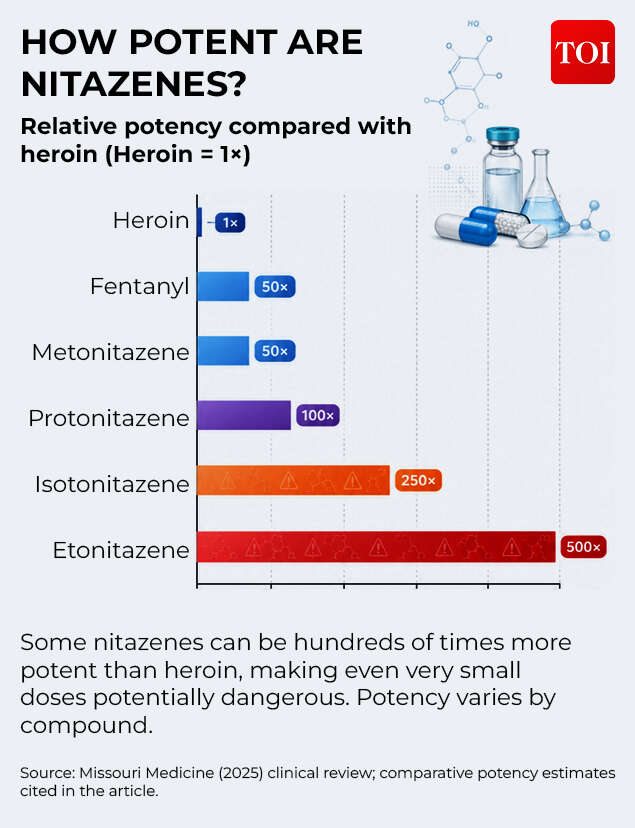
Nitazene potency chart
Potency estimates vary by analogue, but a comparative scale published in a 2025 clinical review in the journal Missouri Medicine took heroin as the baseline, fentanyl and one common nitazene (metonitazene) both land at roughly 50 times heroin’s strength, another (protonitazene) at around 100 times, and the two most dangerous street variants — isotonitazene and etonitazene — at roughly 250 and 500 times heroin’s strength respectively.That scale is what makes even a tiny, accidental dose dangerous when nitazenes turn up in something a user thought was a Xanax pill or a bag of cocaine.The UK’s National Crime Agency linked at least 333 deaths to nitazenes in 2024 alone, and more than 400 deaths in Britain between June 2023 and January 2025 — though the agency itself flags that gaps in routine toxicology testing likely mean this is an undercount. A separate US surveillance system in Tennessee found nitazene-linked overdose deaths roughly quadrupled between 2020 and 2021 alone.The EU Drugs Agency has tracked nitazene detections in at least 21 member states since 2019, with reported deaths concentrated in the Baltic and Nordic countries, alongside France, Germany, Ireland and the UK. In September 2024, EUDA’s director issued a formal call to action to EU member states, warning explicitly against complacency: without the kind of visible, high mortality crisis the US saw with fentanyl, governments have limited political incentive to prepare, even as the underlying risk builds.Two features of how nitazenes reach users matter for the “consumption” question specifically, rather than the supply question. First, unlike heroin, nitazenes are frequently found as an undisclosed contaminant in other drugs — there have been cases of the drug being found in vapes and nasal sprays, meaning many of those affected did not know they were taking an opioid at all.Second, because the required dose is so small, distribution can bypass the layered trafficking networks that move heroin and cocaine. A Global Initiative for Transnational Organized Crime analysis notes that Chinese suppliers have been found marketing nitazenes directly to European buyers through online B2B platforms and encrypted messaging apps, with product mailed in small parcels rather than moved through established smuggling routes. That direct-to-consumer channel is structurally different from anything the Afghan opiate trade relies on, and it’s one reason analysts argue that even a full resolution of Afghanistan’s opium economy would not make this specific risk go away.
The Trojan horse
The claim that opium cultivation in Afghanistan fell 95 percent is accurate and well sourced. The claim that this represents a 95 percent collapse in the global heroin supply is not supported by the same evidence.What the evidence does support is a scarier truth: a heroin trade slowly shifting toward adulteration as the economics of conversion stop working. None of that is a shortage. It’s a market absorbing a shock by changing what it sells, and to whom, while the headline statistic everyone quotes describes only the first link in a much longer chain.The Greeks didn’t need to storm Troy’s walls. They just needed the city to let the horse in and assume the war was over. The Taliban’s ban has worked much the same way, a decree that looked, from the outside, like the end of Afghanistan’s opium economy, wheeled through the gates of global attention while the actual supply chain, the stockpiles, and the slow drift into adulteration kept moving quietly inside it. The 95 percent statistic is just the wooden horse. What’s still inside hasn’t been counted yet.