
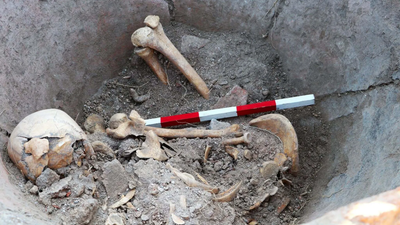
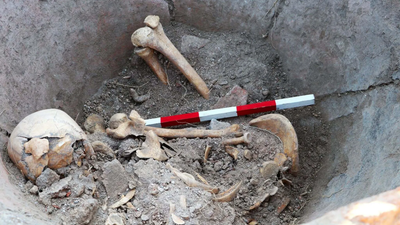
More than 1,600 years ago, as violence swept through a Roman settlement in what is now Bulgaria, a man appears to have made a desperate attempt to survive. He climbed inside a huge ceramic storage jar and hid there, possibly hoping the vessel would protect him from an attack and the fire spreading through the settlement. He never came out. Archaeologists have now uncovered his skeleton inside the jar at the ancient Roman colony of Deultum, providing an unusually direct glimpse into the final moments of a person caught in a violent episode. The discovery is especially striking because the vessel was not a burial container. It was an everyday storage jar, making the circumstances surrounding the man’s death highly unusual. According to a Live Science report, the remains were discovered on August 10, 2026, during excavations of a Late Roman turret near Deultum’s western gate. The skeleton, believed to belong to a young man, was found inside a large vessel known as a dolium, along with two iron knives and a belt. Archaeologists believe he may have climbed inside the jar during an enemy attack, possibly seeking shelter after a fire had already started.
A giant jar becomes a hiding place
The vessel in which the man was found was a dolium, a large Roman ceramic container used to store commodities such as wine, olive oil and other goods. These vessels could be enormous, with the largest examples capable of holding more than 1,000 litres. The surviving part of the newly discovered vessel measured about one metre across. Its size would have made it physically possible for a person to climb inside, although using it as a hiding place was certainly not its intended purpose. The discovery was made in a Late Roman turret, or small defensive tower, forming part of Deultum’s western gate. Archaeologists were excavating the structure when they unexpectedly encountered human remains.
Evidence of a violent attack
The location of the skeleton provides important clues about what may have happened. Archaeologists found extensive evidence of burning around the dolium, including ash and charcoal, broken bricks and roof tiles, blackened walls, melted pieces of glass and animal bones. The area therefore appears to have experienced a destructive event involving fire. Researchers also found numerous bronze coins, which may have been lost during the chaos. The preliminary archaeological evidence dates the event to around A.D. 400, although researchers say a more precise date will be possible after further analysis of the excavation data.
What was he hiding from?
The exact attack responsible for the destruction remains unknown. However, Deultum experienced repeated attacks during the fourth and fifth centuries, including attacks associated with East Germanic groups and the Huns. According to Live Science, archaeologist Lyudmil Vagalinski of the Bulgarian Academy of Sciences believes the man may have entered the jar when an attack was already underway. One clue is particularly important: archaeologists found ash beneath the skeleton. This suggests that the fire had already begun before the man entered the vessel, rather than the fire starting after he was already hiding inside. The researchers therefore think he may have been attempting to escape the flames or the attackers outside.
Two knives with the skeleton
The objects found with the man add another layer to the discovery. He had two iron knives. One was apparently positioned between his legs, while another was associated with his belt. Archaeologist Lyudmil Vagalinski suggested that the knives may have been carried for protection in case attackers discovered his hiding place.However, researchers do not believe the man was necessarily a soldier. The weapons could simply have been personal possessions or tools that he carried when he sought shelter. His position inside the vessel is also significant. According to the archaeological team, the skeleton was positioned much like someone who had been sleeping or crouching. There was no indication that he had attempted to climb back out.
A city rebuilt without knowing he was there
Perhaps the most remarkable part of the discovery came after the attack. Following the destruction, the inhabitants apparently levelled the ruins of the tower and constructed a new, higher floor over the area. They seemingly did not realise that a person remained inside the large storage vessel below. That meant the man and the circumstances of his death remained hidden for roughly 1,600 years.Human remains are relatively unusual inside ancient urban settlements because people who died during ordinary circumstances were generally collected and buried outside city walls. According to Vagalinski, discoveries such as this can occur when extraordinary events, including attacks, fires, earthquakes or volcanic eruptions, leave victims trapped beneath the destruction.
What happens next?
The skeleton has now been transferred to Sofia, Bulgaria, where a physical anthropologist will examine the remains. That analysis could provide more information about the man’s age, health and possibly the circumstances surrounding his death. Archaeologists also plan to return to Deultum next summer to continue excavating the western Roman gate and investigate the northern turret where the jar was discovered. Their work could help establish a more precise chronology for the destruction. For now, the evidence points to a haunting sequence of events. Around A.D. 400, as violence and fire consumed part of Deultum, a man appears to have climbed into an enormous storage jar in search of safety. With two knives and his belt still with him, he stayed inside but never emerged. His hiding place eventually became an accidental time capsule, preserving the story of a desperate attempt to survive an attack more than 1,600 years ago.