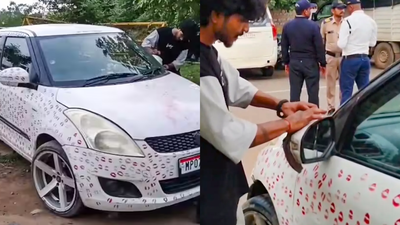
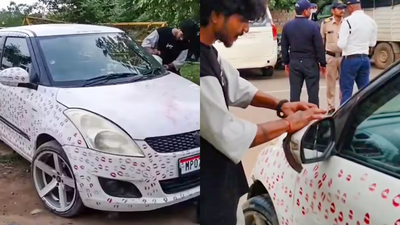
A splash of lipstick or a bold vinyl sticker might seem like a harmless way to make your ride stand out. But when does personalising a car cross the line into a traffic violation? In Gwalior, 3,400 lipstick marks on a car landed its driver a 5,500 challan, turning an unusual makeover into a traffic-rule headache and highlighting the legal risks of vehicle customisation.
My car, my rules? Delhi no stranger to this fiction
A search of Delhi-based car-sticker and accessories shops, along with social media handles promoting such work, throws up a range of examples:
- Some offer to change only a section of a car’s colour, such as turning part of an orange car black
- Some convert a white car to black by full-body wrap
- Others advertise full-body vinyl wraps, cars split between their original colour and a contrasting shade and giant graphics, such as a red lion covering a substantial part of the body
- Stickers for windows, windshields and other prominent surfaces are also widely promoted
- Use of designations like ‘Police’, ‘Army’, ‘Press’, or fake govt logos on private vehicles is rampant
- Use of caste stickers like Brahman, Yadav, Gujjar, Jaat, Rajput and others on cars has also gained traction
- Small decorative stickers may be permitted on body panels as long as they do not obscure the base colour, registration details or safety reflectors
But where does this personalisation end
Ask whether all this is legal, the answers begin to differ. One shopkeeper said RTO permission is required for such modifications, but added that many customers do not bother getting it. “Our job is to tell customers when they ask. We have told you now; what you do after that is up to you,” he said. Another took a more relaxed view, claiming that if only around 30% of the car’s body is covered, it would not be illegal and would not attract a challan.
What the rulebook states
Section 52 of the MV Act defines an alteration as “a change in the structure of a vehicle which results in a change in its basic feature.” It says an owner cannot alter a vehicle in a way that makes the particulars in the RC differ from those originally specified by the manufacturer. The RC records key details, including the vehicle’s colour, making a change potentially actionable. The law provides certain exceptions in specified engine modifications. Where an alteration is permitted, the owner must report it to the registering authority within 14 days and submit the RC along with the prescribed fee.
What happens if you violate it
Section 182A(4) provides for imprisonment of up to six months or a fine of Rs 5,000 for altering a vehicle in a manner not permitted under the Act.Section 177 provides a Rs 500 first-offence penalty where an MV Act violation has no specific punishment.
What experts say
While owners may view a sticker or wrap as a cosmetic change, traffic police assess modifications in terms of vehicle identity, visibility and road safety. Officials say vehicles carrying large banners or other forms of visual defacement, including those spotted around Delhi University, are also challaned.Section 52 of MV Act bars alterations that make a vehicle’s particulars differ from those specified by the manufacturer and recorded in the RC. While not every cosmetic change is a violation, modifications that obstruct visibility, alter the vehicle’s identity or distract the driver or other road users can pose a safety risk and invite action. Traffic police also challan vehicles with vinyl graphics, large stickers covering around 30–60% of the body and other unauthorised modifications. Other common violations include tinted or sun-control films, defective or non-standard number plates and modifications that can obstruct visibility or distract other road users, saidDinesh Kumar Gupta, Additional CP TrafficSection 52 bars alterations that change a vehicle’s particulars from those recorded by the manufacturer, but the law does not specify how much of a vehicle can be covered by a different colour or graphic. The RC clearly records whether a vehicle is single-tone or dual-tone. So, if a black car is wrapped to appear black and red, it can be treated as a violation. Similarly, an orange-and-black car should have both colours reflected in the RC. RTO permission is required for permitted alterations, though private owners rarely seek it, said Anil Chikhara, former Delhi transport commissioner
Gwalior example
Police in Gwalior recently seized a car covered in 3,400 lipstick marks allegedly left by the owner’s girlfriend as part of a social media stunt.