
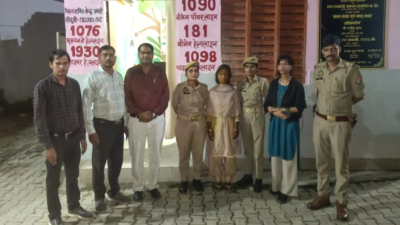
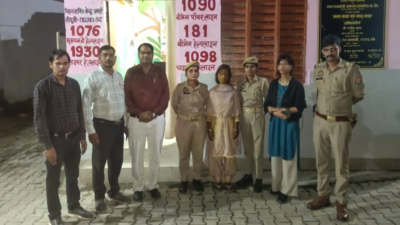
A 16-year-old girl in Uttar Pradesh’s Sambhal district was rescued just a day before her scheduled wedding to a 50-year-old widower, after a joint team of police, local administration and a child protection organisation intervened during preparations for the ceremony. The girl’s family had allegedly accepted Rs 5 lakh in exchange for the marriage, according to Prayatna, a partner organisation of Just Rights for Children (JRC).The wedding was scheduled for October 15, while the haldi ceremony was planned for October 14. By the time the team reached the location, wedding rituals were already underway at a house where the girl had been brought. The intervention prevented the marriage from taking place.According to Prayatna, the girl’s family members fled as the authorities arrived, leaving her behind. The house belonged to a middleman allegedly involved in arranging the marriage. He also managed to evade the police, while his wife and children were present at the premises.The girl was subsequently rescued and taken to a One Stop Centre. Further legal action is underway.
Girl allegedly brought to venue without knowing about wedding
In her statement to the police, the girl said her family had brought her to the location under false pretences. She told the police she had not known that a marriage was being arranged for her and realised what was happening only after reaching the premises, where preparations were already in progress.She confirmed that the haldi ceremony was scheduled for October 14 and that the wedding procession was expected the following day.Expressing relief after the intervention, she told the team, “You arrived just in time and helped me immensely.”Nakhasa station house officer Sanjay Kumar and outpost in-charge Ravindra Chaudhary acted on the tip-off, helping prevent the wedding, according to the information shared by Prayatna.
NGO flags alleged trafficking angle in child marriage case
Gaurishankar Chaudhary, project manager at Prayatna, said the prospective groom was a widower and highlighted the alleged exchange of money as a key aspect of the case.“This is not just a case of child marriage. There is also an element of trafficking as money was exchanged for the marriage. No child should ever be treated as a commodity. Every girl deserves the chance to grow up, continue her education and decide her own future, rather than have her life determined by a transaction,” he said.Bhuwan Ribhu, founder of Just Rights for Children, said the alleged payment of Rs 5 lakh for the marriage raised serious concerns about the exploitation of the minor.“A price of ₹5 lakh was placed on a 16-year-old girl’s future. She was taken to a wedding without even knowing she was to be married. When marriage becomes a cover for the buying and selling of children, we are confronting not just child marriage, but trafficking. We must follow the money, investigate every link in the chain of exploitation and ensure that everyone responsible faces the consequences of the law,” Ribhu said.He added that while the rescue demonstrated the importance of timely intervention, efforts to protect children must extend beyond individual rescue operations.“The rescue in Sambhal demonstrates the power of timely intervention. But our success cannot be measured only by the children we rescue. It must be measured by the crimes we prevent. Prevention must begin long before a child reaches the wedding altar, through schools, schemes and skills for safety, community vigilance and early intervention,” he said.
‘Deterrence prevents the next crime’
Ribhu stressed the importance of consistent enforcement of the law, arguing that communities must be aware of the consequences of offences against children.“The real prevention of such crimes and lasting behaviour change can only come through effective deterrence. The certainty of punishment matters more than its severity. When communities know the law, see it being enforced and understand that every crime has consequences, behaviour changes. Consistent enforcement creates deterrence, and deterrence prevents the next crime. The true measure of justice is not merely the child we rescue today, but the child who will never need to be rescued tomorrow,” he said.Prayatna, a partner organisation of Just Rights for Children, works with a network of more than 300 partner organisations across 782 districts to protect children from abuse, trafficking and child marriage.In the Sambhal case, the intervention came as the wedding preparations were nearing completion. With the minor now at a One Stop Centre and legal action underway, the case has also drawn attention to the alleged financial transaction behind the proposed marriage and the need to investigate those involved in arranging it.