
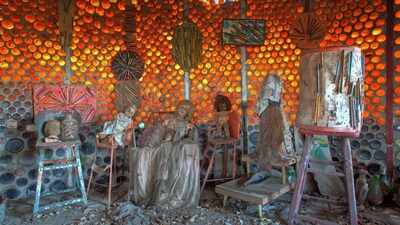
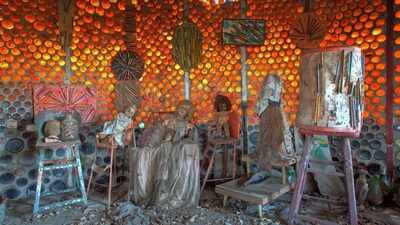
If you picture someone at 60, it’s easy to imagine them settling in, slowing down, letting life get quieter. But Tressa “Grandma” Prisbrey had a different idea. In 1956, when she was about 60, she stood in a dump in Simi Valley, California, eyeing piles of old bottles and forgotten trinkets. Most people saw trash; she saw the beginning of something wild and bright: a project that would eventually become Grandma Prisbrey’s Bottle Village, one of California’s oddest and most surprising landmarks.At first, she wasn’t trying to make art. According to the Library of Congress Historic American Landscapes Survey, she needed a wall to separate her home from a neighboring turkey farm, and money was tight. So she started taking bottles home, lining them up in concrete. It was simple, practical. But then the sunlight started to pour through the colored glass, making patterns she’d never seen before, and she realized she was building something magical, almost by accident.That wall was only the beginning. What should have been a small barrier kept growing. Prisbrey kept visiting the dump, collecting whatever she could carry: a rainbow of bottles, broken dishes, toys, seashells, pencils, headlamps, fragments of other people’s lives. Per Smithsonian American Art Museum, over the next 25 years, her single wall ballooned into a miniature wonderland: buildings covered in bottles and mosaics, shrines, wishing wells, swirling paths, and strange structures with names like the Rumpus Room, Cleopatra’s Bedroom, and the Shot Glass House. Her pencil collection alone filled a building.All told, the Bottle Village sprawled across about a third of an acre: a small spot, but dense with stories and oddities. It looked nothing like a normal home. Instead, it looked like a dream assembled from mid-century America’s leftovers: fun, playful, and just a bit chaotic. Somehow it felt like an open secret: full of the odds and ends that everyone else threw away, except here they all had another shot at life.It didn’t take long for people to notice. California State University Digital Archives detail that, even by the early 1960s, Bottle Village became a sort of accidental roadside attraction. Curious travelers, passing carloads of families, and art lovers showed up, ringing Prisbrey’s doorbell. She welcomed them, showing off her handiwork, telling stories, making sure everyone appreciated the light coming through those old jars. The place drew attention from artists and historians, who began to see Prisbrey’s work as more than a quirky spectacle. This wasn’t just someone filling their yard with junk; this was folk art, the kind that grows out of personal vision, invention, and a refusal to follow the rules.The Smithsonian tallies thirteen main buildings, connected by winding walkways. Each structure is some kind of monument to ordinary things, which is a testament to American abundance and waste, transformed by stubborn creativity. The entire Village became a kind of autobiography in bottles, told by a woman everyone called Grandma.What’s remarkable is how none of this matched the blueprint of “serious art.” Prisbrey was self-taught. She didn’t read architectural textbooks or study painting. She simply built, using what she had right in front of her. Now Bottle Village stands as California Historical Landmark No. 939, listed on the National Register of Historic Places, and recognized as important American folk art. Universities study it. Artists and tourists travel just to walk its paths.But the Village is more than just a roadside oddity or a piece of history. It’s a challenge to the rules about who gets to call themselves an artist and what can become art. Prisbrey’s work is wrapped up not just in creativity, but in the spirit of American reinvention. She took a pile of discards and, just by being stubborn and imaginative, turned it into a story that hasn’t lost its spark.Even after Prisbrey passed away in 1988, the Village persisted, though it hasn’t had an easy time. The 1994 Northridge earthquake did a lot of damage, and the bottles and concrete haven’t always aged gracefully. But somehow, thanks to preservationists and the nonprofit Preserve Bottle Village, the place is still hanging on. You can still schedule a visit today, walk among the walls, and watch sunlight scatter through what others once called garbage.There’s something poetic about the whole thing. Prisbrey built her Village from what nobody else wanted: cast-offs, broken possessions, and memories, given a second shot. She reminds us that creativity doesn’t come from youth or fancy degrees or expensive tools. It can arrive late in life, in the most unexpected places, with a simple, stubborn decision to build something beautiful out of the pieces left behind.And decades later, those bottles are still catching the sun!