
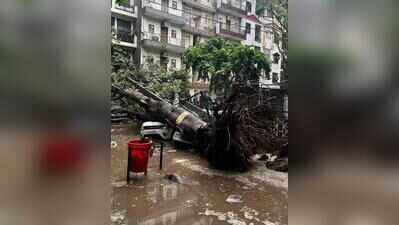
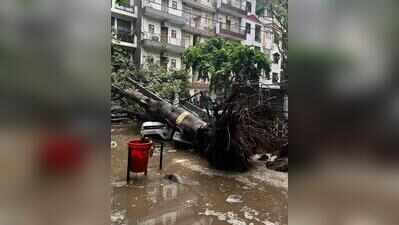
Gurgaon: Continuous rainfall since Wednesday night left some of the city’s upscale residential areas submerged on Friday, with residents of Palam Vihar, Sushant Lok 1, 2 and 3, Sector 17A and Ardee City, trapped inside their homes as roads turned into streams and water entered several lanes.The worst-hit area was Sushant Lok 1, where nearly four feet of water accumulated near the Traffic Tower, making the stretch inaccessible for vehicles and pedestrians. A tree uprooted by the heavy rain in the area brought down an 11kV low transmission pole onto several parked vehicles, disrupting power supply.“Fortunately, there were no casualties, but around 300 families have been left without electricity, which has also disrupted drinking water supply. The fallen tree and damaged electrical infrastructure blocked the road, posing a serious safety hazard and disrupting traffic. The authorities should conduct a technical inspection of vulnerable trees and electricity poles, undertake regular pruning and maintenance before the monsoon, and assess the damage caused to residents’ property,” said Sanjay Gupta, a resident of Sushant Lok-1.In Ardee City, a tempo truck overturned after its wheel slipped into an open gully trap hidden beneath rainwater on a newly constructed road near Gate No. 3. Several two-wheelers also met with accidents at the same spot.RWA member Chaitali Mandhotra alleged that although the road had recently been rebuilt, the contractor failed to raise the gully traps and sewer chambers to the new road level despite it being part of the contract. “This is no longer just waterlogging. It has become a life-threatening safety hazard,” she said, adding that residents had repeatedly flagged the issue through the CM window, the grievance portal and MCG, but no corrective action had been taken.
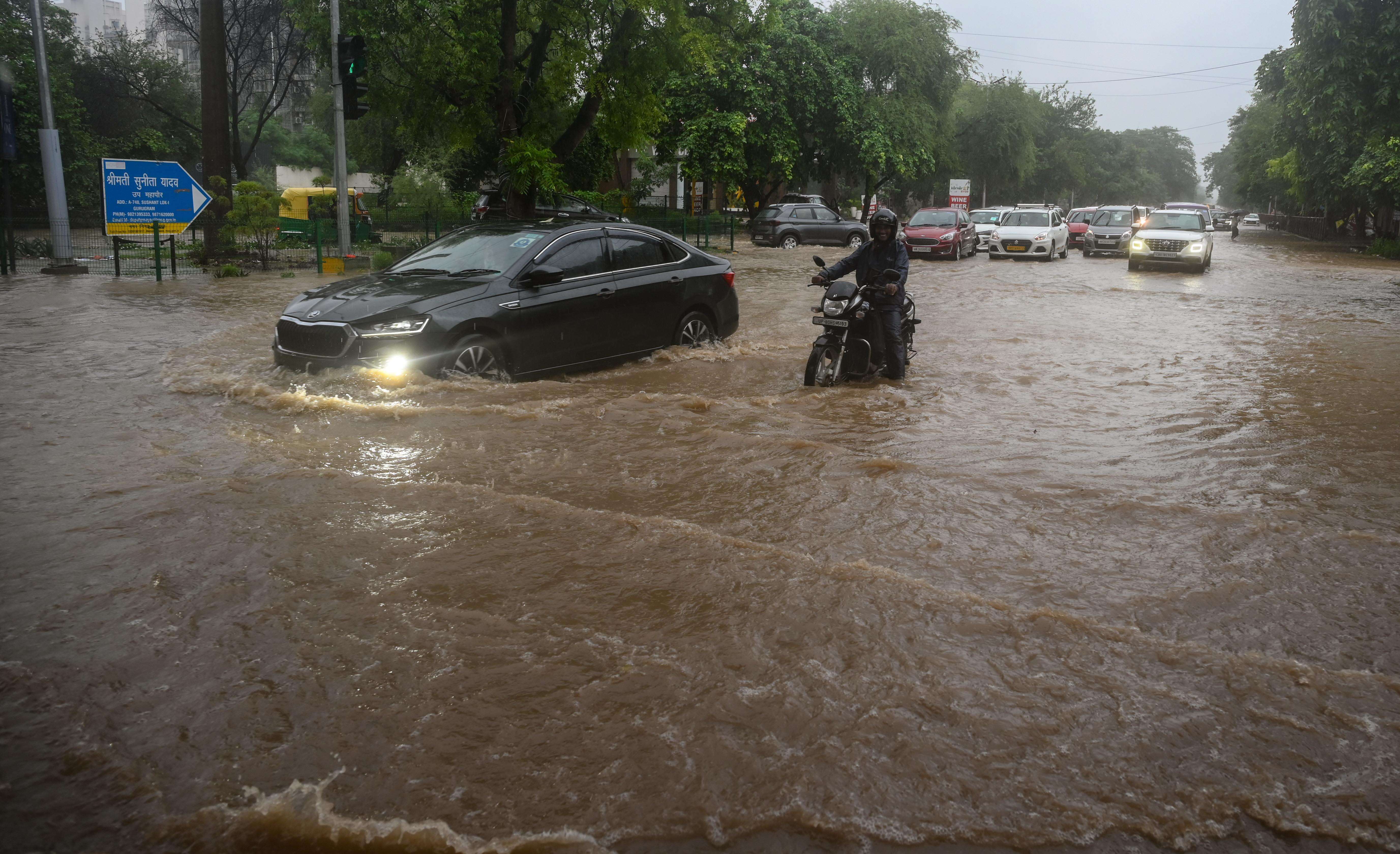
Waterlogging at Hamilton court road
Usha Rai (86) a resident of D Block in Palam Vihar said nearly 2.5 feet of water had entered the parking area, trapping vehicles and threatening to reach the lift’s electrical systems.“For nearly 10 years after I moved here, we never had flooding. Now every monsoon we are left counting our losses,” said Rai, who has lived in the colony since 1997 and recently spent a substantial amount renovating her home, only to see furniture and household belongings damaged by floodwater.According to Sunit Mehrotra, president of D Block RWA, the block is the lowest-lying part of the township, where stormwater from surrounding areas collects before flowing into the Leg-1 drain — but backs up into the colony whenever the drain overflows. He said the Leg-1 drain lacks adequate carrying capacity and that the underground stormwater network was not properly desilted before the monsoon despite repeated representations made since May. “There is simply no outlet for the rainwater. Once the drain overflows, homes, basements and roads are flooded,” he said.Mehrotra also alleged that dewatering pumps installed by MCG remained non-functional for two days, and called for an upgrade of drainage infrastructure, saying the flooding was worsening every year.Sector 17A RWA president Rakesh Jinsi said the colony had witnessed its worst flooding in years despite civic agencies carrying out pre-monsoon works. Last year, rainwater receded within about 90 minutes, this year it took five to six hours, he said, indicating the drainage system was no longer functioning efficiently. “We suspect that changes made during GMDA’s work to separate sewage and stormwater networks may have affected drainage, though the exact cause needs to be identified. Something has clearly changed outside the sector that is preventing stormwater from flowing out,” Jinsi said.Pawan Yadav, RWA president of Sushant Lok 2 & 3, said internal drains in the colony were functional, but GMDA master drainage line they discharge into was already overflowing. “We have repeatedly requested the authorities to clean and desilt GMDA drain before monsoon, but it was not done adequately. This year has been the worst, with water levels reaching nearly four feet in some stretches,” he said.“We are in the process of connecting internal drains to master drains to channelise water runoff. We are also constructing rainwater harvesting pits and connecting waterlogging-prone areas with ponds,” a senior MCG official said.A GMDA official said despite the intensity and persistence of the showers, teams remained deployed on the ground throughout the day to closely monitor the situation and undertake necessary measures for ensuring smooth stormwater flow.“All four major master carrier drains of GMDA were running at full capacity and effectively carrying the stormwater load. Water accumulated at several locations due to the persistent rainfall also receded quickly from most areas. Importantly, key waterlogging-prone locations including Narsingpur, SPR, AIT Chowk, Subhash Chowk, Signature Tower and Sushila Aima Marg, among others, remained largely free from waterlogging compared to previous years. These on-ground results are showing that the strengthening and augmentation of the stormwater drainage network are yielding visible results during the monsoon,” the official said.