
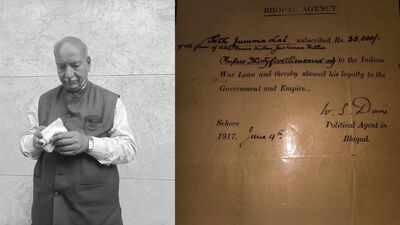
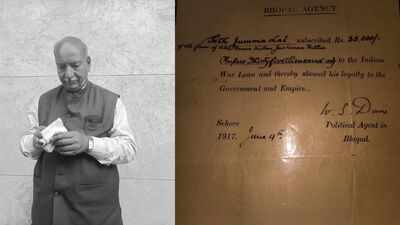
BHOPAL: Nearly five months after a 109-year-old war loan certificate from British India brought him into the spotlight, 63-year-old Sehore resident Vivek Ruthia claims to have received the first official response to his family’s claim from what is believed to be the UK’s Debt Management Office (DMO).Ruthia told TOI that his lawyer recently received an email seeking copies of the original loan certificate and related correspondence after the matter was brought to the attention of the British debt management authority.“I am extremely happy. I never imagined there would be a response at this stage. I hope this reaches a logical conclusion. After all, it is no longer just about money—it is a matter of ego now,” Ruthia said.According to Ruthia, the DMO has sought documents supporting the family’s claim. His legal team is compiling archival records, correspondence and other material before sending a formal response.He said the family would cooperate fully and hopes British authorities will verify whether records relating to the loan still exist.
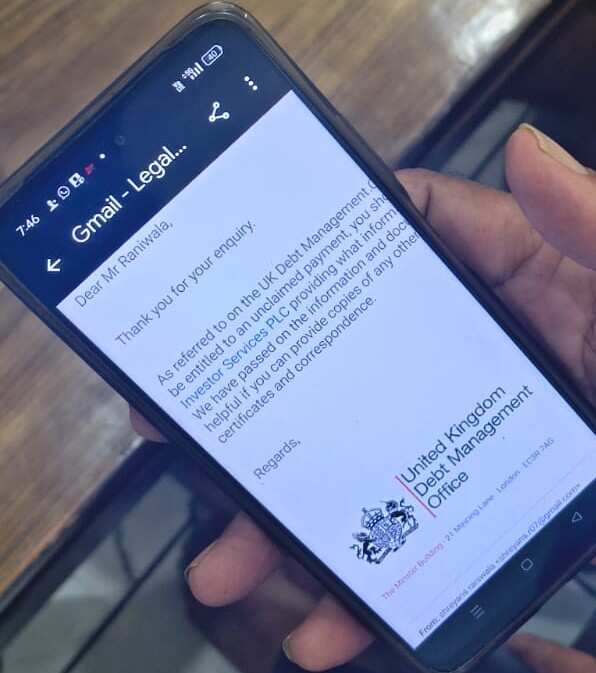
Email from UK Debt Management Office
At the centre of the claim is a certificate dated June 4, 1917, preserved by the Ruthia family for more than a century.The document records that Seth Jumma Lal Ruthia, of the firm Seth Rama Kishan Jaskaran Ruthia in princely Bhopal, subscribed Rs 35,000 to the Indian War Loan floated by the British government during World War I.The certificate bears the signature of WS Davis, then Political Agent in Bhopal.War loans were government-issued debt instruments through which the British administration raised money from traders and wealthy citizens to finance military expenditure during World War I. Investors were promised fixed returns, with the 1917 Indian War Loan carrying an interest rate of 5.5%.Ruthia claims the loan was never repaid. He had earlier told TOI that if the amount were calculated using compound interest or benchmarked against the rise in gold prices over the past 109 years, its present-day value could run into several crores.He has not yet initiated legal proceedings but has been consulting lawyers to assess whether a claim can be pursued against the present-day United Kingdom.Legal experts have pointed out that any such attempt would face significant hurdles, including limitation laws, sovereign immunity and questions of jurisdiction. Establishing continuity of liability between the colonial administration and the modern British government could also be legally complex.Ruthia, however, maintains that the issue is as much about principle as recovering the money.“If the British government accepted the money, there should be a record of how the liability was settled. I simply want an answer. If they tell me the loan was repaid, let them show me the record. If it wasn’t, then the matter deserves to be examined,” he said.“For decades, this certificate remained locked away with our family papers. Today, it has reached the people who may finally be able to tell us what happened. That alone gives me hope,” he said.Seth Jumma Lal Ruthia died in 1937, nearly two decades after the subscription. The British left India in 1947, and the family claims that no repayment or settlement was ever made.The family estimates that at 5.5% annual compound interest over 109 years (1917-2026), the amount would rise to several crores. It also claims that, if indexed to gold prices—which have increased more than 3,000 times since 1917—the equivalent value today could exceed Rs 10 crore.