
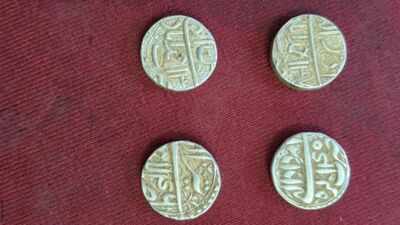
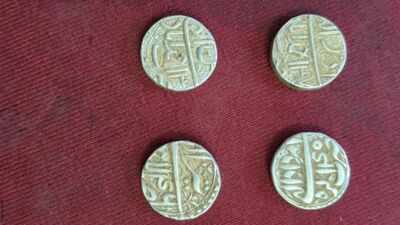
BHOPAL: Four silver coins buried in a field in MP’s Datia have turned out to be a rare archaeological find from the reign of Mughal emperor Akbar, carrying the unmistakable imprint of his short-lived Ilahi experiment.The discovery was made by the family of Bharatgarh area resident Pritam Rajak on their land during construction work. The family took the coins to Datia royal Ghanshyam Singh, who called collector Swapnil G Wankhade.“Ghanshyam ji called me. I told him to send me the coins and the person who found them. On Wednesday evening he deposited the coins at the collectorate. Initial findings revealed they were old coins made of silver,” Wankhade said.The collector then contacted the state Directorate of Archaeology, Archives and Museums to have the coins examined. Archaeologist-historian Dr Wasim Khan studied and authenticated all four, identifying their inscriptions, Ilahi months and mints.What the coins revealed made the find significant. “All four are silver coins of Akbar’s Ilahi era. One side carries ‘Allah-u-Akbar, Jalla Jalaluhu’, while the reverse names an Ilahi month and the mint: ‘Azar Ilahi-Ahmedabad, Amardad Ilahi-Agra, Bahman Ilahi-Ahmedabad and Tir Ilahi-Lahore’,” Dr Khan said.The inscriptions offer a glimpse of Akbar’s extraordinary attempt to create a new imperial vocabulary. His Din-i-Ilahi, introduced in 1582, was a highly restricted spiritual order, while the related Ilahi calendar introduced solar months with Persian names. The new system also found expression in coinage, replacing conventional Islamic dating with Ilahi-era dates and month names, he added.Archaeology commissioner Madan Kumar Nagargoje said the coins will now be scanned and made available on the department’s website for study. “Coins tell the history of an era — its metallurgical knowledge and motifs,” he said, adding that the digitised coins could provide material for student internships and research projects.From a farmer’s field to the archaeological record, the four silver coins have survived as small but unusually telling witnesses to Akbar’s experiment with faith, time and imperial identity.