
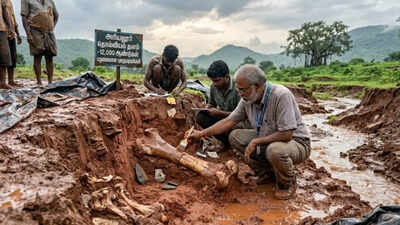
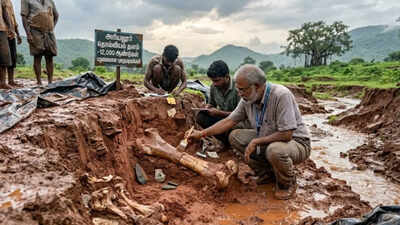
In the district of Thoothukudi in Tamil Nadu, India, a very interesting geological discovery has been made as a result of heavy rains that caused substantial soil erosion, exposing an ancient fossil bed that is around 12,000 years old. The Union Minister for the Environment, Bhupender Yadav, confirmed that this site is from the Holocene Epoch. which represents an important transitional period in the development of modern ecosystems and the development of early humanity. At the request of local government entities, the Zoological Survey of India (ZSI) completed a comprehensive field survey of the area and confirmed that the types of deposits found in this fossil bed represent a major addition to the Quaternary record of India. These types of finds provide a natural record of ancient biodiversity, climate change, and conditions that existed in Southern India.
Discovery of a 12,000-year-old fossil bed that opens a window into prehistoric India
The fossil exposure provides a unique view into the late Holocene epoch through a scientific assessment of the available marine invertebrate fossils (for example, molluscs, gastropods, bivalves) that are contained in ancient sedimentary formations. Researchers assert that these ‘natural archives’ enable scientists to examine how regional ecosystems responded to past climatic changes. As noted in a study on CSR Journal, researchers hope to use fossil composition analysis to determine if the area has always been dominated by a specific vegetation type (forests, grasslands) or whether it has ever been located in a marine environment. The data from fossil analyses will enable scientists to fill gaps in the southern Indian fossil record.
Geological insights from Holocene sedimentary structures
The Quaternary Period, covering the last 2.6 million years, is marked by dynamic climatic shifts. The Thoothukudi site offers a high-resolution window into Holocene sedimentology. Geologists use preserved structures such as cross-stratification (layers formed by currents) and bioturbation (evidence of organisms burrowing) to reconstruct ancient coastal dynamics. Because these fossils have been exposed to natural erosion, their integrity is at risk from the elements. Experts are currently urging immediate conservation protocols to prevent the degradation of these natural archives before thorough longitudinal studies can be completed.
A chronicle of human civilisation and climate
The Holocene Epoch is the most recent period of geologic time, which spans about the last 11,700 years. It is unique in geological history because it coincides with the late and post – Stone Age history of human civilisation. In the context of the Indian subcontinent, researchers use such records to trace the intensification of monsoonal variations – specifically the Southwest and Northeast monsoons – which have historically influenced the rise and fall of ancient regional civilisations. The discovery in Tamil Nadu provides a calibrated chronological framework that helps link paleontological findings with documented environmental changes, offering a clearer picture of the region’s ancient past.