
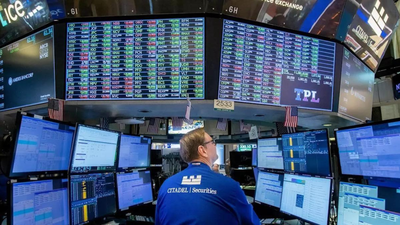
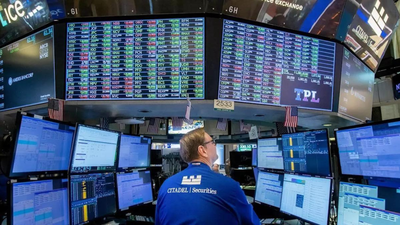
US stock markets moved sharply higher on Tuesday as investors cheered signs of possible de-escalation in the Middle East conflict, even as major indexes remain on track for their steepest monthly declines in years.At 10:05 a.m. ET, the Dow Jones Industrial Average surged 627.92 points, or 1.39%, to 45,844.06. The S&P 500 gained 103.78 points, or 1.64%, to 6,447.50, while the Nasdaq Composite advanced 432.71 points, or 2.08%, to 21,227.35, reported Reuters.Market sentiment improved after a Wall Street Journal report said US President Donald Trump had indicated willingness to end the military campaign against Iran, even if the Strait of Hormuz remains largely closed.The development eased investor concerns after weeks of volatility triggered by the conflict, which has pushed the S&P 500 and the Dow toward their largest monthly losses since September 2022. The benchmark index is also on track for its weakest quarterly performance since 2022.Oil prices remained volatile but are set for a record monthly gain. The S&P 500 energy index has risen more than 11% in March, making it the only sector expected to end the month in positive territory and marking its strongest quarterly performance on record.“The move in markets is reflecting what traders want to see, what they hear. They would like to hear that resolution to this is quick,” said Mark Malek, CIO at Siebert Financial, Reuters quoted.He cautioned that elevated oil prices, driven by continued disruption in the Strait of Hormuz, could “cause damage” to the broader economy.Technology stocks led Tuesday’s gains, with the S&P 500 technology index rising 2% after a weak quarter marked by concerns over heavy capital expenditure and AI-led disruption in software services.CoreWeave climbed 8.4% after securing an $8.5 billion loan to expand AI infrastructure, while Marvell Technology rose 6.8% following a $2 billion investment from Nvidia.Communication services stocks also advanced, with Meta Platforms gaining 3.9% and Alphabet rising 2.5%, lifting the sector index by 2.2%.Overall, nine of the 11 major sectors in the S&P 500 traded in positive territory.Last week, both the Dow and Nasdaq confirmed correction territory after falling more than 10% from their record highs, while the small-cap Russell 2000 had entered correction earlier in the month.On the macro front, the Job Openings and Labor Turnover Survey (JOLTS) showed vacancies declined to 6.882 million in February, slightly below expectations of 6.918 million, while consumer confidence came in above estimates.Investors are also watching comments from Federal Reserve officials, including Austan Goolsbee and Michelle Bowman, for signals on the policy outlook.The surge in oil prices has revived inflation concerns, prompting markets to scale back expectations of rate cuts this year, according to CME Group’s FedWatch Tool.Among other stocks, McCormick fell 6% after Unilever agreed to spin off its food business and merge it with the company in a deal valuing the spice maker at about $44.8 billion. Constellation Energy dropped 7.1% after issuing a weaker-than-expected profit forecast for 2026.Market breadth remained strong, with advancing stocks outnumbering decliners by a 5.23-to-1 ratio on the NYSE and 4.21-to-1 on the Nasdaq. The S&P 500 recorded three new 52-week highs and three lows, while the Nasdaq saw 19 new highs and 85 new lows.