
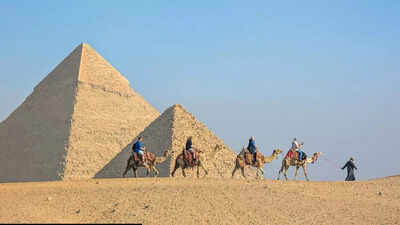
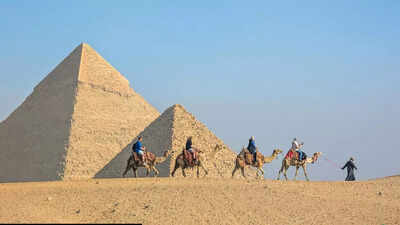
News stories in March 2025 brought to light new claims that there are hidden buildings under the Pyramid of Khafre on the Giza plateau. A study group in Italy, using satellite radar images instead of digging in the ground, says it has found large underground features that go deep below the monument. The group used Synthetic Aperture Radar data from satellites in space and processed it to make a set of images showing the density of the ground below. Based on what they know, there are vertical shafts and large rooms cut into the rock. It has not been confirmed by an investigation that took place on-site. For now, they are still part of a debate about how to use remote sensing, how to analyse data, and the geology of Egypt’s Giza plateau, which has been studied for a long time.
Synthetic aperture radar used to map subsurface features beneath the Pyramid of Khafre
The researchers relied on Synthetic Aperture Radar, often shortened to SAR. This technology sends radar signals from satellites in orbit. The signals reflect off the ground and are recorded, then processed using mathematical modelling. Variations in density and structure can appear as patterns in the final images.Based on this study, “What Really Lies Beneath the Pyramids?”, the team believes it can see eight deep cylindrical shafts beneath the pyramid. These are said to descend hundreds of metres into the limestone bedrock. At the lower end, the images appear to show two large cubic chambers. Inside the pyramid itself, five vertical voids are also suggested. It is an interpretation of patterns rather than a physical survey.
Claims generate online interest and academic caution
The announcement moved quickly across social media platforms. Alternative history commentators gave it prominence. Videos and commentary circulated widely within days.Academic reaction has been more restrained. Egyptologists point out that satellite radar imagery can be complex. Image processing may produce shapes that resemble structures without confirming their material nature. Without drilling, excavation or ground-penetrating surveys, it is difficult to establish what lies below.
Natural caves already exist beneath the Giza Plateau
The Giza plateau is not solid stone throughout. Limestone bedrock in the area contains natural cavities and fissures. Some caves have been explored in previous decades. Earlier geophysical surveys also detected voids in certain areas beneath the pyramids.Because of this, some researchers suggest the radar signatures could represent natural formations rather than engineered shafts. The difference matters. Geological voids are common in limestone terrain. The present claims do not yet clearly separate between natural and artificial origins.
Speculation links findings to ancient myths and older cultures
Beyond the technical dispute, some authors have made similarities between the suggested structures and the Duat, the nether region mentioned in funerary texts in ancient Egypt. Others go further and propose connections to Taş Tepeler-related prehistoric sites in Anatolia. These connections are yet theoretical. There is currently no archaeological evidence linking those previous cultures to the Giza plateau. For the time being, the radar investigation broadens the debate about Khafre’s pyramid. It doesn’t resolve the issue.