
Human beings are capable of even doing the unimaginable – birthing life, where it seems nearly impossible. Just like what happened in the vast expanse of sands, where even little signs of life find it tough to grow, human hands have quietly rewritten the rules of nature.China’s bold scientific experiment with the Taklamakan Desert, one of Earth’s harshest, driest corners, shows that even “dead” lands can breathe life back into our planet.Where one would least expect, massive tree-planting efforts around the edges of a dry barren desert, have had a surprising change, turning barren rims into green barriers that fight climate change in real time.
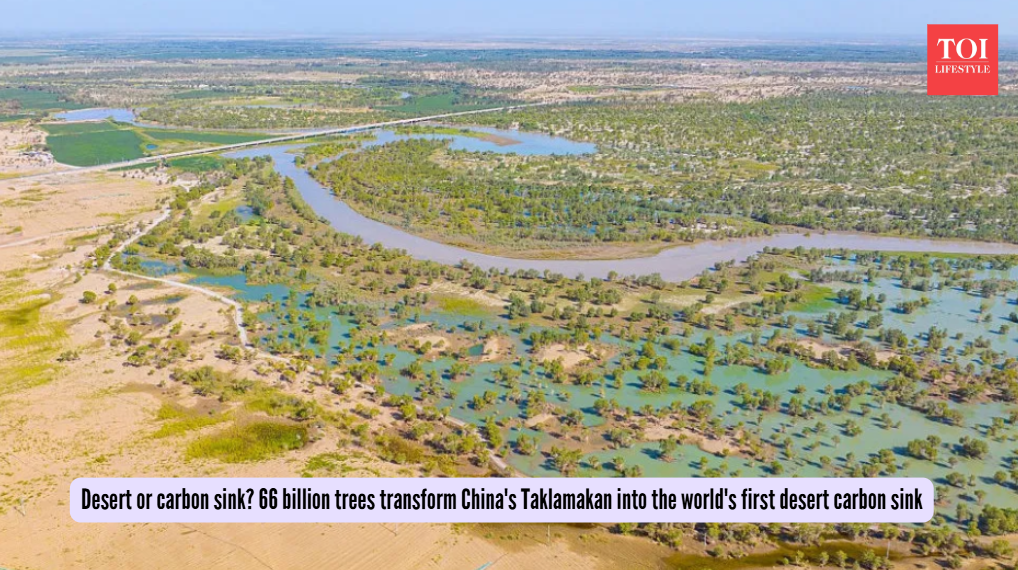
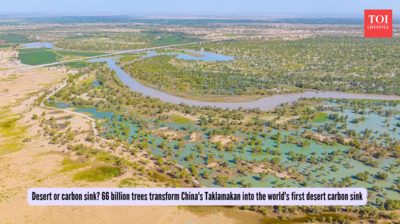
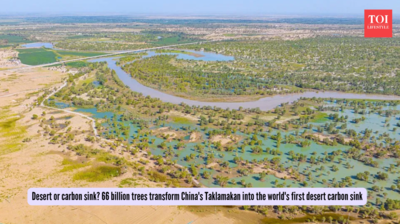
Desert or carbon sink? 66 billion trees transform China’s Taklamakan into the world’s first desert carbon sink (Image credit: CFOTO/Future Publishing via Getty Images)
China’s green ring around a giant desert
The Taklamakan Desert covers about 130,000 square miles in northwest China, roughly the size of Montana, hemmed in by mountains that trap out moisture year-round. Once labeled a “biological void” with over 95% shifting sands, it expanded after 1950s urbanization and farming took up nearby lands, leading to sandstorms and more desert.According to a Live Science report, in 1978, China launched the Three-North Shelterbelt Program, intriguingly called the “Great Green Wall”, aiming to plant billions of trees by 2050 around the Taklamakan and Gobi to halt this creep. By late 2024, they completed a 3,000-km vegetation belt encircling the Taklamakan, boosting China’s overall forest cover from 10% in 1949 to over 25% today.
Green plants in desert turned into major Carbon absorbers
A new study in PNAS reveals this greening has made the desert’s edges a carbon sink, sucking up more CO2 than they release. Researchers crunched 25 years of satellite data on rain, plant cover, photosynthesis, and CO2 flows, plus ground checks and NOAA’s Carbon Tracker models.Wet-season rains, ranging from July-September, averaging 16 mm monthly, 2.5 times drier months, with supercharged greenery, dropping CO2 from 416 ppm dry to 413 ppm wet along the rims. “We found, for the first time, that human-led intervention can effectively enhance carbon sequestration in even the most extreme arid landscapes, demonstrating the potential to transform a desert into a carbon sink and halt desertification,” study co-author Yuk Yung, Caltech planetary science professor and NASA JPL researcher, told Live Science.
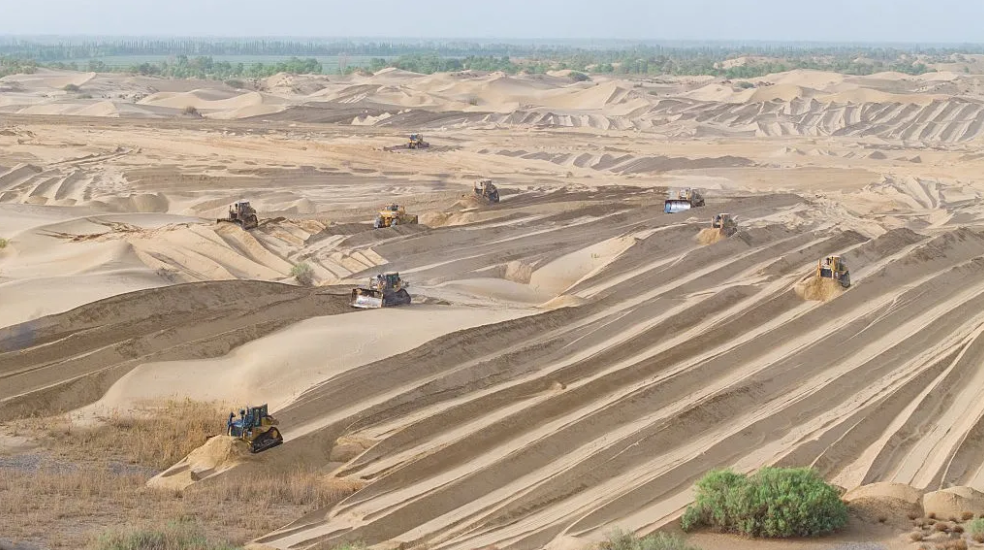
Image credit: CFOTO/Future Publishing via Getty Images
Plants did their magic
Earlier work hinted the desert’s sands trapped some CO2, but warming could release it, unlike stable plant sinks. Vegetation growth tracks perfectly with the Green Wall’s rollout, stabilizing dunes via heavy machinery and hardy shrubs fed by mountain runoff.Over 66 billion trees planted northwide show mixed sandstorm results, but this edge success shines. “Based on the results of this study, the Taklamakan Desert, although only around its rim, represents the first successful model demonstrating the possibility of transforming a desert into a carbon sink,” Yung added, calling it a blueprint for other arid zones despite water hurdles.