
GOA | One teacher, four classes: Schools shrink towards closure
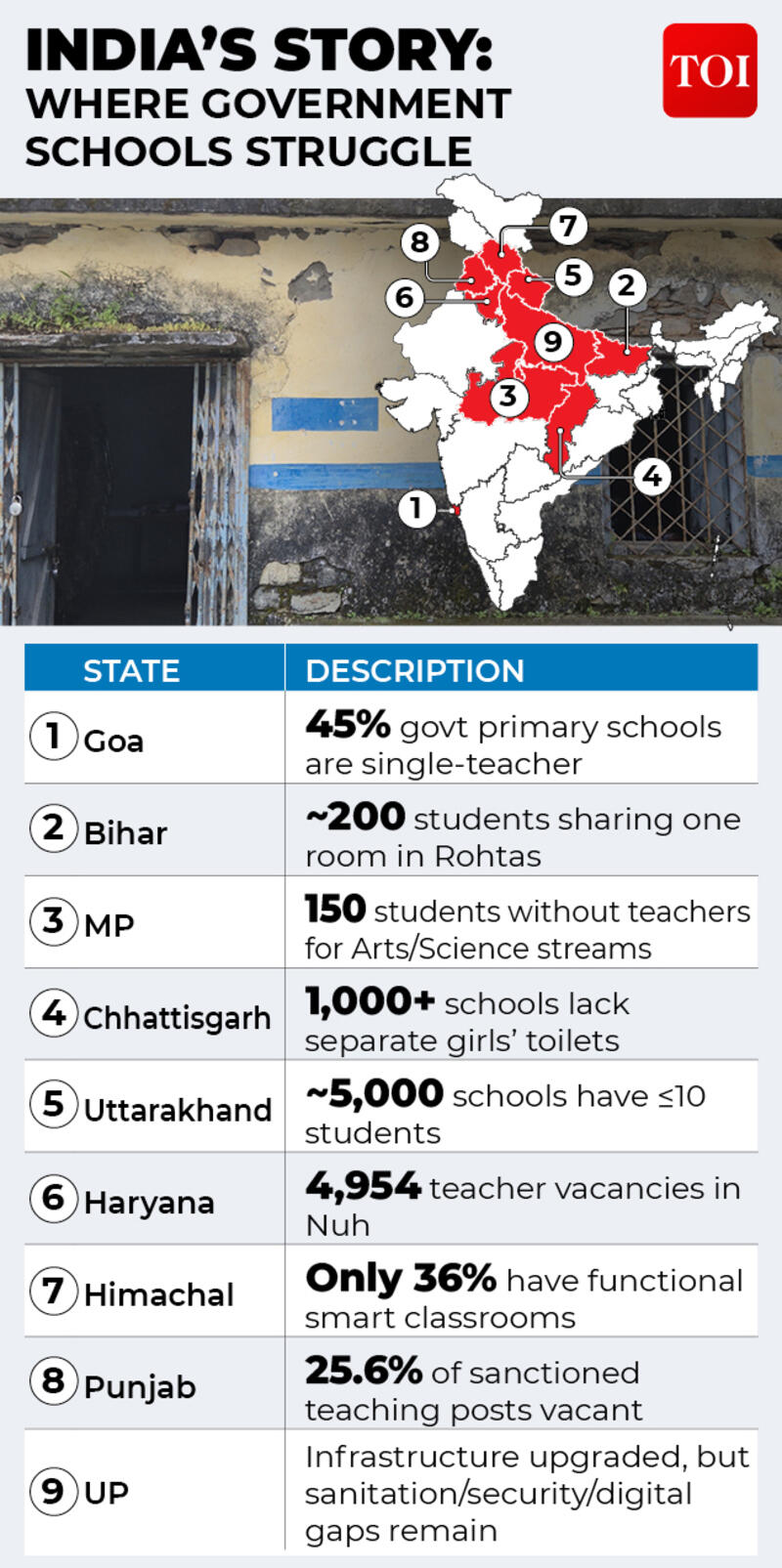
Goa reports full coverage of essentials such as toilets, drinking water and electricity. But its govt primary-school network is steadily thinning as enrolment falls and teachers become scarce. Of the state’s 696 govt primary schools — down from nearly 1,000 around a decade ago — 320, or 45%, are single-teacher schools. Another 118 have fewer than 10 students, putting them at risk of closure; 20 have shut over the past three years.The effects are already visible. In May, parents at Govt High School, Gaondongrim, which serves Scheduled Tribe students, threatened a boycott after transfers left 180 children with just two teachers. In 2020, an unemployed local youth stepped in to teach at a Sanguem primary school after its lone teacher was transferred without a replacement.
BIHAR | Cattle get two rooms, 200 children get one
At Upgraded Middle School in Doiya village, Rohtas, four classes and nearly 200 students share a single room. Two of the school’s three rooms are allegedly occupied by a local resident who stores cattle feed, grass-cutting machines and other equipment there, claiming ownership of the land on which the school was built.Students walk through mud and garbage to a campus where cattle and a foul smell make lessons difficult. When rainwater leaks into the rundown building, classes are sometimes suspended. School officials say repeated complaints have brought no relief, although senior officials have visited since the building came up in 2003. After the matter was raised at a district meeting, the district magistrate promised an inquiry.
MP | ‘PM Shri’ tag, but no teachers for a year
Bilgaon village in Mandla has a PM Shri higher secondary school, but its 150 students in Classes 11 and 12 have had no teachers for the newly introduced Arts and Science streams since the upgrade in August 2025. They have relied on self-study for a year while posts await sanction. Students have repeatedly petitioned the collector; the panchayat has threatened an agitation.Elsewhere, unsafe buildings compound staffing gaps. In Bhopal’s Kolar, 70 children and one teacher operate from a single dilapidated room, often shifting outdoors. In Paniya, plaster falls from cracked ceilings; Bhaironpura’s school is said to be on the verge of collapse. Near Indore, the 98-year-old Govt Excellence School in Mhow has leaking roofs and rain-soaked walls, while serving more than 800 students.
CHHATTISGARH | Over 1,000 schools lack separate girls’ toilets
Official figures show drinking water in 99.8% of Chhattisgarh’s govt schools and electricity in 95.7%. But sanitation and structural safety remain serious gaps. Courts flagged the lack of separate girls’ toilets in over 1,000 schools in March.In Bilaspur district alone, 222 of 1,856 govt school buildings were reported to be severely dilapidated and more than 43 required complete replacement. Classes have moved to verandahs and community buildings. In Raipur and Durg, students blocked roads for hours demanding teachers and toilets, forcing the education minister to promise additional deployments. In Bastar’s remote districts, children and teachers must also cross muddy roads and streams simply to reach school.
UTTARAKHAND | Buckets, umbrellas as classroom fixtures
At Govt Girls Inter College in Gangolihat, Pithoragarh, leaking roofs have forced teachers and its 130 students to use buckets and umbrellas during class. Some lessons have moved to a laboratory block and a nearby school; only five of nine lecturer posts are filled. At a Mussoorie school, seepage has damaged computers. In Baggad, near Nainital, 15 of 20 rooms are in extremely poor condition, although many students travel 20-25km through forested stretches to attend.Across Uttarakhand, eight school buildings in Uttarkashi are categorised as completely dilapidated and about 150 are partly damaged. Staffing is equally uneven: remote hill schools struggle to retain teachers even as out-migration has left nearly 5,000 of the state’s 17,000-plus schools with 10 or fewer students.
HARYANA | Smart-school drive runs into cattle sheds
Haryana plans new buildings for 150 schools and upgrades to 719 model schools, complete with smart classrooms, labs and libraries. Yet in Ferozepur Jhirka, Nuh, the state human rights commission took cognisance of reports that children were studying in cattle sheds, open fields and dilapidated structures.Nuh also has 4,954 teacher vacancies — nearly a third of the state’s 15,451 vacant posts as of January. In Bhiwani, a video from a Sangwan village primary school allegedly showed insects in foodgrain, and poorly maintained toilets. The in-charge was suspended and two cooks removed. The education minister subsequently barred “unauthorised entry” into schools, citing safety and political point-scoring.
HIMACHAL | Toilets for all, but smart classes in just 36%
Govt schools in the state present a more mixed picture. UDISE 2025-26 records universal functional toilets, drinking water and handwashing facilities. Electricity reaches 99.4% of schools, libraries 99.5%, and playgrounds 98%.But the digital and accessibility gaps are substantial. Only 66.2% of schools have internet and 36% have functional smart classrooms; digital libraries are available in just 2.5%. Although 85.6% have ramps for children with special needs, only 32.8% have functional disability-friendly toilets.
PUNJAB | Rs 2,300cr upgrade, but one in four teaching posts vacant
Punjab says it has spent Rs 2,300 crore over four-and-a-half years on govt schools, building more than 9,000 classrooms and laboratories and 13,920 toilets, and installing over 10,000 interactive panels. Computer labs and libraries have been upgraded in 5,012 schools and Wi-Fi extended to all.But teachers remain the missing piece. Of 1,22,490 sanctioned posts, 31,370 — 25.6% — were vacant, according to figures placed in the assembly this month. Infrastructure has also repeatedly taken a hit from floods: more than 7,000 schools were damaged in 2023 and 2025, particularly in Amritsar, Gurdaspur, Ropar, Ferozepur and Fazilka.
No Roofs, No Toilets, No Teachers: What Toi Found In Rajasthan Govt Schools | Ground Report
UP | Ambitious infra push, but sanitation & security issues remain
UP govt launched Operation Kayakalp in 2018 to completely overhaul and modernise infrastructure at state-run primary and upper primary schools. So far, over Rs 11,000 crore have been spent to rejuvenate over 1.3 lakh govt schools across 75 districts, with latest data showing all 1.3 lakh state-run schools have safe drinking water, separate toilets for boys and girls with running water, multiple handwash units, and black/green/white boards.While all schools that TOI visited had separate toilets for boys and girls, they mostly wore an unclean look due to a lack of sanitation workers, with teachers further ruing the lack of security guards, saying that their absence allows locals to enter the school and steal taps, cylinders, utensils, etc. No school had libraries, and digital resources were missing. In all the five schools — located in Malihabad block, about 50km away from Lucknow — there were no tablet computers given to teachers for digitisation purposes.With inputs from Gauree Malkarnekar, Alok Chamaria, Litha Achari, Ramendra Singh, Siddharth Pandey, Rashmi Drolia, Tanmayee Tyagi, Sonali Mishra, Anmol Jain, Prem Punetha, Yogesh Nagarkoti, Ashish Mishra, Manvir Saini, Rohit Mullick, Vinod Kumar, Isha Jain
KERALAM | What sustained public investment can build
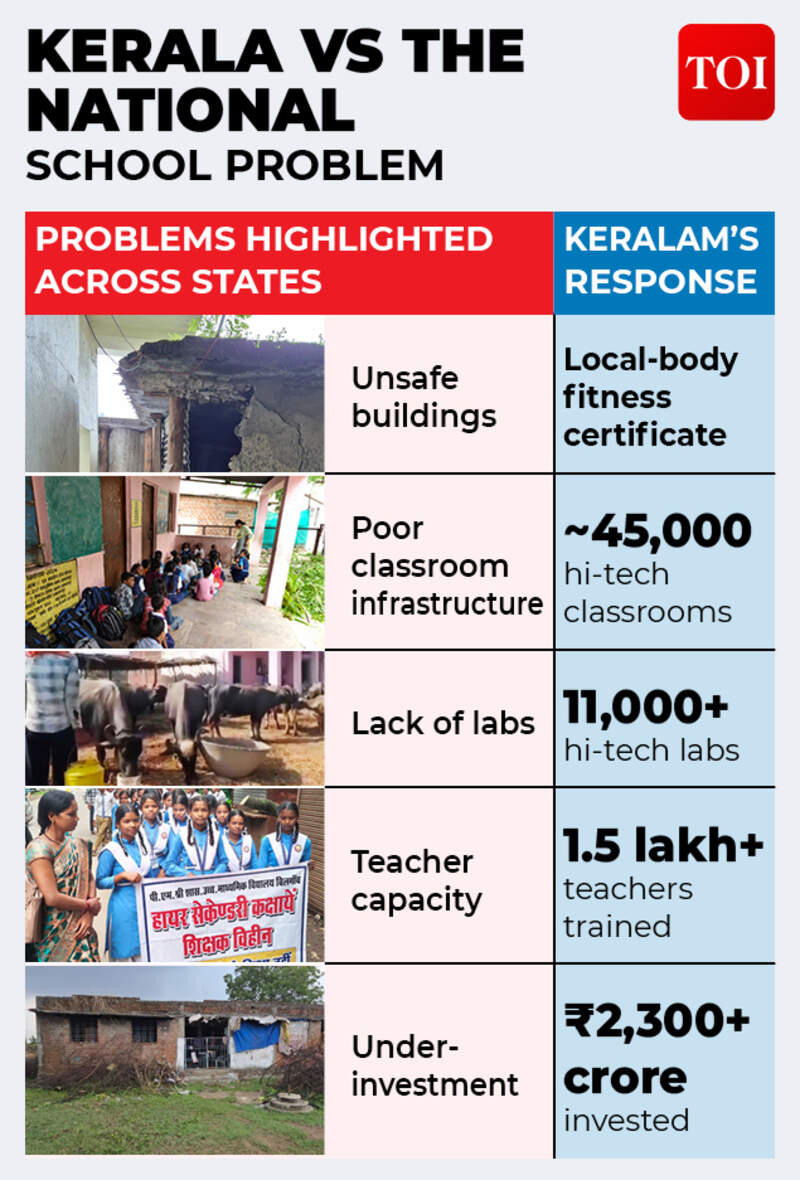
Keralam’s public-school story offers a counterpoint. Successive govts have treated school education as a public good, but the biggest transformation came between 2016 and 2021, when the General Education Rejuvenation Mission pumped more than Rs 2,300 crore into infrastructure.There are 4,752 public schools in which every classroom is hi-tech, together accounting for around 45,000 such rooms. There are more than 11,000 hi-tech labs. The state-run Kerala Infrastructure and Technology for Education manages the network, creates digital content and has trained over 1.5 lakh teachers. Keralam has also built in a basic safeguard: every school must obtain a local-body fitness certificate to establish that its building is safe and adequately equipped.With inputs from Gauree Malkarnekar; Alok Chamaria, Litha Achari, Ramendra Singh, Siddharth Pandey, Rashmi Drolia, Tanmayee Tyagi, Sonali Mishra, Anmol Jain, Prem Punetha, Yogesh Nagarkoti, Ashish Mishra, Manvir Saint, Rohit Mullick, Vinod Kumar, Isha Jain