
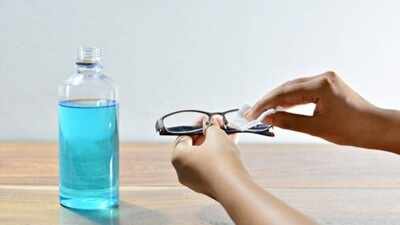
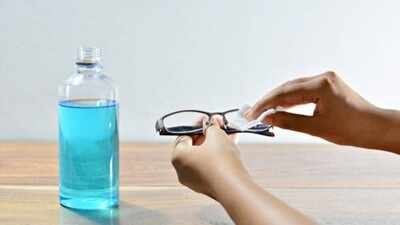
Most people clean their glasses with whatever’s within arm’s reach, a shirt hem, a tissue, or a quick spray of whatever cleaning bottle happens to be on the counter, without realising that almost every modern prescription lens carries a genuinely delicate anti-reflective coating underneath its surface. That coating is what cuts down glare and reflections, but it’s also surprisingly easy to damage permanently, and once it’s scratched or stripped, there’s no repairing it, only replacing the lenses entirely. Here are five common cleaning habits worth breaking before they cost you a pair of glasses.
Vinegar and other acidic “natural” cleaners
This is the one that catches the most people off guard, since vinegar gets recommended online as a supposedly gentle, natural glass cleaner. In reality, its acidity is specifically damaging to anti-reflective coating, and the effect isn’t subtle either, some people have actually used vinegar deliberately, soaking glasses in it for a full day, specifically to soften and strip away a damaged coating before scraping it off entirely. That’s a genuine sign of how corrosive it is to that coating layer. Lemon juice and other acidic “natural” cleaning hacks carry the same basic risk and are worth avoiding for exactly the same reason.
Paper towels, tissues, or napkins
These feel harmless because they look soft, but paper products are made from wood fibres that are considerably more abrasive at a microscopic level than they appear. Wiping a lens with tissue or paper towel, especially when there’s already dust or grit sitting on the surface, grinds those particles directly into the coating, leaving a network of fine scratches that build up gradually and cloud the lens over time. A proper microfibre cloth, made specifically for glass and lens surfaces, is genuinely worth keeping on hand instead.
Your shirt or any dry fabric
Reaching for a shirt hem to wipe a smudge is probably the single most universal glasses-cleaning habit and also one that eye care professionals consistently flag as a mistake. Clothing fabric, even soft cotton, carries dust and grit from a day of wear, and rubbing that fabric dry across a lens does the same fine-scratching damage as a tissue would, just less obviously. If a cloth is genuinely all you have in the moment, at least rinsing the lenses under water first, so there’s nothing dry and gritty being ground into the surface, meaningfully reduces the risk.
Glass cleaner, ammonia, or alcohol-based sprays
Products built for windows and mirrors are formulated with exactly the kind of harsh chemicals, ammonia in particular, that break down anti-reflective and other speciality coatings on contact. Alcohol-based sprays carry a similar risk, and they’re a specific problem for polarised sunglasses too, since repeated alcohol exposure can degrade the polarising film layer built into the lens over time. It’s worth keeping a dedicated eyeglass cleaning spray, or simply lotion-free dish soap and water, on hand instead of reaching for whatever’s already under the sink.
Hot water
This one is easy to overlook, since hot water feels like it should clean better than lukewarm or cool water. In practice, high heat can actually warp certain lens materials and stress the coating layers bonded to the surface, leading to damage that shows up gradually rather than all at once. Lukewarm water is genuinely the safer choice for rinsing lenses before wiping them dry.
What to use instead
The safer routine is refreshingly simple once you know it: rinse your lenses under lukewarm water first to clear away loose dust and grit, add a small drop of lotion-free dish soap if there’s grease or fingerprints to deal with, rinse again thoroughly, and dry gently with a proper microfibre cloth rather than anything reached for in a hurry. It takes barely longer than any of the shortcuts above, and it’s the difference between a coating that lasts as long as the frames and one that clouds over within a year.
Disclaimer:
This article is intended for general informational purposes only and is not a substitute for professional advice. Cleaning requirements can vary depending on your specific lens type and coating, so check with your optician or the lens manufacturer if you’re unsure what’s safe for your glasses.