

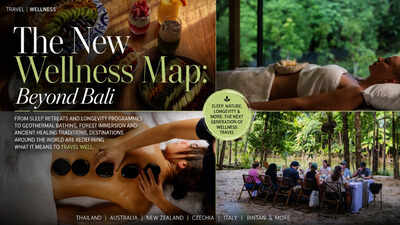
For years, Bali was almost synonymous with wellness travel — yoga retreats, massages, meditation and detox programmes offering travellers a chance to slow down and switch off. But the wellness traveller has evolved. Today, a holiday can be as much about understanding your body, sleeping better and improving long-term health as it is about relaxation.The result is a new wellness map stretching across destinations as diverse as Thailand, Australia, New Zealand, Czechia, Italy and Indonesia. And the common denominator isn’t necessarily a spa. It is the promise of returning home feeling different — healthier, calmer and more connected.At Layan Life by Anantara in Phuket, the shift is increasingly towards personalised, results-oriented wellness. Wellness Manager Sasithorn Charmorchad says travellers want to understand their health rather than simply be pampered. She says, “The wellness traveller is increasingly looking for something much more meaningful than simply relaxation or a traditional spa experience. We are seeing a shift towards personalised, results-oriented wellness, where guests want to understand their health, identify what affects their well-being, and leave with practical tools they can continue using in everyday life.”That means wellness programmes now encompass longevity, metabolic health, nutrition, movement, sleep and stress management. Longevity, in particular, has become less about simply adding years to life and more about preserving the quality of those years. “People are increasingly interested not simply in living longer, but in maintaining their energy, mobility, cognitive health and quality of life as they age,” says Charmorchad.There is also a growing appetite for combining modern science with traditional healing. At Layan Life, diagnostics and lifestyle medicine sit alongside Traditional Thai Medicine and holistic therapies. The aim is not to create a week-long bubble that disappears once the traveller boards a flight home, but to give guests habits they can sustain. “The reset trip is increasingly becoming a starting point rather than the end goal,” she says.When sleep becomes the holidayIf longevity is one of the biggest new wellness buzzwords, sleep may be its most relatable counterpart. At Layan Life, Charmorchad says sleep has become a much more prominent reason for guests to seek professional wellness support. She says, “Sleep, in particular, has become a much bigger priority over the last two to three years. Previously, guests might mention poor sleep as one of many concerns. Today, we see people arriving specifically because they know their sleep is disrupted and want to understand why.”At Anantara Palazzo Naiadi Rome Hotel, Spa Directors Tomislav Dasovic and Jennifer Rukavina are seeing increased interest in sleep optimisation, longevity and biohacking. The duo says, “Today’s lifestyle—constant connectivity, stress, poor sleep, lack of movement and unbalanced nutrition—is creating a greater need for digital detox, stress management, better sleep, renewed energy and mental balance.”But even as wellness becomes more scientific, the human element remains crucial. “The spa is therefore evolving beyond traditional treatments towards a more integrated approach, combining science and ritual, technology and human touch, nutrition, recovery, mindfulness and nature.”Nature as the new treatment roomPerhaps the biggest shift is that wellness is increasingly happening outside the spa. Australia’s wellness proposition is built around exactly that idea. According to Nishant Kashikar, Country Manager – India & Gulf, Tourism Australia, today’s traveller is looking beyond the traditional treatment menu. “It’s no longer just a ninety-minute massage, rather the whole vacation is now a reset for the traveller of today, waking up to solitude, eating what is farmed locally, and having the space and time to genuinely switch off.”Australia’s vast landscapes offer what many urban travellers are increasingly short of: space, silence and time outdoors. Dark-sky stargazing in Jervis Bay, geothermal bathing at Peninsula Hot Springs, immersion in the Daintree rainforest and slow walks through remote landscapes all become wellness experiences in their own right. “Australia’s biggest advantage in the wellness market is its vast, quiet, and unspoiled nature,” says Kashikar. “The strongest demand is for nature-based experiences, deep rest, and mental reset,” he says.The same philosophy is evident in Bintan, where wellness is deliberately being stripped of rigid schedules. Abdul Wahab, CEO, Bintan Resorts Cakrawala, believes travellers increasingly want the freedom to define their own version of wellbeing. “Travellers still appreciate a good spa, but they increasingly want to feel restored without following a rigid retreat schedule. They want to sleep well, eat well, move outdoors, spend time near water and reconnect with the people they are travelling with or simply find time for themselves.”That could mean yoga, cycling and kayaking — or simply an afternoon with no plans. “Not everyone wants wellness to come with a timetable. For some, it may mean yoga at sunrise or cycling through nature; for others, it may be an afternoon with no plans at all.”And for Indian travellers, the fact that Bintan can be reached by ferry from Singapore in roughly an hour makes the island particularly relevant for a short reset.The choice of wellness experiences is broad. Banyan Tree Bintan combines sea-facing villas and spa-led luxury, while The Sanchaya offers personalised treatments, yoga and meditation. Angsana Bintan draws on local traditions through spa treatments and yoga, while Club Med Bintan Island takes a more active approach with fitness, sport, yoga and spa experiences.For a closer connection with nature, Natra Bintan offers glamping at Treasure Bay, while Bintan Village Nature & River Spa combines treatments with a coconut plantation, private beach and mangrove activities. Beyond the resorts, travellers can explore the Mangrove Discovery Tour, play golf at Ria Bintan or simply spend quiet time along Lagoi’s beaches.Ancient wisdom, new relevanceNot every emerging wellness destination is about futuristic diagnostics and biohacking. Some are rediscovering traditions that have existed for centuries. Czechia, for instance, brings a long-established spa culture to the new wellness map. Karlovy Vary, part of UNESCO’s Great Spa Towns of Europe combines mineral springs, traditional drinking cures, specialist spa hotels, forest trails and historic architecture.Beyond Karlovy Vary, Bohemian Switzerland offers sandstone landscapes and forest walks, while South Bohemia lends itself to cycling, countryside stays and slow days around ponds and forests. The Krkonoše Mountains, home to Czechia’s highest peak, offer fresh air, outdoor movement and distance from crowded urban life.Barbara Andelova, International Marketing Manager, Middle East & India, Czech Tourism, says travellers are becoming more conscious of prevention and long-term health. “Wellness travel is becoming more purposeful. Travellers are no longer satisfied with a massage squeezed between sightseeing appointments. They want experiences that address how they actually feel: overstimulated, sleep-deprived, physically inactive and mentally fatigued.” The country’s appeal lies in allowing medical wellness and nature to coexist with a holiday. She says, “Czechia allows these different approaches to coexist. A traveller can begin with a professionally guided programme in a historic spa town and continue into the mountains, forests or South Bohemian countryside. Wellness becomes a natural part of the journey rather than taking over the entire holiday.”New Zealand takes an even more holistic approach, connecting wellness to nature and indigenous culture. Tourism New Zealand points to the Māori understanding of hauora, or holistic wellbeing, which encompasses connection to place, people and self. Rotorua exemplifies this through geothermal bathing and Māori cultural experiences at places such as Wai Ariki Hot Springs & Spa. Forest bathing, hiking, kayaking and simply spending time away from technology form part of the country’s broader proposition. Marisa Balle of RotoruaNZ describes the destination’s appeal succinctly, saying, “Rotorua’s wellness story is much deeper than a traditional spa experience. This is a place where geothermal waters, forests, lakes and Māori culture come together to create a distinctive sense of wellbeing and connection.”According to Tourism New Zealand, 44% of Indian travellers plan to incorporate more wellness or mindfulness into their journeys in 2026, rising to 73% among travellers who already engage with wellness practices. And 74% of Indian Active Considerers see New Zealand as an ideal place to relax and refresh.Rotorua brings both together at Wai Ariki Hot Springs & Spa, where geothermal bathing is combined with Māori cultural traditions. Secret Spot Hot Tubs offers a more intimate geothermal experience, while Whakarewarewa Forest provides guided walks and cultural experiences.Elsewhere in New Zealand, Cabot Lodge in Fiordland offers hiking, kayaking and fishing amid expansive landscapes, while Eagles Nest in the Far North combines wide-open skies, minimal light pollution, scenic flights and visits to Waipoua Forest. And for travellers wanting to literally immerse themselves in nature, there is forest bathing on Waiheke Island, inspired by Japan’s Shinrin-Yoku and offered by operator Terra & Tide.Wellness that follows you homeAt Anantara Convento di Amalfi Grand Hotel, Spa Manager Sonia Serio sees another important change: travellers want wellness that feels meaningful but doesn’t necessarily require an intensive retreat. “Today’s wellness travellers are seeking experiences that go beyond simple physical relaxation and embrace a more holistic and conscious approach to wellbeing,” she says. Stress relief, sleep rituals, nature and personalised treatments are increasingly popular, but the experience needs to fit naturally into the holiday.For Serio, the true measure of a wellness destination is personalisation. “The defining factor is personalisation: understanding each guest’s unique needs and creating meaningful experiences rather than offering a standardised approach.”That may ultimately be the biggest change in wellness travel. The new traveller isn’t necessarily looking for another detox, another treatment or another perfectly curated retreat. They are looking for something that makes everyday life feel better after the holiday ends.