
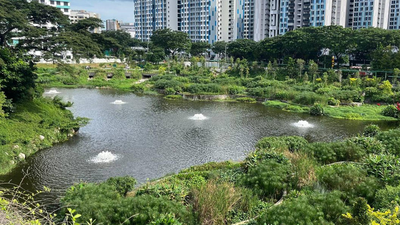
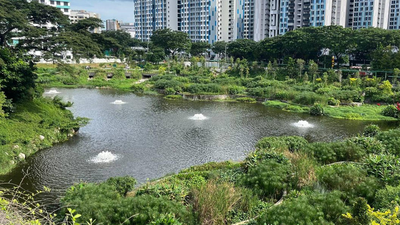
Singapore has brought the memory of a vanished 1920s landmark into one of its newest housing estates, but the new Alkaff Lake is doing much more than recreating a piece of the past. Built inside Bidadari Park, the 1.8-hectare lake was inspired by the former Alkaff Gardens, which opened to the public in 1929. Today, it doubles as a stormwater retention pond designed to reduce flood risk while also serving as a recreational and natural space for residents. During heavy rain, the lake can hold up to 40,000 cubic metres of water, roughly the equivalent of 16 Olympic-sized swimming pools. Its wetlands, swales and surrounding greenery also help cleanse stormwater and provide a habitat and stopover area for wildlife.
Singapore revived the memory of a 1929 landmark
The story of Alkaff Lake goes back to 1929, when the Alkaff family, a prominent Arab merchant and landowning family in Singapore, opened Alkaff Gardens to the public in the Bidadari area. The gardens became a popular attraction and were known for their landscaped surroundings and recreational spaces. Decades later, as Bidadari was redeveloped into a new residential estate, planners decided to incorporate elements of its history into the new neighbourhood. The modern Alkaff Lake does not restore the original garden or recreate an identical historic lake. Instead, Singapore’s agencies say it was designed to pay homage to the former Alkaff Gardens and recreate their sense of tranquillity while giving the site a new practical function.
The lake is actually a giant stormwater reservoir
The most unusual feature of Alkaff Lake is what happens during a downpour. The lake sits at the lowest point of Bidadari and is designed to receive runoff from about 43.5 hectares, or roughly half of the estate. It can temporarily store as much as 40,000 cubic metres of water, equivalent to about 16 Olympic-sized swimming pools. When heavy rain arrives, water is diverted into the lake rather than flowing immediately into downstream drains. Outlet points then control the rate at which the stored water is released, slowing the flow and reducing pressure on the downstream drainage system. PUB developed the arrangement partly because the downstream drain could not simply be widened further due to space constraints.
A lake that changes its job when it rains
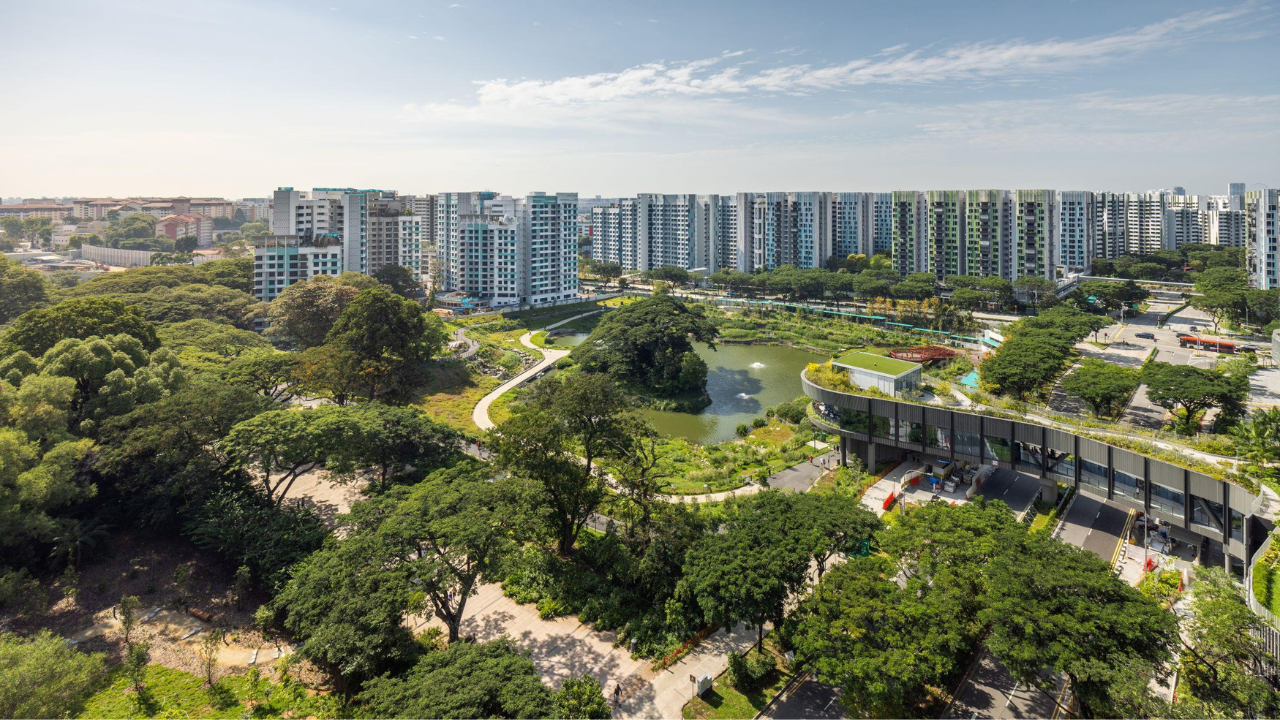
On an ordinary dry day, Alkaff Lake looks like a conventional urban waterbody, with landscaped banks, viewing areas and recreational space for the surrounding community. During intense rainfall, however, its role changes into that of a temporary stormwater storage facility. PUB says the lake’s normal water level is typically maintained between 1 and 1.5 metres, but it can rise to around 4 metres during heavy rain as it captures excess runoff. Water-level sensors are connected to warning beacons and audio announcements in four languages, alerting visitors to move away from the lake when the water rises. The design therefore allows the same piece of land to function as public space during normal conditions and flood-control infrastructure during storms.
Wetlands help turn the infrastructure into a living landscape
The lake was designed using Singapore’s Active, Beautiful, Clean Waters, or ABC Waters, approach, which seeks to integrate water management with attractive public spaces and natural features. Alkaff Lake contains terraced wetlands, swales and a cascading creek that help slow and cleanse stormwater before it enters the lake. Gross Pollutant Traps capture litter and sediment carried by runoff, while aerators improve water circulation and increase dissolved oxygen in the lake. The surrounding park also contains greenery, trails, viewing decks and a nest-shaped shelter overlooking the water. Rather than hiding the drainage infrastructure underground or behind concrete barriers, the design makes the water-management system part of the landscape that residents can actually see and use.
The housing estate was designed around nature too
Alkaff Lake forms part of the much larger Bidadari Park, which occupies more than 10% of the Bidadari estate and was developed around the idea of a “Community in a Garden”. The park was planned to preserve the area’s natural character while providing recreational space for the surrounding housing developments. Planners retained an approximately 1-hectare hillock as a stopover site for migratory birds and created a land bridge connecting it with the main park area. The bridge also creates a route for people and wildlife between the green spaces. Authorities have recorded species including the collared kingfisher, yellow-vented bulbul and pink-necked green pigeon using the bridge, while butterfly-attracting plants and other vegetation have been incorporated into the landscape.