
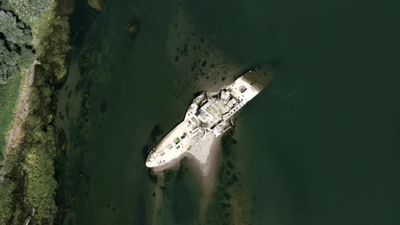
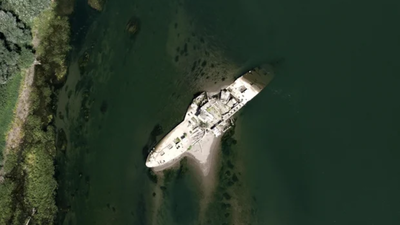
The rusting hull of a century-old steam tug has emerged almost completely from the shrinking waters of Serbia’s Sava River near Sremska Mitrovica, about 45 miles north-west of Belgrade. Extreme heat and prolonged drought across Central and Southeastern Europe have pushed water levels to historic lows, revealing a vessel known locally as “Sava’s Titanic.” Built in 1913 at a shipyard in Budapest, Hungary, during the Austro-Hungarian Empire, the 177-foot ship was originally named the Vag. After the First World War and the collapse of the empire, the vessel was transferred in 1921 to the Kingdom of Serbs, Croats and Slovenes and renamed the Slovenac. The steam tug survived decades of service and two world wars before sinking in late April 1945, near the end of the Second World War. While carrying wounded fighters near the Serbian village of Drenovac, the vessel hit a German magnetic river mine and sank.According to reports by Associated Press and CBS News, the wreck has remained in the same place on the riverbed for nearly 80 years. Small parts of its upper structure had appeared during earlier dry periods, but the current record-low water levels have exposed much more of the hull and parts of the interior. “It’s been several years since it was last seen, so there is quite an interest,” Andrija Popovic, head of the Sremska Mitrovica town museum, told the Associated Press. “It’s truly something you don’t see every day,” Popovic said, noting that the vessel sank in spring 1945 and has remained on the riverbed ever since. The sudden appearance of the Slovenac has attracted crowds of local residents. Some have walked across the exposed riverbed to see the ship up close and even held picnics on the muddy banks beside the wreck.
A rich maritime legacy
The story of the Slovenac is closely linked to the troubled history of the Balkans in the early 20th century. Built as a heavy river steam tug, the vessel was designed to pull large barges along the Danube and Sava rivers. When the First World War began in 1914, the Austro-Hungarian military took control of the boat and used it for transport and supply work along the Danube front. It survived four years of fighting without being damaged. After the Austro-Hungarian Empire collapsed in 1918, international commissions divided river fleets among the newly formed countries of Europe. In 1921, the tug became part of the civilian transport fleet of the Kingdom of Serbs, Croats and Slovenes. Under the name Slovenac, it became a regular sight at river ports from Belgrade to Zagreb, carrying industrial goods and farm products across the region.
The final voyage in 1945
The peaceful service of the Slovenac ended during the Second World War, when Yugoslavia was invaded and occupied by Axis forces. The vessel was again used for military work, carrying personnel, equipment and wounded people across areas affected by the fighting. In the final weeks of the war in Europe in April 1945, Allied and Yugoslav partisan forces pushed Axis troops back across the northern plains. Retreating German forces laid mines in major rivers to slow the advancing forces. While operating near Drenovac with wounded soldiers aboard, the Slovenac passed over a hidden magnetic mine. The explosion tore through its iron hull, causing the tug to sink quickly into the deep waters of the Sava. The vessel remained buried in river silt for nearly eight decades. Now, as drought pushes the Sava to unusually low levels, the long-hidden wreck has once again emerged into public view.
A wider river crisis
The emergence of the steam tug is part of a much wider water crisis affecting Europe’s major rivers. Severe drought has lowered water levels in the Danube, Rhine and Sava, disrupting shipping, hurting agriculture and creating problems for power production. Reports from Reuters and Radio Free Europe say that as the Danube falls near Prahovo on Serbia’s eastern border, dozens of Second World War Nazi warships have also appeared above the water. In late 1944, retreating German forces deliberately sank nearly 200 vessels from their Black Sea Fleet to stop them from being captured by advancing Soviet Red Army troops. Many of the sunken warships still contain tonnes of ammunition and unexploded weapons. Their presence narrows the navigable parts of the Danube, forcing commercial ships to use tight passages and causing major losses for Serbia’s river transport sector. Further upstream in Hungary, falling water levels have exposed other wartime remains, including a Second World War German motorcycle and human remains near the parliament building in Budapest. In Bulgaria, shallow waters near the city of Ruse have also revealed prehistoric mammoth bones. Local historians and authorities in Serbia continue to monitor the site near Sremska Mitrovica as the Sava remains dangerously low. For now, the ghostly outline of the Slovenac is a reminder of both the wars of the 20th century and the environmental crisis now affecting Europe’s rivers.