
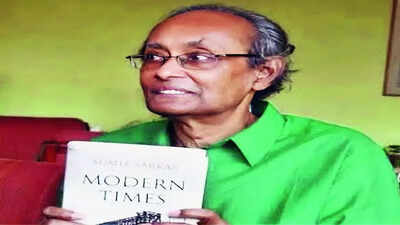
Professor Sumit Sarkar, widely regarded as among the finest historians of modern Indian history, was educated at Presidency College and the University of Calcutta, and went on to teach for 30 years in the Department of History, University of Delhi. While his scholarship ranged and roamed over the vast canvas of modern Indian history, some indication of the originality of his vision and the painstaking rigour of his scholarship might be gathered by examining one particular facet. There was a recursive quality to the way he returned to the question of nationalism in colonial India, its critique as much as its self-critique. One sees this in his early essays on the 19th-century Bengali intelligentsia, the path-breaking study of the Swadeshi movement in Bengal, as well as the singularly important essays on Gandhian nationalism.Sarkar was a Marxist historian and, it might surprise some that his scholarship was aimed at democratising the scope of nationalism, in terms of method as much as archive. Nationalism could only be understood in terms of popular aspirations and struggles for justice, be they about land, labour, dignity or representation. In the words of Sarkar, “what was remarkable [about the national movement] was the capacity for internal debate, change and auto-critique…combined with a persistent concern for mass poverty…and the need for mass mobilization [leading] to a progressive broadening of the meanings of freedom. One need only note that none of the four features central to the [Indian] constitution…democracy based on universal suffrage, secularism, elements of federalism and social justice through affirmative action had been present in the early programs of mainstream nationalism”.His study of the Swadeshi movement in Bengal captured this complexity by analysing its radical agenda of complete independence, the rapid connections made between individuals and organisations nationally and internationally, the granular contestations over ideology, and the challenges of mass mobilisation. While Hindu religious symbols and imagery were employed by some for mobilisation, Sarkar shows us that even at the time of the Swadeshi movement, there was a recognition that such invocations of Hindu identity could be read in ways that reinforced narratives of Muslim tyranny or caste privilege.Sarkar documents the efforts made at the time to combat this possibility and to discover cult figures that would appeal to both communities, so as to broaden the scope of the national, with the revolutionary journal Yugantar suggesting a festival to honour Mir Kasim, not unlike those around Shivaji. Sarkar also discusses tensions within the revolutionary movement, including Hemchandra Kanungo’s writings of the late 1920s, which critiqued the invocation of Hindu religious imagery as much as arguments of a Hindu golden past in the Swadeshi movement, since this was bound to exclude Muslims, valorise caste privilege, and encourage a cultic devotion to a leader rather than broaden into a mass movement with a political and socio-economic agenda.Kanungo could not be ignored: he was a legend even among revolutionaries, had travelled to Europe to study the technology of the bomb and meet revolutionaries, was imprisoned in the Cellular Jail following his involvement in the Alipore bomb case, and was deeply admired among fellow revolutionaries.While the Swadeshi movement was no doubt central to the formation of nationalism, it had its limitations in terms of its treatment of the communal and caste question, as well as its inability to adequately formulate a broader agrarian programme; these challenges continued well into the period of Gandhian nationalism.This complex and evolving understanding of the phenomenon of nationalism informs Sarkar’s critique of theorisations which treat nationalism as captive to the rigid binary between India and the “West”. Such theorisations of Indian nationalism, which value it merely in terms of its perceived indigeneity and difference from the “West”, fail to recognise the evolving and transformative interaction between the two. Could one question Ambedkar for invoking the French Revolution in the Mahad Satyagraha, or forget Bhagat Singh’s invocation of Lenin during his trial?The agenda of nationalism was broadened because of popular movements and local struggles by marginalised sections, so-called lower castes, “tribal” groups, Socialists and Communists. It is this historical and democratic expansion, based on ideals of justice and equality, that characterised the national movement and that, in Sarkar’s analysis, distinguished it from Hindutva nationalism. He argued that important strands of the latter retained features visible in its early 20th-century formulations and remained open to critiques made at the time; he also questioned the extent to which questions of mass poverty or socio-economic change occupied a central place within it.Fiercely independent, Sarkar’s Marxism did not prevent him from publicly critiquing in the strongest terms the Left government’s policies and the events surrounding Singur and Nandigram.Sarkar, therefore, never shied away from drawing on his scholarship to speak as a citizen historian on what he perceived to be the crises of the day wracking the body politic. He was able to occupy that rare position of a public intellectual because his research attended to the fundamental questions that had a direct bearing on the dizzying churns of the present, soaring above the drive for narrow specialisation that can sometimes leave historians unprepared when it comes to addressing the most urgent challenges of the times.Writing this obituary, it is impossible not to remember his small office in which about six of us, privileged students of the MA, sat in 1999-2000 to learn, not Indian history, but the Renaissance and the Reformation in Europe.Professor Sarkar had his lectures meticulously prepared, written in his flowing, slanting hand on foolscap sheets of paper. The lectures lucidly brought alive the worlds of the Renaissance and the Reformation, and moved from Michelangelo’s search for the perfect blue and the ambivalence and originality of Machiavelli’s ‘ethics’ to the intricacies of theological dispute, showing how deeply knowledgeable Sarkar was about various aspects of European history.
Share your thoughts in the comments
Be respectful · TOI community guidelines
Amidst the gravity of the issues being discussed, on more than one occasion there was the unmistakable, almost child-like mischievous humour that would surface, his face breaking into a smile, the tone and voice assuming the sharp edge of an irreverence that is perhaps always inseparable from great learning.It was very painful meeting Professor Sarkar in the years of his illness, which he bore with remarkable and rare fortitude. Farewell Professor Sarkar, even as you remain in the gift of your teaching and in the luminosity of your works.Rahul Govind was a student of Sumit Sarkar at the University of Delhi. He has a PhD. from Columbia University and is currently Professor of History at the University of Delhi.