
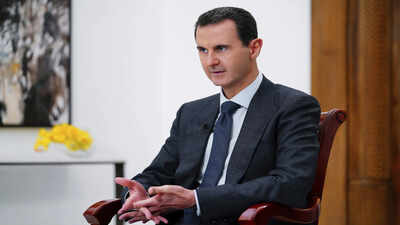
A Syrian criminal court in Damascus has sentenced ousted president Bashar al-Assad to death in absentia after finding him guilty of killings, torture, arbitrary arrests and crimes against humanity committed during the country’s nearly 14-year civil war. The verdict, delivered on Tuesday, August 11, marks the first conviction against Assad by Syria’s transitional authorities since his regime collapsed in December 2024. But while the court has pronounced a death sentence, the former Syrian ruler remains far beyond the reach of the authorities who now control Damascus.Assad is currently in Russia, where he and his family were granted asylum after fleeing Syria when rebel forces captured Damascus in December 2024. His precise location inside Russia has not been publicly confirmed. However, reporting over the past year has placed the former dictator in Moscow, with sources previously indicating that his family was likely living in the heavily guarded Rublyovka area, an affluent district on the western outskirts of the Russian capital.The death sentence therefore raises a central question: where is Bashar al-Assad now, and can Syria ever bring him back to face the punishment handed down by its court?
Assad remains in Russia after fleeing Syria
The most recent credible reports continue to place Assad in Moscow. Reuters reported after Tuesday’s verdict that Assad “is currently in Russia”, where he and his family received asylum on humanitarian grounds. His brother Maher al-Assad, who also received a death sentence in absentia, is likewise believed to be in Russia.Assad’s escape from Syria came on December 8, 2024, when rebel forces led by Ahmed al-Sharaa swept into Damascus after a lightning offensive that lasted less than two weeks. The advance brought down the Assad government and ended more than five decades of rule by the Assad family.At the time, Assad’s whereabouts were initially unknown. Russia’s foreign ministry said he had resigned and left Syria, while reports suggested he had travelled from the coastal region before being flown to Russia. Russian state media subsequently reported that Assad and his family had arrived in Moscow and had been granted asylum.In a statement issued after his escape, Assad disputed accounts that he had planned his departure in advance. He said he had remained in Damascus until the final hours and later moved to a Russian military base in Latakia as the security situation deteriorated.“First, my departure from Syria was neither planned nor did it occur during the final hours of the battles, as some have claimed,” Assad said in the statement.“On the contrary, I remained in Damascus, carrying out my duties until the early hours of Sunday, December 8, 2024,” he added.According to Assad’s account, he travelled to the Russian Khmeimim airbase in Latakia after opposition forces entered Damascus and intended to continue overseeing military operations. He said the situation at the base then became untenable and Moscow asked its command to arrange his evacuation.“With no viable means of leaving the base, Moscow requested that the base’s command arrange an immediate evacuation to Russia on the evening of Sunday 8 December,” the statement said.Independent reporting has also described Assad’s departure as a Russian-assisted evacuation. The Guardian reported in December 2025 that Assad and his sons were taken under Russian military escort to Khmeimim before being flown out of Syria.
Where exactly in Moscow is Assad living?
This is where the trail becomes less certain. There is no publicly verified address for Assad in Moscow, and he has rarely, if ever, been seen publicly since arriving in Russia. A detailed Guardian investigation published in December 2025, based on sources in Russia and Syria, a family friend and leaked data, reported that the Assad family was likely living in Rublyovka, a prestigious gated area associated with Russia’s political and business elite.The report described the family’s life in Moscow as secluded and closely controlled. A family friend said Assad had little contact with the outside world and remained in touch with only a small number of people who had served around his presidential palace.“It’s a very quiet life,” said the family friend. “He has very little, if any, contact with the outside world. He’s only in touch with a couple of people who were in his palace, like Mansour Azzam [former Syrian minister of presidency affairs] and Yassar Ibrahim [Assad’s top economic crony].”The same investigation said Assad was studying Russian and revisiting his training in ophthalmology. Before entering politics, Assad had trained as an ophthalmologist in London and had originally intended to pursue a medical career before the death of his elder brother Basil changed the succession plans of the Assad family.“He’s studying Russian and brushing up on his ophthalmology again,” a family friend told the Guardian. “It’s a passion of his, he obviously doesn’t need the money. Even before the war in Syria began, he used to regularly practice his ophthalmology in Damascus.”However, the Rublyovka location should be treated as a reported possibility rather than a confirmed current address. What is firmly established is that Assad remains in Russia and has been kept away from public political life.
Russia has kept Assad away from public life
Moscow’s decision to shelter Assad has been one of the biggest obstacles to attempts by Syria’s new authorities to bring the former president before a court.Russia granted Assad and his family asylum on humanitarian grounds after the fall of his government. Since then, reports have indicated that the Kremlin has placed restrictions on his public activities.In a November 2025 interview cited by the Guardian, Russia’s ambassador to Iraq, Elbrus Kutrashev, said Assad was safe in Russia but could not engage in political or media activity.“Assad may live here but cannot engage in political activities … He has no right to engage in any media or political activity. Have you heard anything from him? You haven’t, because he is not allowed to – but he is safe and alive,” Kutrashev said.The restrictions have contributed to the mystery surrounding Assad’s life in exile. Unlike other deposed leaders who have appeared publicly after leaving office, Assad has remained largely invisible.His children, however, have had a somewhat more visible life in Moscow. The Guardian reported that Assad’s daughter Zein attended the prestigious Moscow State Institute of International Relations, known as MGIMO, and graduated in June 2025. Other family members were also seen at the ceremony, although they kept a low profile.The family has also reportedly travelled to the United Arab Emirates, a destination with which it had longstanding connections. But reports said the family initially hoped to relocate there permanently and later concluded that such a move would be difficult because of the political implications of hosting Assad.
Why Syria sentenced Assad to death
The Damascus court’s verdict is the first Syrian conviction against Assad himself. The court found him guilty of offences including premeditated and intentional murder, torture, arbitrary arrest and crimes against humanity. His younger brother Maher was handed the same sentence in absentia.Maher commanded Syria’s elite Fourth Armoured Division and was one of the most powerful military figures under Assad. The division was repeatedly accused by opposition activists and rights groups of involvement in crackdowns, killings and torture during the conflict.Assad’s cousin Atef Najib, the former head of political security in Deraa province, was also sentenced to death. Unlike Assad and Maher, Najib was in Syrian custody and appeared in court wearing a prison uniform.Najib’s role is particularly important because Deraa is widely regarded as the birthplace of the 2011 uprising against Assad. The unrest began after security forces detained and allegedly tortured teenagers who had written anti-government graffiti on a school wall.The crackdown that followed helped turn local protests into nationwide demonstrations. The government’s violent response contributed to the escalation into an armed conflict that eventually drew in regional and global powers.The court also sentenced several other former military and security officials to death in absentia, including former defence minister Fahd al-Freij and former military intelligence chief in Deraa Louay al-Ali.
Verdict welcomed by Assad’s victims
The ruling was met with celebrations in parts of Syria, particularly in areas that suffered heavily under Assad’s security forces.Crowds gathered outside the courthouse in Damascus, chanting and waving Syrian flags. In Deraa, families of people killed or detained during the early years of the uprising gathered with photographs of their relatives.For many victims, the verdict carried significance beyond the punishment itself. It was an official acknowledgement by Syria’s new authorities of crimes committed during the Assad era.Noha al-Masri, a prosecutor involved in the case, lost her brother during the crackdown in Deraa in 2011.“We have been waiting for 15 years to reclaim even a small part of our rights, for all those who have spilled our blood, committed crimes, violated our rights, killed, and tortured us,” Masri told the BBC.“Our demand is that this not be the end of the trials… In the new Syria, there will be no impunity from this day forward.”Reuters reported that the trial process lasted nearly four months and was presented by Syria’s new authorities as part of a wider effort to pursue transitional justice after the fall of Assad.But the verdict has also drawn criticism from human rights groups over the fairness of the proceedings. The Associated Press reported that rights organisations raised concerns about whether the trials were rushed and whether defendants received adequate legal protections. Human Rights Watch also criticised the use of the death penalty, saying accountability requires a justice system capable of guaranteeing fair trials.
Can Syria actually bring Assad back?
For now, the answer appears to be no. The death sentence has no immediate practical effect on Assad because he is outside Syrian territory and under Russian protection. Syria would need Russia to surrender him or otherwise allow him to be transferred to Syrian custody.Anwar al-Bunni, head of the Syrian Centre for Legal Studies and Research, argued that the death sentence itself could make extradition harder.“There is a huge problem, which is that no one will hand over a criminal to a country that issues a death sentence. This will cut off the road to Assad, and many other criminals, being handed over to Syria,” Bunni told Reuters.“This is performative justice, not transitional justice,” he said.Syria’s new authorities have previously sought accountability for Assad and senior figures from his government. The issue has also been part of the complicated relationship between Damascus and Moscow. Syrian President Ahmed al-Sharaa travelled to Moscow in October 2025 for talks with Russian President Vladimir Putin, with Assad’s extradition among the issues surrounding the relationship.Assad also faces legal action outside Syria. France has issued an arrest warrant against him over allegations connected to the bombing of a press centre in Homs in 2012, according to Reuters.
From Syria’s president to a secluded exile
Assad inherited the presidency in 2000 after the death of his father, Hafez al-Assad, who had ruled Syria for nearly three decades. Bashar initially presented himself as a modernising leader, but his rule became increasingly associated with political repression and the security apparatus.The defining event of his presidency was the 2011 uprising. What began as protests demanding political change developed into a devastating civil war involving the Syrian government, opposition groups, extremist organisations and foreign powers. Russia intervened militarily in support of Assad in 2015, helping his forces regain territory and eventually reducing the opposition’s hold over much of the country.For years, Assad appeared to have survived the war. Then, in late 2024, the balance changed with extraordinary speed.Forces led by Ahmed al-Sharaa launched an offensive from northern Syria and advanced rapidly towards Damascus. On December 8, the capital fell and the Assad government collapsed.The man who had ruled Syria for more than two decades disappeared from the country and resurfaced in Moscow.Nearly two years later, a Syrian court has sentenced him to death. Yet the most important fact remains unchanged: Bashar al-Assad is not in a Syrian prison. He is in Russia, living under the protection of the country that stood by his regime during the civil war.His exact whereabouts in Moscow remain undisclosed. Reports have pointed to the elite Rublyovka district, while other details of his life suggest a tightly controlled existence away from politics and public view.The Damascus verdict therefore closes one chapter of Assad’s rule, but not the question of whether the former Syrian president will ever return to the country he ruled for 24 years.For now, the death sentence exists on paper in Damascus while Assad remains thousands of kilometres away in Russia.