
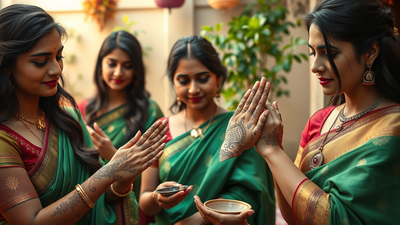
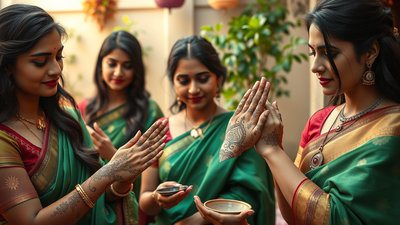
If you’ve ever seen Hariyali Teej celebrations, you probably already know one thing: green is everywhere.Green saris, green suits, green lehengas, green bangles – even the smallest details of a festive look often have a touch of the colour. And somehow, it just feels right. But why green? Why has this particular colour become so closely tied to Hariyali Teej?There’s actually a lovely reason behind it, and it has as much to do with the monsoon as it does with tradition.
It starts with the name ‘Hariyali’
The easiest clue is right there in the name.“Hariyali” means greenery, and Hariyali Teej arrives during the monsoon. After the scorching summer months, the rains change the landscape completely. Trees get their colour back, fields turn green and everything seems a little fresher.So, naturally, green became part of the festival.It’s almost as if women are dressing to match the season around them. A bright green saree during the monsoon doesn’t just look festive; it reflects what’s happening outside.And that’s probably one reason the colour has stayed so strongly associated with Teej over the years.
There’s a religious story behind it too
Hariyali Teej is dedicated to Goddess Parvati and is closely associated with her devotion to Lord Shiva.According to Hindu tradition, Parvati undertook intense penance because she wished to marry Shiva. Her devotion eventually led to their union, which is why Teej holds such significance for women.Traditionally, married women observe the festival and pray for the wellbeing and long life of their husbands. Unmarried women may also keep the fast and pray for a good life partner.Green fits into this story in its own way. The colour is commonly associated with life, growth, prosperity and renewal. Those ideas naturally sit alongside a festival centred around marriage, devotion and new beginnings.
And then there are those green bangles
Ask someone to picture a Hariyali Teej outfit and there’s a good chance green bangles will make an appearance.They’re almost part of the festival’s visual identity.Bangles already have a special place in Indian festive dressing, but green ones are particularly popular during Teej. Women may wear a whole stack of them, mixing different shades and designs, or simply add a few green glass bangles to an otherwise colourful outfit.And let’s be honest, there’s something about the sound of bangles clinking against each other that instantly makes an outfit feel festive.For many women, it’s also a tradition they’ve grown up seeing. Their mothers wore green bangles for Teej. Their grandmothers probably did too. So putting them on can feel less like following a fashion rule and more like continuing something familiar.
Does that mean you have to wear green?
Not really.Green may be the colour most closely associated with Hariyali Teej, but women don’t necessarily stick to just one shade or even one colour.You’ll see plenty of red, pink, yellow, orange and other bright festive colours too. And within green itself, there’s a whole world to choose from – emerald, bottle green, pista, parrot green, olive and softer pastel shades.That’s part of what makes festive dressing interesting. The tradition stays, but the way people interpret it changes.One woman may choose a traditional green sari with gold jewellery. Another may wear a contemporary green lehenga. Someone else might simply add green bangles to a pink suit.The idea is still there.
Hariyali Teej isn’t only about fasting
There’s another side to the festival that often gets lost when we talk only about rituals.Hariyali Teej is also a time for women to get together, dress up, apply mehendi, sing traditional songs and enjoy the celebrations. In several parts of India, swings decorated with flowers are an important part of the festivities.It’s a celebration that has a strong social side to it.And naturally, dressing up becomes part of that.A green sari might be paired with jhumkas and bangles, while a lehenga could be styled with traditional jewellery and mehendi. Some women go completely traditional, while others give their Teej outfit a more modern twist.The clothes may change, but green continues to quietly tie the look back to the festival.
Green also makes sense in the middle of the monsoon
Think about the timing of Hariyali Teej.India has just gone through months of heat, dust and dry landscapes. Then the rain arrives. Suddenly, there’s greenery everywhere.Plants grow. Trees look fuller. Fields change colour. The air feels different.So wearing green during this particular festival isn’t a random choice. It’s connected to that seasonal change.Green represents the freshness that comes with the rains, which is why it fits Hariyali Teej so naturally.It’s also why the colour can feel especially beautiful during the festival. Against a rainy-season backdrop, a bright green sari or a set of green bangles almost seems to belong there.
It has become tradition, not just symbolism
Over time, the meaning of green has become part of the way Hariyali Teej is celebrated.For some women, the colour represents the greenery brought by the monsoon. For others, it is linked to prosperity, growth and marital happiness. And for many, it’s simply what Teej has always looked like in their homes.That last part matters.Traditions often survive because they’re repeated at home. A girl sees her mother getting ready in a green sari for Teej. Years later, she reaches for green herself. Maybe she doesn’t think about the symbolism every time, but the association remains.That’s how a colour becomes part of a festival’s identity.
The meaning of green has evolved too
Today, there’s also a very modern side to Hariyali Teej fashion.Social media has turned festive dressing into something people love to share. Celebrity Teej looks, carefully styled saris, mehendi designs and jewellery combinations often become part of the conversation around the festival.Yet green still holds its place.The styling may be more contemporary, the silhouettes may change and the jewellery may be less traditional, but the colour keeps that connection with Teej.And perhaps that’s the nicest thing about it. You don’t have to dress exactly the way women did generations ago to take part in the tradition.
So, why green on Hariyali Teej?
There isn’t just one reason.Green is tied to the monsoon and the greenery that gives Hariyali Teej its name. It has associations with growth, prosperity and new beginnings. The festival’s connection with Goddess Parvati and her devotion to Lord Shiva gives it a deeper cultural and religious context.But there’s also something much simpler.Green has become part of what Teej looks and feels like.It’s in the sari your mother might have worn. It’s in the bangles stacked on a grandmother’s wrist. It’s in the mehendi-covered hands, the swings decorated during celebrations and the festive photographs taken every year.So when women wear green on Hariyali Teej, they’re not necessarily thinking about symbolism with every choice they make. Sometimes they’re simply following a tradition they know and love.And that’s perhaps why the colour has lasted.Green isn’t just the colour of Hariyali Teej. For many women, it has become one of the things that makes the festival feel like Teej at all.Thumb image: AI generated image