
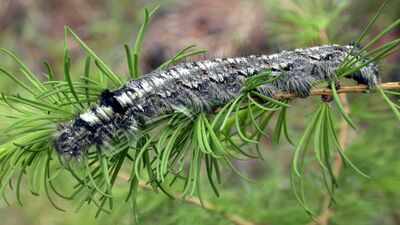
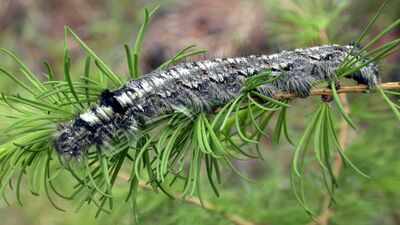
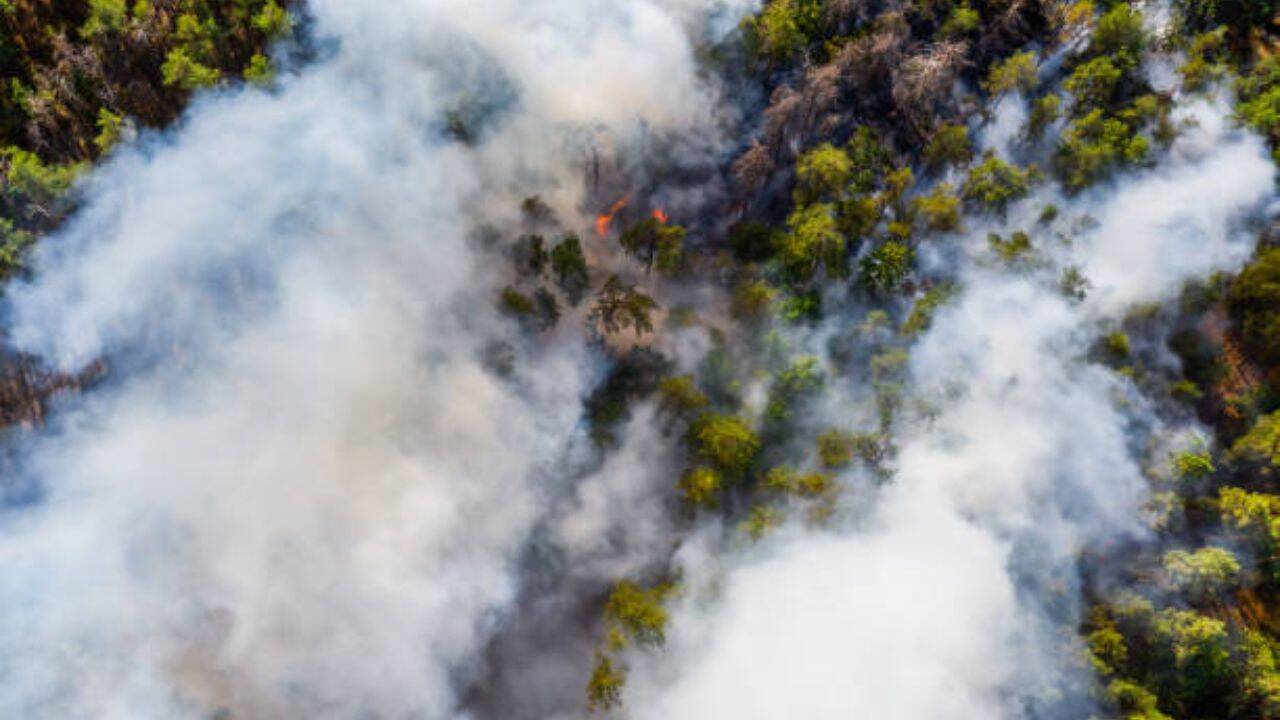
An insect outbreak has left Siberia’s forests dead while also transforming the region into a tinderbox where wildfires are now spreading beyond human control. The trees burning across Krasnoyarsk this year were, in a lot of cases, already dead. Not from the fire or the drought, but because of a small moth.Dendrolimus sibiricus, the Siberian silk moth, has spent the last several years stripping needles from fir, spruce, larch and pine across huge stretches of central Siberia and a tree that loses its needles for numerous consecutive seasons simply dies where it stands. It will not decompose, but stand upright in the cold, dry climate until something eventually sets it alight. This year, it was the flame of an unusually hot, dry stretch of Siberian summer.
Striking a fire
The Siberian silk moth has burned up the forests, without ever touching the fire. Its caterpillars are defoliators, meaning they eat needles rather than wood, bark or roots and a single bad outbreak year can strip hundreds of thousands of hectares. A 2026 research study into the moth’s life cycle published in Frontiers in Insect Science examined why some populations follow a one-year larval cycle while others take two and found the split is not simply a matter of temperature or food availability.Laboratory tests that varied larval density, food supply and host plant didn’t reproduce the switch; the researchers found a distinct molecular signature instead, pointing to a more complex mix of cues and environmental history behind which path a population takes.Whatever sets the timing, a conifer can usually survive losing its needles once. But it is less likely to survive losing them in consecutive years, which is what happens once an outbreak takes hold.
A major outbreak
The moth outbreaks recur roughly every ten to eleven years and run for two to three seasons once they start.
Remote sensing work tracking a more recent outbreak in central Siberia found that the scale of destruction is not small. A study analysing satellite data from 2016 to 2020 documented Siberian silk moth damage across multiple sites in the Yenisei and Irbei districts, with the outbreak that ran from 2015 to 2018 alone disturbing an estimated 428,600 hectares of forest in the Yenisei region, and a second, smaller outbreak from 2018 to 2020 affecting a further 41,500 hectares in Irbei.These are just two districts in one stretch of years. The moth outbreaks recur roughly every ten to eleven years and run for two to three seasons once they start. This means that the deadwood now feeding Krasnoyarsk’s fires was highly likely put in place by an outbreak that peaked years before this fire season.
A repeated incident
Russian forestry records on this moth go back further than most pest histories. A contingency assessment compiled for the UK’s plant health authorities, drawing on that longer Russian record, states that across the ninety years from 1855 to 1945, Siberian silk moth outbreaks killed at least 4 million hectares of Russian forest. A subsequent twenty-five-year stretch, from 1932 to 1957, saw the moth damage 7 million hectares of forest in Western Siberia and Chita Oblast alone, with the assessment noting that the insect killed the forest outright across roughly half that area rather than merely thinning it. These are not one-off disasters. They are what happens, repeatedly, when an outbreak-prone species with a ten-year cycle meets a forest type it is well adapted to defoliate, across a landscape too vast for any human intervention to meaningfully interrupt.The damage is not usually visible to anyone who is not specifically monitoring moth populations. The insect itself does most of its damage during a narrow larval feeding window each year, and by the time a stand’s needle loss is severe enough to be obvious from the ground, the underlying population boom that caused it may already be subsiding. The dead trees, on the other hand, do not subside. They remain part of the landscape for years afterwards, and it is that gap, between an outbreak most people never noticed and the fire season that eventually arrives, that connects an entomological event to a wildfire emergency that looks, on the surface, like a purely meteorological one.The reason it is so easy to lose track of the moth outbreak and the fire show up is that they happen in completely different seasons. An outbreak plays out over successive spring and early summer feeding windows, tracked mostly by foresters and the handful of remote sensing researchers who specialise in this insect. The wildfire emergency plays out in front of the regional officials, emergency crews and general public. The gap in visibility is one reason the deadwood explanation, when offered, arrives as a surprising detail.Fire agencies fighting the current Krasnoyarsk fires have been explicit that the moth-killed deadwood is a major factor in how fast this year’s fires have spread, alongside the high temperatures driving the season generally. Clearing dead timber across hundreds of thousands of hectares of remote taiga is not a realistic undertaking at the scale the outbreaks operate on. Moreover, the moth itself is native to the region, not an invasive species that can be targeted for eradication.