
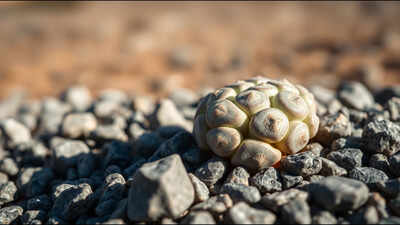
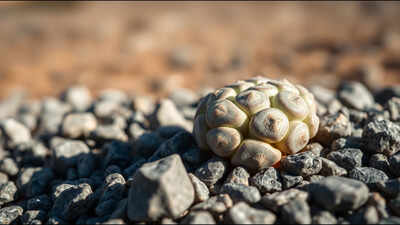
In a small patch of Namibia’s Erongo Mountains, a tiny succulent grows so convincingly disguised as a pebble that most people would walk straight past it without a second glance. This plant, Lithops werneri, survives by mimicking the grey, weathered stones scattered across the thin gravel where it grows, a camouflage strategy that has helped protect it from grazing animals for millions of years but has done little to shield it from human collectors and a changing climate. Found in a single four square kilometre patch of land and nowhere else on Earth, the species was formally listed as critically endangered on the IUCN Red List in February 2026, after surveys found fewer than 200 plants remaining in the wild.
Why this plant has always been genuinely rare
According to Mongabay’s reporting, Sonja Loots, manager of the Threatened Plants Programme at Namibia’s National Botanical Research Institute, said Lithops werneri has always had a naturally restricted range, occurring in just one small area rather than being spread across the wider landscape the way many related species are. According to the IUCN Red List, the global authority on species conservation status, the species has declined by more than 80 per cent since 1981, a drop steep enough on its own to justify its critically endangered listing, even before accounting for how small its total range has always been.Loots explained that L. werneri grows within an extremely thin layer of gravel, only about 2 centimetres deep, sitting directly on top of a solid granite sheet, an unusually narrow and specific set of growing conditions found in very few other places nearby.
How illegal collection nearly wiped the species out entirely
Lithops werneri was first scientifically described in the 1950s, and according to Loots, it was subsequently heavily harvested for the horticulture market in Europe, where collectors have long prized Lithops, commonly known as living stones or pebble plants, for their unusual pebble-like appearance. This early wave of collection caused such a steep decline that the species was, for a period, widely believed to have gone extinct in the wild altogether.That assumption held for decades. According to Mongabay, several succulent enthusiasts searched repeatedly for the plant over the years without success, and no additional wild populations were ever discovered elsewhere. It was not until 2012 that the species was rediscovered at its original known location, offering renewed hope that it had survived after all, even in drastically reduced numbers.
What recent population surveys have actually found
Since that 2012 rediscovery, follow-up surveys have painted an increasingly worrying picture. According to figures compiled by the IUCN, a 2012 census recorded 659 individual plants at the site, but subsequent surveys found the number had fallen sharply, to just 118 plants in 2019 and 163 in 2020, fluctuations that still fall well short of the population recorded only a few years earlier. With fewer than 200 plants now believed to remain, the species sits in a genuinely precarious position, especially given how limited its total known habitat is.
Why the threats facing this plant are shifting over time
While illegal collection played the dominant role in the species’ historical decline, Loots said the balance of threats facing Lithops werneri has shifted in recent years. Illegal collection may still be contributing to the population’s ongoing decline, but climate change has now emerged as a major additional pressure. Because the plant has an extremely shallow root system, mature individuals can survive only a few years without adequate water, leaving the species highly vulnerable to prolonged drought or shifting rainfall patterns across its already narrow range.The species does retain one meaningful survival advantage. According to Loots, its seeds can remain viable for a long time inside their protective seed capsules, meaning the plant may be able to weather difficult dry periods by keeping a dormant seed bank in reserve, ready to germinate once favourable conditions eventually return, even if the visible adult population continues to shrink in the meantime.
Why camouflage alone is no longer enough to guarantee survival
Lithops as a genus are famous precisely because of the survival strategy Lithops werneri also relies on, blending in so completely with the surrounding rock and gravel that grazing animals largely overlook them. This camouflage evolved as a defence against being eaten, and for millions of years it worked well enough to let these slow-growing succulents persist in some of the harshest, most exposed desert environments on the planet.What that camouflage cannot protect against, however, is a collector who already knows precisely where and what to look for, or a changing climate that alters rainfall patterns across an entire habitat rather than threatening any single plant at a time. With its total range confined to just four square kilometres and its population now measured in the low hundreds, Lithops werneri stands as a clear example of how a species that survived millions of years of natural predation pressure can still find itself pushed to the edge of extinction by comparatively recent human-driven threats, ones its ancient camouflage was never actually built to withstand.