


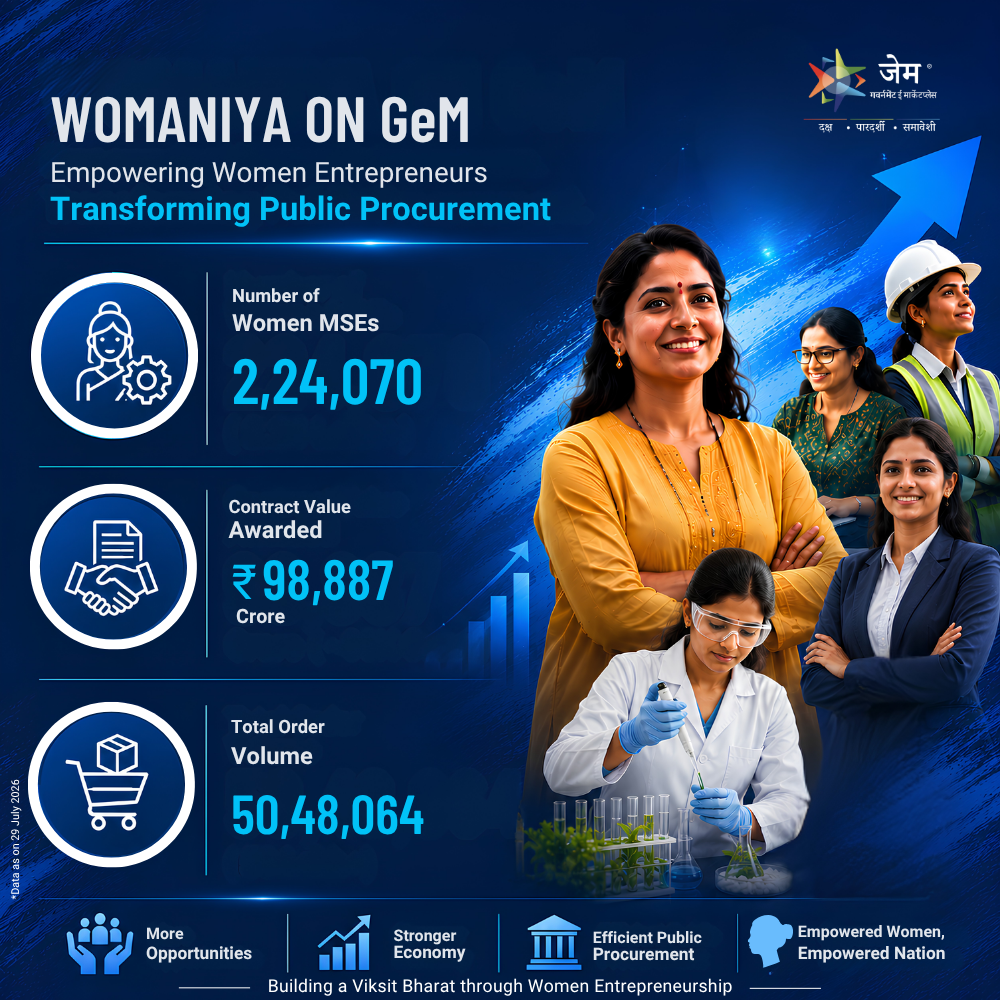
As the Government eMarketplace (GeM) marks its 10th Foundation Year, one of the most significant stories to emerge from its journey is the growing participation of women entrepreneurs in public procurement. Across sectors and geographies, women-led enterprises are moving beyond informal networks and local markets, stepping into scale, formalisation, and long-term sustainability. The capability was never in question; what has changed is the emergence of systems that recognise, enable, and accelerate their growth.Recognising the expanding influence of women entrepreneurs in India’s economic evolution, the Government e Marketplace (GeM) under the Ministry of Commerce and Industry introduced ‘Womaniya,’ an initiative that embodies resilience, ambition, and the transformative energy driving women-led enterprises. Across the country, business growth is no longer constrained by reliance on intermediaries or limited market access; instead, it can begin with a simple digital presence on GeM. From small home-based ventures to organised self-help groups operating at scale, this initiative serves as a direct bridge to public procurement, opening new avenues of opportunity. What emerges is a compelling shift where technology enables access, participation expands, and women entrepreneurs are not just entering the marketplace but actively redefining its scope and impact. The evolution of Womaniya mirrors GeM’s own evolution over the last decade. What began as an effort to make public procurement more transparent and efficient has steadily expanded into a platform that enables participation, inclusion, and opportunity at scale. The growing presence of women-led enterprises across the marketplace is among the clearest demonstrations of that transformation. From participation to presence: The growth of Womaniya on GeMThrough Womaniya, the Government e Marketplace (GeM) has become a powerful vehicle of transformation, directly linking women entrepreneurs with government buyers and bringing them into India’s formal public procurement ecosystem. Since its launch in January 2019, the initiative has witnessed steady and sustained growth, expanding from just 5,756 registered women sellers* in FY 2019–20 to over 2.24 lakh women-led enterprises by July 2026. This remarkable rise reflects increasing awareness, deepening trust, and consistent engagement, underscoring how Womaniya is not only widening market access but also reshaping the scale and scope of women’s participation in the country’s economic landscape.This participation has translated into tangible outcomes. Cumulatively, women-led Micro and Small Enterprises and Women Self-Help Groups have secured orders worth ₹99K crore, accounting for approx. 4.7% of GeM’s total order value1. This exceeds the mandated 3% procurement target, underscoring not only compliance but sustained engagement by women entrepreneurs within the public procurement ecosystem1.As GeM completes ten years of building a transparent and technology-driven procurement ecosystem, this achievement reflects more than growing transaction volumes. It demonstrates how public procurement can create pathways for economic empowerment by connecting capable entrepreneurs directly with market opportunities.Equally significant is the breadth of participation. Women-led enterprises on GeM are not limited to niche segments. They supply core products such as computers, sanitary products, recycled materials, and electrical and home appliances, while also maintaining a strong presence in service categories including manpower outsourcing, facility management, sanitation, transport, and consultancy services. With registrations spanning across all States and Union Territories, Womaniya reflects a truly pan-India footprint, integrating enterprises from urban centres, semi-urban regions, and rural economies into a single national marketplace.
Growth fuelled by Opportunity
Built to enable, designed to includeAt its core, Womaniya is designed to strengthen participation by reducing the structural barriers that often limit women-led enterprises. Built on GeM’s transparent and intermediary-free procurement framework, the initiative creates a focused pathway for women entrepreneurs to onboard, be discovered, and transact with confidence.Simplified onboarding through Udyam-GeM API integration enables faster entry for first-time and small sellers, while marketplace filters improve discoverability of women-led enterprises. Policy enablers such as reduced vendor assessment and transaction charges, exemption from caution money, and continued handholding further lower the cost and complexity of participation.Recognising that many women-led enterprises are rooted in traditional skills and local production, GeM has also specially categorised products such as handicrafts and handloom, jute and coir products, bamboo products, organic foods, spices, home décor, and office furnishings. These categories support ease-in-procurement while enabling women entrepreneurs to scale authentically into formal markets.Shaping a more inclusive procurement ecosystemWomaniya’s progress reflects a broader shift in how public procurement can support inclusive economic growth. By institutionalising direct access for women-led enterprises, Government e Marketplace has strengthened transparency, widened participation, and reduced reliance on intermediaries – aligning with national priorities such as Make in India and Viksit Bharat @2047, while advancing the larger goal of women-led development.As GeM celebrates its 10th Foundation Year, Womaniya stands as a powerful example of what happens when access is redesigned with inclusion in mind. The initiative has shown that women entrepreneurs do not need special markets; they need fair access to existing ones.Today, women-led enterprises are not merely participating in public procurement, they are helping shape it. And as the marketplace continues to grow, the journey from woman to Womaniya is becoming a story of confidence, capability, and opportunity for entrepreneurs across India.Reference/s:Disclaimer: This article has been produced on behalf of TCS by Times Internet’s Spotlight team.