
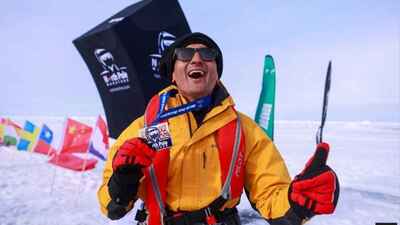
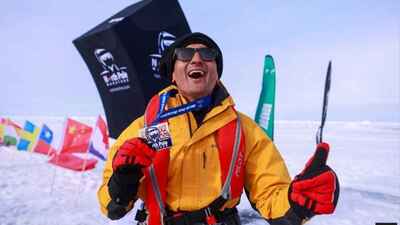
There are moments in life when you are so defeated by the events that you believe it is the end, the limit has been reached and there is nothing you could possibly do to change it. But if you survive these dark moments, you are able to realise just how beautiful and expansive life can be. When it comes to Ram Gopal Kothari, there was a time he was standing at a Kolkata metro station ready to end his life, but today, he is the first Indian to run a marathon at the North Pole.At 44, he runs Epic Assurance Services LLP, a business he built from scratch. But that’s not all. Ge recently became the first Indian to complete a marathon at the Geographic North Pole, running 42.2 kilometres across floating ice at 90 degrees north. “I do not believe in giving up on anything I do. The moment you give up, everything ends there. But if you take one more step, something always changes,” he said to The Better India.Behind this dedication is no inspiring Bollywood movie or fictional book, but a life lived by a man who was made wise by the experiences of life.
Beginnings in Kolkata
Born in 1981, Kothari grew up in Burrabazar, Kolkata in a modest home with an asbestos roof and shared facilities. Since there was no space inside, he mostly spent time outdoors on the streets. His father worked in a small clothing shop, earning enough to keep the household going, while his mother ensured that education continued. At the centre of the clan, was their grandmother whom he described as the emotional anchor of their family. “She always taught us to be kind, to stay patient, and to believe in something bigger than whatever hardship we were facing at that moment,” he said.Inspired, he would often wake up at 3 am to study before school, in order to excel in his education, revising the lessons from the day before. He eventually completed graduation from Bhawanipur Education Society College in Kolkata and was among the only few of his friends to do so. During that time, he was able to manage the fees for the first year, but later when the college increased the fee, the pressure on his family increased. He kept on requesting the college and eventually his fees got reduced to an amount that the family could manage. This became his earliest memories of persistence.
First job and hello to the world
Soon after completing his graduation in 2002, he stepped into his first job in the home loan sector. The role demanded higher expectations, had stringent routines and tied the outcomes directly to performance. His early assignments involved distributing pamphlets at airports and metro stations, a task that tested not just patience but also comfort levels. However, he stayed on till March 2008, learning the basics of sales, client interaction and the discipline required to survive in a target-driven environment. Over time, he became more stable in his role. He got married and became a father, and life briefly took on a predictable shape that felt like it might continue.In 2008, the recession hit loan-related businesses particularly hard and led to Kothari losing his job. “There were days when I did not know how to manage even basic expenses. It felt like everything around me was uncertain,” he said. He joined HDFC Standard Life in July, trying to rebuild without delay, but that phase did not last long. Within months, he moved out and took a difficult but necessary risk, starting a small clothing manufacturing business using a loan of four lakh rupees. By May 2009, the business had failed. Around that time, Cyclone Aila struck West Bengal, bringing incessant rain and strong winds that tore through the city. In the asbestos-roof space where he had set up his small operation, water seeped in, soaking the fabrics he had invested in and leaving them unusable.A relative later helped him re-enter the general insurance industry and for a short period, things improved. He worked long hours, rebuilt contacts and began regaining confidence. But in May 2011, he was again removed from the job. That moment became the lowest point of his life. One day, overwhelmed by pressure and exhaustion, he went to a metro station with the intention of ending his life. At that moment, his phone rang and it was his wife, Shipra Kothari. “I told him we will face everything together. We will survive this,” she said.“That call brought me back,” he added. “It did not solve anything immediately, but it stopped what was happening inside me, and gave me a lot of hope.”After that, he began again from scratch. He worked from cyber cafes, preparing insurance quotations manually and then travelled across neighbourhoods on foot to meet clients directly. On 22 May 2012, he formally established Epic Assurance Services LLP. It began as a small operation but celebrated the beginning of a long phase of rebuilding.
A slice of travel and life
As the business grew, he began travelling internationally. A trip to Dubai in 2013 changed his perspective on what life could look like beyond work. Over the years, he has travelled to 79 countries and seven continents, and that journey is continuing, led by a growing list of expeditions that include Antarctica, Greenland, Yakutia, and climbs such as Mount Kilimanjaro and Mount Elbrus.In 2018, a conversation about the Tata Mumbai Marathon led him to take part in it and he decided to try it for the first time. He had no formal preparation for it and no athletic background. After the event, he kept on running and participating in such events.After visiting Antarctica, he began thinking about reaching the North Pole. The idea slowly grew into participation in a marathon at 90 degrees North. He attempted it twice in 2023 and 2024, but both times the event was cancelled due to external conditions and logistical challenges. Finally, in July 2025, he travelled through Svalbard as part of an icebreaker expedition.On 13 July 2025, he stood at the Geographic North Pole. The marathon was conducted on floating ice, in repeated loops around a marked circuit, because a continuous route is impossible in that environment. The ice itself was unstable, shifting underfoot, and there was no fixed ground beneath.The race began at 8:45 am with the temperature hovering around minus eight degrees Celsius. He started strongly, managing the first set of loops with controlled pace but as the hours passed, the ice began to soften. Water started pooling in certain sections, turning parts of the circuit into slush. Every step required adjustment, as the surface beneath him alternated between hard ice and soft, sinking patches.“My shoes were filled with icy water, and at one point I could feel my feet going numb before sudden sharp pain set in as the cold shifted,” he said. By the 26th kilometre, conditions had changed considerably. The track near the cruise support area had become unstable, and runners were forced to carefully avoid sections where the ice was thinning. By the 42nd loop, exhaustion was no longer the main issue. It was pain from repeated cramps, combined with the mental strain of continuing in conditions that kept changing without warning.“I thought I might not finish, and there was a moment when stopping felt reasonable,” he admitted. But he continued moving forward and completed the marathon after 50 loops, finishing in approximately 2 hours and 45 minutes. With this, he became the first Indian to complete a marathon at the Geographic 90 degrees North Pole. “When I finished, I felt I had taken India there with me,” he said.