
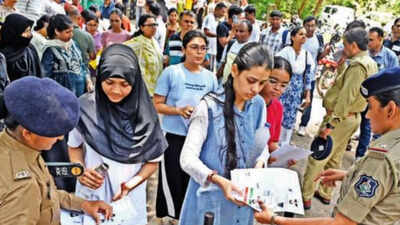
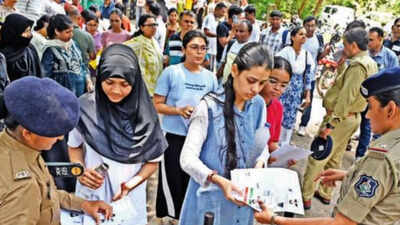
MUMBAI: A security guard stands at the gate of an exam centre in Mumbai. Inside, women staff frisk female candidates before letting them in.A doorframe metal detector marks the entrance. Computer terminals wait in disciplined rows. Invigilators watch for the smallest suspicious movement, as CCTV cameras record every second of the examination.Somewhere behind this elaborate machinery sits the question paper, delivered by a logistics firm.To a student entering the centre, it may appear to be a single examination. In reality, almost every part of it has been assembled by a different agency.India’s calendar is marked not only by seasons and festivals, but by examinations. On nearly every day of the year, except national holidays, somewhere in the country, a student or job applicant is being tested, and a future being decided.The scale is difficult to comprehend.An estimated 31.4 crore candidates registered for various govt recruitment exams in 2025, according to consulting firm Frost & Sullivan, and 38.3 crore registered for academic exams.
Pieces Of A Puzzle
India’s examination system is a vast, fragmented enterprise that increasingly resembles a jigsaw puzzle assembled in the dark. And the final picture of how an exam is pieced together is rarely visible to students, parents and educators.In India, unlike China, what appears to be a public examination is often delivered through a long chain of private contractors.One company may operate the exam centres. A second may provide the computers, servers and testing software.Manpower aggregators may recruit smaller agencies to supply invigilators, security personnel, frisking staff and technicians. Each contractor performs one part of the examination.Yet, no single participant may fully control the whole.Until recently, India had no clearly articulated national norms governing which service provider could undertake which part of the process.That began to change in April, when a handbook of standards was released.The handbook recommends that exam-conducting agencies, exam security providers and content providers operate independently of one another.Facility management, however, may either be handled by a separate service provider or combined with the responsibilities of the exam-conducting or security agency, depending on operational requirements.
Decentralising Power
Separating the creation of the question paper, the administration of the examination and the security of the centre can prevent too much power from being concentrated in one place.Each layer can watch the others. Conversely, each layer can also create greater distance between authority and responsibility.The agency that hires the guards may not operate the computers.The company managing the centre may not control the exam software. The institution conducting the test may not directly supervise the people interacting with candidates.This fragmentation matters most when something goes wrong: a computer crash, a malfunctioning server, mistreatment of candidates during frisking, and the like. Whom does one hold responsible?In each case, accountability may travel from one contractor to another, through agreements, subcontracting arrangements and service-level clauses.“With so much sub-contracting, no one gets to know if a firm defaulted in a previous exam,” a source says.
Checks And Balances
Yet, the same fragmentation can also produce checks and balances, argues Ashish Mittal, founder and director of Innovatiview, which supplies examination security equipment.In 2024, Innovatiview secured 735 examinations across India, monitored 44,045 venues and covered examinations involving 3.5 crore candidates, Mittal said. Its systems also processed more than 4.4 crore biometric scans.Those numbers reveal not only the scale of the examination economy, but also the infrastructure required to sustain it.Innovatiview is now constructing examination centres in several states after concluding that India does not have enough dedicated seats to conduct large computer-based exams.The largest provider of computer-based testing venues is currently TCS, which uses a combination of its own TCS iON facilities and other smaller centres operating from multipurpose buildings.The shortage of reliable exam infrastructure creates another vulnerability. A testing venue may appear to be a secure, technologically controlled environment, but it still depends on people hired locally: centre managers, guards, invigilators, technicians and temporary staff.And people are the most difficult part of the system to standardise.“The manpower agencies are the biggest loopholes,” said the vice-chancellor of a group of universities that conducts a computer-based entrance exam.“We have seen paan sellers and thela waalas being supervisory roles for high-stakes exams,” said Abhay Jere, former vice-chairman of the All India Council for Technical Education and CEO of Dexit Global, a digital exam agency.The re-NEET 2026 was compromised at a centre in Lakhisari, Bihar, where apart from dummy candidates, biometric staff members, supervisors and other operators were arrested.“Undertrained, unsupervised invigilators are India’s most consistent point of failure,” said Jere. Rajat Moona, the director of IIT Gandhinagar , said exams used to be run out of schools, and teachers took up supervision and the role of invigilators.“Today’s exam supervisors are 23-25-year-olds who are employees of companies that run the exam venue. They don’t come with the maturity of teachers,” he said.
New Problems, New Solutions
Threats are no longer limited to candidates carrying handwritten notes into the examination hall.“They have cameras in spectacles, in their pens. The idea is to stop communication and so, year, for JEE (Advanced), we scanned students for electronic devices, machines that can tell if there are any wi-fi or Bluetooth waves,” Moona explained.Unfortunately, ‘large gangs’ now study the examination system with the same attention that authorities devote to protecting it.The vice-chancellor described one such operation uncovered through conversations with first-year students. Gangs, he said, work to compromise exam centres from within.“They may bribe a centre in-charge, a faculty member or a security employee to smuggle a mobile phone into the premises. Candidates then enter wearing Bluetooth devices so small that they need to be injected into the ear, and ordinary frisking cannot detect them.”Once the candidate gains access to the concealed phone, the integrity of the entire examination can collapse.The case came to light not because the security system detected the breach, but because the financial arrangement behind it failed. The candidate qualified and then allegedly refused to make the promised payment.Exam-conducting authorities operate independently, and there is no shared infrastructure, no common benchmark, and institutional memory. Vendors migrate across agencies without accountability.And that is the central paradox of an outsourced exam. The process may be monitored extensively, yet accountability can remain invisible. Every candidate is watched, every movement recorded, every entry point guarded.But when the system itself fails, identifying who was responsible may prove difficult, said an IIT director who said they are against outsourcing exams to private agencies.
‘An Outsourcing Of Trust’
Questions, however, remain. Can a system claim integrity merely because it has cameras, computers and metal detectors? Must it also not possess a clear chain of command, enforceable standards and an accessible mechanism through which candidates can seek redress?“We have to alter the way we conduct exams,” said Moona. “No single private enterprise can have the infrastructure or manpower to conduct exams at the scale we have in India. So, either we go back to schools or start bucketing the exams in a way that an exam can be taken any time of year.”The danger is compounded when companies found unfit in one jurisdiction continue to get work elsewhere.A parliamentary committee reported in 2025 that some firms involved in setting question papers, administering exams and evaluating responses had been blacklisted by one organisation or state govt, only for them to secure contracts from another.One exam contractor, Confisec Pvt Ltd, resurfaced as Edutest Solutions Pvt Ltd after an earlier paper-leak controversy and continued securing govt examination contracts.Rajasthan investigators identified another firm that allegedly rebranded itself as Rabhav Ltd after being barred in UP. Despite getting blacklisted, companies like Eduquity, Satvat Infosol, Aptech kept bagging contracts to conduct exams.The committee said such companies should not be engaged by the National Testing Agency or state govts. It recommended the creation of a nationwide register of blacklisted firms, along with details of the people and entities associated with them, so that disqualified operators could not simply return under another name.“Such a register would be an elementary safeguard,” Jere said.But it would also acknowledge a larger truth: the exam system cannot depend on each institution discovering the same unreliable contractor separately, after the damage has already been done.Ultimately, an exam is an act of public trust, which may determine admission to a university, a profession, a govt job, a future. But the State, in outsourcing buildings, computers, surveillance equipment and manpower, “is outsourcing its obligation to ensure fairness to India’s youth,” said the IIT director.