
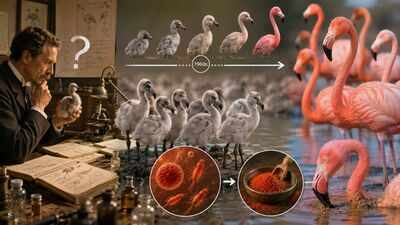
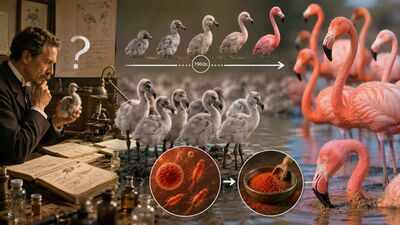
For centuries, flamingos were recognised by their vivid pink feathers, yet the reason behind that striking colour remained uncertain. Early naturalists could describe what they saw, but they could not explain why young flamingos emerged from the nest in muted shades before gradually becoming brighter as they matured. The answer only began to take shape during the middle decades of the twentieth century, when advances in chemistry and bird physiology allowed scientists to follow pigments through an animal’s body. By the 1960s, a long-standing puzzle had largely been resolved. Flamingos were not born pink, nor did their feathers naturally produce the colour. Their appearance depended on what they ate and on an unusual ability to transform pigments obtained from their food.
The 1940s–1960s research that explained why flamingos are pink
The turning point came through a series of investigations led by biochemist Dennis L. Fox and colleagues between the 1940s and the 1960s. Instead of treating flamingo feathers as a curiosity, they examined the pigments themselves, identifying the compounds responsible for the birds’ distinctive colouring.According to the study published in ResearchGate, titled “Flamingo colouration and its significance,” Fox’s studies were among the earliest to explain how flamingos obtain their colour and remain the foundation for much of what is known about the subject today.Those experiments revealed something unexpected. Flamingos did not manufacture pink pigment from scratch. Like most animals, they relied on carotenoids, naturally occurring pigments produced by plants, algae and certain microorganisms. The birds absorbed these compounds through their diet before converting some of them into different carotenoids that eventually accumulated in feathers, skin and bills.The findings explained why captive flamingos sometimes became noticeably paler when their food changed. Without a steady dietary supply of carotenoids, their bodies gradually exhausted existing pigment reserves.
Why flamingos turn pink after eating carotenoid-rich food
The idea that flamingos are coloured by their diet is now widely accepted, but it emerged only after controlled feeding experiments demonstrated the relationship directly.According to the Smithsonian’s National Zoo, flamingos obtain their pink colouring from carotenoid pigments found in microscopic algae and in animals such as brine shrimp that feed on those algae. As flamingos consume this food, the pigments are metabolised and gradually deposited into their feathers, producing shades that range from pale pink to deep coral depending on diet.The longer-term scientific evidence fits that explanation. Amat and Rendón note that carotenoids cannot normally be produced by animals themselves, meaning flamingos must acquire them through food before either storing them or chemically modifying them into other pigments.Young birds provide another clue. Newly hatched chicks begin life with white-grey down before developing darker juvenile plumage that contains melanin rather than carotenoids. The familiar pink colouring only appears later as immature birds begin eating independently and gradually accumulate dietary pigments over several years.
Why different flamingo species have different shades of pink
Scientists realised that different flamingo species do not all rely on the same carotenoids, suggesting that habitat and available food influence which pigments become dominant.Flamingos possess an efficient metabolic system that converts dietary carotenoids into compounds such as canthaxanthin and astaxanthin. These pigments are relatively resistant to bleaching from sunlight, an advantage for birds that spend much of their lives in exposed wetlands. The authors also suggest that species living at high altitudes tend to contain greater amounts of certain carotenoids than relatives inhabiting lower wetlands, possibly because stronger ultraviolet exposure favours more stable pigments.That work transformed the discussion from a simple question of colour into a broader investigation of ecology, evolution and physiology. The shade of a flamingo was no longer viewed as a decorative feature but as the visible outcome of diet, metabolism and environment working together.
Why flamingos’ pink colour is important for survival, breeding and evolution
Scientists have continued building on the discoveries made during the mid-twentieth century. Once the chemical origin of flamingo colour had been established, researchers began asking why those bright feathers mattered.As per the study, adult plumage serves as a link with breeding, helping birds advertise their parental quality when choosing mates. Flamingos can intensify their appearance by spreading carotenoid-rich secretions from the uropygial gland across their feathers, effectively refreshing their colour between moults.That later work builds directly upon the discoveries made between the 1940s and the 1960s. The central mystery had already been answered: flamingos do not hatch pink, and they do not manufacture their famous colour independently. Their appearance begins with pigments acquired from food, processed through specialised biology and displayed in feathers that reveal far more than simple colour alone.