
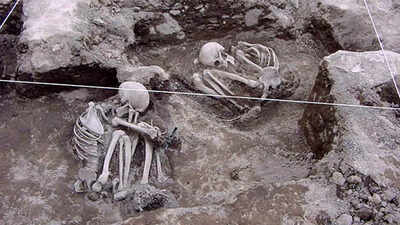
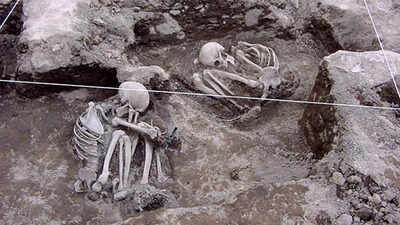
When people hear about human sacrifice in ancient Mexico, the Aztecs and their dramatic rituals usually steal the show. Giant pyramids, skull racks, and tales of heart-extracting ceremonies fill popular imagination. But history is always more layered.However, a fresh archaeological find near the old Toltec city of Tula now reminds us these rituals didn’t start with the Aztecs — they stretch back centuries further.
The history of human sacrifice : What we know now
Per Science Alert, archaeologists have revealed a nearly 1,000-year-old ceremonial altar tied to the Toltec culture, complete with human skulls, femur bones, obsidian knives, and other offerings. This discovery not only strengthens the case that the Toltecs practiced ritual sacrifice, but also shows that the Aztecs picked up and reshaped religious traditions that were already well established across Mesoamerica.The altar turned up during a rescue excavation linked to railway construction near Tula (present-day Hidalgo, Mexico), once the Toltec capital (roughly AD 900-1150). At the center of the site stands a stepped, square structure called a momoztli (about one meter across) carefully built from quarry stones and river rocks. Scattered nearby, archaeologists found four human skulls (one still attached to neck vertebrae), several femurs, ceremonial bowls, obsidian blades, and fragments of other ritual items.The placement and condition of these bones suggest ritual killing, not simple burial. One skull still had its cervical vertebrae attached, possibly pointing to decapitation. Researchers plan to analyze the bones for cut marks from obsidian or flint blades, which would be the telltale scars of ceremonial sacrifice.According to Science Alert, archaeologist Víctor Francisco Heredia Guillén of the National Institute of Anthropology and History (INAH) in Mexico explained, “We assume that these were either rooms or part of an elite context, or for groups of higher rank, remains of palaces that may have existed on the site.”
Why does this discovery matter?
This isn’t just a sensational find; it deepens our understanding of how human sacrifice predates the Aztecs by hundreds of years. While the Aztecs became infamous for large-scale, state-sponsored sacrifices, archaeological evidence now shows earlier civilizations (the Olmec, Maya, and Toltecs among them) practiced their own versions, sometimes at a smaller scale or in different ceremonial settings.The Toltecs were famous for their architecture, artistry, and military prowess, with their influence sweeping across much of Mesoamerica. Their capital, Tula, was a showpiece of monumental pyramids, towering warrior statues (the “Atlantes”), public plazas, and sophisticated urban planning. Later, the Aztecs admired the Toltecs so much they claimed to be their heirs, importing elements of Toltec culture and religion into their own.That’s why this altar is such a big deal. It gives us solid evidence that the Aztecs weren’t inventing these ideas out of thin air—they were inheriting and adapting older traditions.Of course, not every culture or era practiced sacrifice in exactly the same way. The Aztecs’ massive, highly organized ceremonies were unique for their scale and political purpose. Earlier societies probably followed different rituals and had their own religious frameworks. This new Toltec altar offers a rare window into those distinctions.And the discoveries go beyond just the altar. Archaeologists found walls, floors, and signs of what looks like a courtyard — all the clues that this was part of a larger settlement just outside Tula’s main core. These details are helping to fill in the everyday world of the Toltecs, showing how regular life and sacred rituals lived side by side.
What’s next?
Work is ongoing as researchers study the bones and artifacts, hoping to learn more about who these sacrificed people were and what their deaths meant to the Toltecs. What’s clear already? The Aztecs might have taken human sacrifice to new and frightening heights, but they were just the latest chapter in a much older, evolving Mesoamerican tradition: one shaped by each culture’s own history, beliefs, and needs. This discovery nudges us to see the ancient world not as a series of headlines, but as an ongoing, deeply human story.