
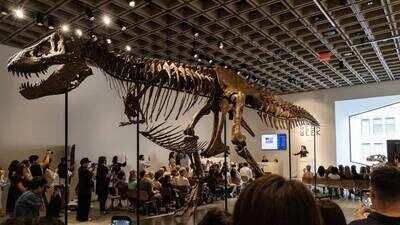
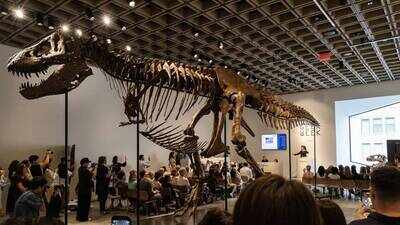
A Tyrannosaurus rex fossil nicknamed “Gus” has made history after selling for a staggering $50.1 million at a Sotheby’s auction in New York, setting a new record as the most expensive dinosaur fossil ever sold.The 67-million-year-old skeleton surpassed the previous auction record held by the stegosaurus “Apex,” which sold for nearly $45 million in 2024. It also overtook “Stan,” a famous T. rex skeleton that fetched nearly $32 million in 2020.
One of the largest and most complete T. rex fossils ever found
According to Sotheby’s, Gus is a 38-foot-long (11.5-metre) Tyrannosaurus rex and one of the largest and most complete specimens ever discovered.The adult dinosaur stands around 12.5 feet (3.8 metres) tall and is 63 per cent complete, with those preserved bones accounting for an estimated 75 to 80 per cent of the animal’s total mass. Among its most impressive features are an exceptionally preserved skull with its powerful jaws and teeth, two well-preserved feet and several rarely found bones, including a furcula, or wishbone.
Discovered almost by chance in South Dakota
Gus was discovered in 2021 on a ranch in South Dakota after a fossil-hunting team decided, almost on a whim, to spend a couple of days exploring a different area after wrapping up another excavation nearby.Remarkably, the first fossil they uncovered, a metatarsal bone from the dinosaur’s foot, appeared just hours into the search.What followed was a painstaking five-year excavation, mapping and restoration project, during which nearly 1,000 individual fossil pieces were recovered, catalogued and carefully reassembled by hand.Once the restoration was complete, Gus was mounted on a custom-built support frame inside one of the few buildings large enough to accommodate its enormous size, a local pickleball court.
Named after the ranch owner
The fossil was named after Gary Licking, the ranch owner on whose land it was found.Sadly, Gary died before he could see the fully restored dinosaur. His widow, Dana Licking, has remained closely involved with the project, and the excavation team has continued to share major milestones and newly restored parts of Gus with her throughout the process.
Sotheby’s calls it an exceptional specimen
Cassandra Hatton, Sotheby’s vice chair, said the record-breaking sale reflected the fossil’s extraordinary quality.“Gus is not only an exceptional find, but a specimen that’s been excavated, documented, prepared, and cared for with real excellence,” she said.“The market responds when great specimens are taken care of in the right way.”Before the auction, the fossil had been expected to fetch between $20 million and $30 million, making the final sale price far higher than pre-sale estimates.The winning bidder, whose identity has not been disclosed, outbid six other prospective buyers during an intense 10-minute bidding battle.At one point, auctioneer Phyllis Kao playfully urged bidders to increase their offers, saying, “Try a bigger bite. It’s a T. rex, after all.”
Scientists hoped it would end up in a museum
Not everyone celebrated the sale.Ahead of the auction, the Society of Vertebrate Paleontology urged that scientifically important fossils like Gus should remain in public museums and research institutions where they can continue to be studied.“The discovery of an important fossil is only the beginning of its scientific story,” said the society’s vice president, Kristina Curry Rogers.She noted that many groundbreaking discoveries have come years or even decades after fossils were first excavated, as advances in technology have allowed scientists to answer entirely new questions using museum collections.
A dinosaur icon
Tyrannosaurus rex, whose name translates to “King of the Tyrant Lizards,” ruled western North America during the Late Cretaceous period around 67 million years ago.With its enormous jaws, fearsome bite and famously tiny arms, the predator has become one of the world’s most recognisable dinosaurs, inspiring everything from the Jurassic Park franchise to children’s television shows.Whether Gus ultimately ends up in a private collection or on public display remains unknown. But after fetching a record $50.1 million, the giant predator has firmly secured its place as the world’s most valuable dinosaur fossil ever sold.