
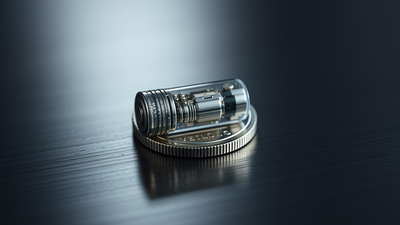
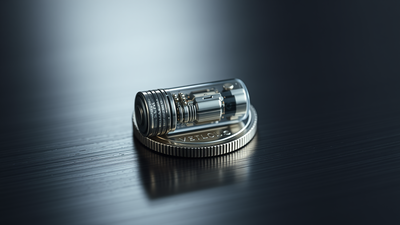
A Chinese company has unveiled a battery smaller than a coin that its makers say can generate steady electricity for fifty years without ever needing to be charged or replaced. The device, called the BV100, comes from Beijing-based Betavolt New Energy Technology and works by harnessing the natural decay of a radioactive isotope rather than storing chemical energy the way conventional batteries do. While the BV100 itself produces only a tiny amount of power, its underlying technology points toward a much bigger idea, betavoltaic batteries capable of powering small devices reliably for years or even decades at a stretch, addressing one of the most persistent limitations of modern electronics, the need to constantly recharge or replace a power source.
How Betavolt ‘s nuclear battery generates electricity without charging
According to World Nuclear News, the industry publication run by the World Nuclear Association, Betavolt’s battery combines nickel-63 nuclear isotope decay technology with what the company describes as China’s first diamond semiconductor module, placing a two-micron-thick sheet of nickel-63 between two ultra-thin diamond semiconductor converters. As the nickel-63 decays, it releases fast-moving electrons, and the diamond semiconductor layers capture and channel this energy into a usable electric current, a process broadly similar in principle to how a solar panel converts photons of light into electricity rather than relying on any kind of chemical reaction.
Why was nickel-63 chosen as the power source
The choice of nickel-63 as the radioactive material at the heart of the battery was a deliberate safety decision rather than an arbitrary one. According to World Nuclear News, the isotope decays into a stable, non radioactive form of copper, meaning that once the nickel-63 has fully decayed, the resulting material poses no ongoing radiation risk or environmental contamination concern. Nickel-63 has a half life of approximately one hundred years, and the isotope emits comparatively low energy radiation that can be shielded by very thin layers of material, a property that has made it a common choice in earlier experimental betavoltaic battery designs going back decades before Betavolt’s own product emerged.
What the BV100 can and cannot actually do
The BV100 measures just 15 by 15 by 5 millimetres, smaller than a typical coin, and generates 100 microwatts of power at 3 volts, according to the specifications Betavolt has published. That is a genuinely tiny amount of electricity, nowhere near enough to charge a smartphone, which typically requires several watts of power, but it is well suited to low power applications such as medical implants, environmental sensors and small tracking devices that need a small, constant and highly reliable source of energy over very long periods without maintenance. Betavolt has said its batteries are modular, meaning multiple units can be combined in series or parallel to scale up total power output for applications that need more than a single module can provide on its own, and the company has stated plans to eventually release higher powered versions using different isotopes.
How this compares to an even longer lasting prototype
Betavolt’s fifty year battery is not the only project of its kind making headlines recently. According to LiveScience’s reporting on a separate project, scientists at the University of Bristol in the United Kingdom have built a prototype nuclear diamond battery using carbon-14 instead of nickel-63 as its radioactive source, a material chosen specifically because it emits very short range radiation that is absorbed almost immediately by the surrounding solid diamond material, minimising any concern about radiation exposure. Carbon-14 has a half life exceeding five thousand years, dramatically longer than nickel-63, meaning a battery built around this isotope could theoretically continue producing usable power for a period measured in thousands rather than tens of years, though the Bristol team’s device remains a research prototype rather than a commercially available product like Betavolt’s BV100.
Why long lasting nuclear batteries are not entirely new technology
Despite how novel these developments sound, the fundamental idea of a nuclear battery is far from new. According to World Nuclear News, betavoltaic batteries of various kinds have existed since the 1950s, historically built as radioisotope thermoelectric generators that convert heat released by decaying radioactive material into electricity through a thermocouple, technology that has long been used to power spacecraft, satellites and other equipment operating far from any conventional power grid. What sets recent developments like Betavolt’s diamond semiconductor design apart is the successful miniaturisation of this decades old principle into a form small and stable enough for potential everyday consumer and medical applications, something earlier nuclear battery designs, often bulky, expensive and reliant on more hazardous isotopes such as plutonium, were never realistically able to achieve.
Why this technology remains a long way from powering everyday devices
Even with genuine technical progress behind them, both Betavolt’s commercial battery and the University of Bristol’s carbon-14 prototype remain far from replacing the lithium-ion batteries found in most everyday consumer electronics. The amount of power these devices currently produce is simply too small for anything beyond very low power applications, and scaling up output while keeping the technology safe, affordable and suitable for mass production remains a genuine engineering challenge still being worked through. For now, the most realistic near-term uses for this technology lie in specialised fields like medical implants, aerospace equipment and remote sensors, applications where an extremely long-lasting, low-maintenance power source matters far more than raw power output, offering a glimpse of where nuclear battery technology may be headed even as it remains many steps away from ever charging a phone.