
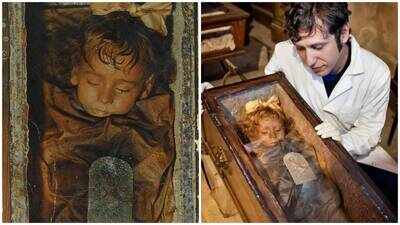
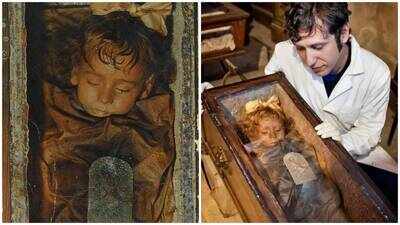
More than 100 years after her death, Rosalia Lombardo continues to captivate the world. Preserved inside a glass coffin in the Capuchin Catacombs in Palermo, Sicily, the two-year-old girl looks so lifelike that many visitors believe she is merely asleep. Nicknamed the “Sleeping Beauty of Palermo” and often described as the world’s most beautiful mummy, Rosalia has become the subject of documentaries, scientific research and internet myths, particularly the long-standing claim that she opens and closes her eyes.But behind the haunting images and viral videos lies a heartbreaking story of a grieving father’s love, a revolutionary embalming technique and a scientific explanation that finally solved one of history’s biggest preservation mysteries.
A life cut short during the Spanish flu pandemic
Rosalia Lombardo was born in Sicily in 1918 into a wealthy family. Her life was tragically cut short in 1920 when she died of pneumonia caused by the Spanish flu pandemic, one of the deadliest outbreaks in modern history.Devastated by the loss of his daughter, her father Mario Lombardo turned to Alfredo Salafia, one of Sicily’s most renowned embalmers and taxidermists. Historical accounts suggest Mario had one request for Salafia — preserve his daughter so she could remain exactly as she was.More than a century later, Rosalia’s skin remains smooth, her blonde hair is still tied neatly with a ribbon and her peaceful facial expression has barely changed, making her one of the best-preserved mummies ever discovered.
The embalming formula that remained a secret for decades
For nearly 80 years, nobody knew how Alfredo Salafia achieved what many experts considered impossible.The mystery remained unsolved until 2009 when Italian paleopathologist Dario Piombino Mascali tracked down Salafia’s surviving relatives and uncovered the embalmer’s handwritten notes.According to Piombino Mascali’s research, Salafia injected Rosalia’s body with a carefully prepared mixture of formalin, glycerin, alcohol, salicylic acid and zinc salts.Each ingredient played a specific role. Formalin destroyed bacteria responsible for decomposition, alcohol dried the tissues, glycerin prevented excessive dehydration and salicylic acid stopped fungal growth.The most important ingredient, however, was zinc. Melissa Johnson Williams, executive director of the American Society of Embalmers, told National Geographic that zinc effectively petrified Rosalia’s body, helping preserve her remarkable appearance for more than a century.The discovery finally solved one of the greatest mysteries in the history of embalming and highlighted how far ahead of his time Salafia was.
Why people think Rosalia opens her eyes
One of the biggest mysteries surrounding Rosalia is the belief that she opens and closes her eyes throughout the day.For decades, visitors to the Capuchin Catacombs have claimed to witness the little girl’s eyelids moving. Time-lapse photographs circulating online appeared to support those claims, earning her the nickname “the blinking mummy.”The story soon spread across the internet, with many believing the preserved child displayed unexplained paranormal activity.However, scientists say there is a much simpler explanation.According to ScienceAlert, Dario Piombino Mascali concluded that the apparent movement is an optical illusion caused by changing daylight entering the catacombs.He explained that Rosalia’s eyelids have never been completely shut. As sunlight filters through the side windows at different angles during the day, shifting shadows create the illusion that her eyes are opening and closing.His findings debunked one of Sicily’s most enduring legends while offering a scientific explanation for a mystery that had fascinated visitors for generations.
Preserved for future generations
Although Rosalia’s body remained remarkably intact for decades, experts later became concerned that humidity, oxygen, bacteria and changing temperatures could eventually damage the remains.To ensure her long-term preservation, she was placed inside a specially designed nitrogen-filled glass chamber that protects the body from light, oxygen and environmental changes.According to Piombino Mascali, the protective enclosure has significantly slowed deterioration and will help preserve Rosalia for future generations.
Why Rosalia still fascinates the world
Rosalia Lombardo was among the final people buried inside the Capuchin Catacombs before they were closed to new burials. The underground cemetery contains more than 8,000 mummified bodies dating back to the 16th century, including monks, priests, nobles and wealthy citizens.Yet none has become as famous as the little girl whose grieving father wanted her memory to live on.Today, Rosalia continues to attract historians, scientists and tourists from around the world. Her story has inspired books, documentaries and scientific research, while her extraordinary preservation remains one of the greatest achievements in the history of embalming.Although stories about the “blinking mummy” continue to circulate online, researchers say Rosalia’s real legacy lies not in myth but in the remarkable combination of a father’s love, pioneering science and historical preservation. More than a century after her death, she remains one of the world’s most fascinating historical figures, reminding visitors that some of history’s greatest mysteries are ultimately explained not by the supernatural, but by science.