
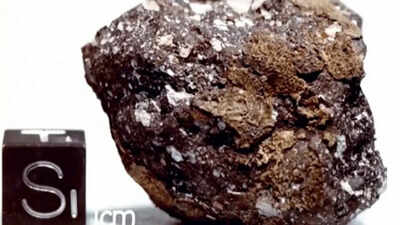
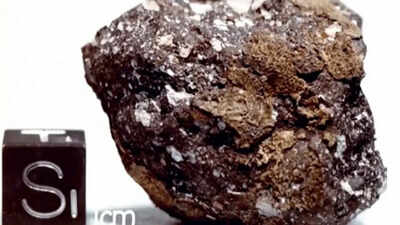
BENGALURU: Nearly three years after Chandrayaan-3 made history by landing in the Moon’s south polar region, scientists have found that soil studied by its Pragyan rover closely matches the chemical makeup of the first meteorite ever confirmed to have come from the Moon.The finding links measurements taken at the mission’s “Shiv Shakti Statio” with “ALHA 81005”, a meteorite found in Antarctica’s Allan Hills region during a 1981-82 expedition. ALHA 81005 was the first meteorite ever officially recognised as being of lunar origin.The study was carried out by scientists at the Physical Research Laboratory (PRL) — Dwijesh Ray, Rishitosh K Sinha, Santosh V Vadawale, M Shanmugam and Anil Bhardwaj — and has been published in the journal npj Space Exploration.Researchers compared data from Pragyan’s Alpha Particle X-ray Spectrometer (APXS) against 66 lunar meteorites recovered on Earth. Of these, ALHA 81005 turned out to be the closest chemical match, with both samples sitting in an unusual compositional zone between two major lunar rock families — the aluminium-rich “ferroan anorthosites” and the denser “Mg-suite” rocks.The numbers illustrate just how close the match is. Isro’s data shows Shiv Shakti statio soil contains about 26.1 per cent aluminium oxide, compared with 25.8 per cent in ALHA 81005 — both notably lower than the roughly 29.6 per cent typical of the Moon’s highland terrain.Conversely, the combined iron-and-magnesium-oxide content at the landing site (14.4 per cent) is close to the meteorite’s 13.7 per cent, and nearly double the highland average of about 8.15 per cent. Isro was careful to note that this doesn’t mean the meteorite physically originated at the Chandrayaan-3 site. Rather, it shows that both represent the same broad category of magnesium-rich material from the Moon’s crust.The APXS instrument recorded the soil’s elemental makeup after Chandrayaan-3’s landing on Aug 23, 2023, finding less aluminium and more iron and magnesium than is typical of highland regions elsewhere on the Moon.According to the study, the landing site’s soil appears to be a blend of material from different depths of the lunar crust — not just the upper layer, but also magnesium-rich rock likely dragged up from far below the surface.Scientists believe this deeper material may have been thrown up during the formation of the South Pole-Aitken (SPA) basin, one of the largest impact craters in the solar system, roughly 350 km from the landing site.The impact that created it billions of years ago could have excavated material from deep within the Moon and scattered it across the surrounding terrain, including the area Chandrayaan-3 later explored.The results also support earlier Chandrayaan-3 findings backing the Lunar Magma Ocean hypothesis, which holds that the young Moon was once covered by a vast ocean of molten rock. As it cooled over time, different minerals crystallised out to form the layered crust and interior structure seen today.By tying a specific site on the Moon to a meteorite recovered on Earth, researchers say the study offers a new way to connect lunar samples on our planet with actual locations on the Moon’s surface — potentially aiding future missions in identifying where meteorites and returned samples originate.Isro said the discovery opens fresh opportunities to understand how the Moon’s ancient crust took shape over billions of years.