


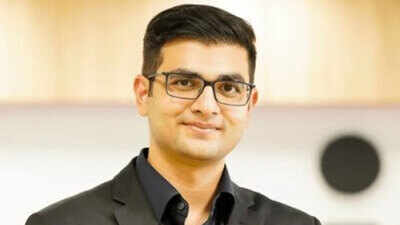
Long before high-speed internet and AI tools became part of students’ daily lives, learning often depended on whatever books were available. For one boy growing up in a small village in Karnataka, there was no internet connection, no smartphone and no YouTube videos to answer questions about space. There were only encyclopaedias his father brought home and an imagination that refused to stop asking questions.That boy was Awais Ahmed. Today, the satellites built by his company, Pixxel, are orbiting Earth, helping detect crop stress, methane leaks, industrial pollution and environmental changes that ordinary satellites often fail to capture. What began with childhood curiosity has grown into one of India’s most celebrated space technology startups.
When curiosity had to replace the internet
Awais Ahmed grew up in Aldur, a village in Karnataka’s Chikkamagaluru district, nearly five hours from Bengaluru. Internet access arrived only when he was in Class 8, meaning most of his childhood was spent learning the old-fashioned way.His father recognised his fascination with space and regularly brought home encyclopaedias on galaxies, planets and the universe. Those books became Awais’s window to a world he could not explore online.By the time he reached college, that curiosity had evolved into ambition.At BITS Pilani, where he studied Mathematics, Awais joined Team Anant, the institute’s student satellite programme in collaboration with ISRO. He also became the engineering lead of Hyperloop India, one of the finalist teams in the SpaceX Hyperloop Pod Competition.Rather than spending an additional year to complete a dual degree, he chose a different path—building a company he believed could transform satellite technology.
The problem no satellite could solve
In 2018, Awais and his BITS Pilani batchmate Kshitij Khandelwal were participating in the IBM Watson AI Challenge. Their project required highly detailed satellite imagery to predict crop health.The data simply did not exist.Conventional satellites capture Earth in only a limited number of broad spectral bands, making it difficult to detect subtle changes invisible to the human eye. Problems such as early crop disease, methane leaks, illegal mining or industrial pollutants often remain unnoticed until significant damage has already occurred.Instead of accepting the limitation, the two students decided to solve it themselves.Using money borrowed from Awais’s father and living on around Rs 10,000 a month, they founded Pixxel in February 2019 while still in their early twenties.
From a student startup to a company backed by global investors
What started as an ambitious college idea has since become one of India’s biggest private space success stories.Pixxel has raised around $95 million from investors including Google, Radical Ventures and Lightspeed, making it the world’s highest-funded hyperspectral imaging company.In 2025, the company successfully launched all six of its Firefly satellites into orbit. Unlike conventional satellites, Pixxel’s constellation captures Earth in more than 250 spectral bands at a five-metre resolution, producing around 50 times more spectral information than traditional Earth observation systems.The technology has practical applications that extend far beyond space exploration. It can help farmers detect crop stress weeks before visible damage appears, identify methane leaks from energy infrastructure, monitor illegal mining activities and track pollutants entering rivers and lakes.Pixxel’s rapid rise has also earned international recognition. TIME included the company among its 100 Best Inventions of 2023, while the World Economic Forum named it a Technology Pioneer in 2024. In the same year, Pixxel became the first Indian space startup to secure a contract with NASA and also signed a five-year agreement with the US National Reconnaissance Office.For Awais, the journey has brought personal recognition as well. He has featured in Forbes 30 Under 30, MIT Innovators Under 35 and Fortune India’s 40 Under 40, while his co-founder Kshitij Khandelwal has also been recognised in the Forbes 30 Under 30 list.For students, however, the most remarkable part of the story lies elsewhere. Awais Ahmed did not grow up surrounded by cutting-edge technology. He grew up surrounded by books, questions and curiosity.His journey is a reminder that while technology can accelerate learning, it is curiosity that often starts it. Sometimes, an encyclopaedia in a small village can inspire an idea that eventually reaches space.