
About an hour’s drive southwest of Chicago, in the coal-mining spoil heaps of northern Illinois, lies one of the most important fossil sites on the planet. Mazon Creek doesn’t look like much from the surface, a stretch of land across more than 250 locations between the city of Morris and the village of Essex. But beneath it, locked inside iron carbonate nodules that formed roughly 309 million years ago, is an entire Palaeozoic ecosystem preserved in extraordinary detail: soft tissues, scales, internal organs, and now, in a discovery published in the journal Science, the babies of creatures that represent some of the very first vertebrates to walk on land. Those babies have just overturned a foundational assumption about how life made the transition from water to earth, one that has been taught for over 150 years.
What Mazon Creek preserves and why it matters for evolutionary science
Most fossil sites preserve hard material, such as bones, teeth, and shells. Mazon Creek preserves the impossible. The ironstone concretions that form here trap entire organisms before decay can begin, capturing soft tissue, skin, and in the case of some specimens examined in the new study, abdominal yolk still visible inside hatchlings that died within days of emerging from the egg. This level of preservation is what made the site so valuable to the Field Museum researchers who led the study, Dr Arjan Mann, the museum’s assistant curator of early tetrapods, and Jason Pardo, a research associate at the same institution.Mann first encountered the baby embolomere fossil that became central to the study nearly a decade ago, when a predecessor pulled it out of a drawer in the Field Museum’s collections during a visit. He spent the years since tracking down additional specimens from both public museum archives and private collections built up by amateur fossil hunters who have combed the Mazon Creek spoil piles for decades. The new paper, Mann told AFP, is partly a tribute to that community. As he described it, it is a love letter to the amateur scientists whose patient, decades-long work made high-impact research possible.
What an embolomere was and what its baby fossils show
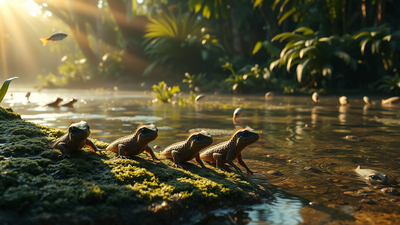
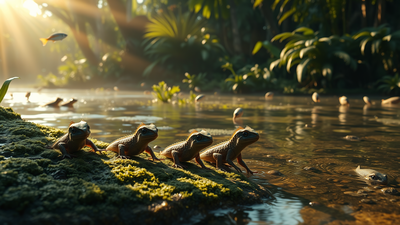
The centrepiece specimens in the study are hatchlings of a group of early tetrapods called embolomeres. As adults, embolomeres were formidable crocodile-like predators that dominated rivers, lakes, and swamps from roughly 350 to 280 million years ago, during the Carboniferous and Permian periods, and could grow to over three metres in length. The baby specimens recovered from Mazon Creek were just a few centimetres long and had likely been alive for only days to a couple of weeks when they died.What the researchers expected to find in these juveniles, based on the prevailing scientific model, was evidence of a tadpole-like larval stage: external gills, a body plan distinct from the adult form, and the developmental markers associated with amphibian-style metamorphosis. What they found instead was none of that. Neither baby embolomere showed external gills. One still had yolk visible in its abdomen, indicating it had barely emerged from the egg. But both showed developing limbs and a body form that was a smaller version of the adult not a fundamentally different larval animal waiting to transform.
The tadpole assumption and why it dominated for so long
For most of the history of vertebrate palaeontology, the assumed life history of the earliest tetrapods was modelled on modern amphibians, frogs, salamanders, and caecilians, which are the living animals most closely associated with the water-to-land transition. Modern amphibians hatch as aquatic larvae, breathe through external gills, and later undergo metamorphosis, a dramatic remodelling of their body plan, to become land-capable adults. It seemed logical that the first four-limbed vertebrates to colonise land followed a similar developmental path, and that this metamorphic capacity might even have been what enabled the transition in the first place.The problem was that this assumption was built almost entirely on inference, not fossil evidence. Juvenile specimens of early tetrapods have been extraordinarily rare in the fossil record precisely because small, soft, developing animals preserve very poorly. Without direct fossil evidence of hatchlings, the tadpole model remained a dominant hypothesis rather than a tested conclusion.
Direct development: a completely different evolutionary story
What the Mazon Creek hatchlings show is that early tetrapods followed a pattern researchers call direct development hatching as smaller versions of their adult selves, without passing through a distinct larval stage or metamorphosis. This is the pattern seen today in reptiles, birds, and mammals, including humans. It is not the pattern seen in modern amphibians.As summarised in Science, Pardo and Mann examined not just the embolomere fossils but dozens of Mazon Creek specimens representing multiple lineages across the fin-to-limb transition including a hatchling aïstopod (a snake-like early tetrapod), several megalichthyid finned fish, and other early tetrapod relatives. Across every group examined, the pattern was consistent. None showed anything resembling a tadpole larval stage. All showed developmental trajectories closer to fish or amniotes than to modern amphibians.“We looked at a number of different species that represent different lineages in the transition from fish to tetrapods, and what we found is that none of them have anything that looks remotely like a tadpole,” Pardo said. “And if you don’t have a tadpole, then you don’t have a metamorphosis.”
What this means for how we understand the water-to-land transition
The implications of the finding go beyond developmental biology. If the earliest land animals did not possess an amphibian-style larval stage, then the metamorphic life cycle of modern amphibians cannot be an ancient, inherited feature that dates back to the original water-to-land transition. Instead, it must have evolved later, separately, within the amphibian lineage making it a derived trait rather than an ancestral one.This matters because metamorphosis had long been theorised as a possible driver or enabler of terrestrial colonisation, a developmental strategy that allowed animals to exploit both aquatic and land environments across their lifecycle. The Mazon Creek fossils suggest that explanation is wrong. The first animals to conquer land did so not through metamorphosis but through a more direct, continuous developmental path growing from small versions of themselves into large ones, without dramatic transformation.It also raises fresh questions about when and why modern amphibian metamorphosis evolved, and what function it serves given that the group’s own ancient ancestors apparently got along without it. These are questions researchers say the field is now positioned to begin asking more rigorously, precisely because direct fossil evidence of early developmental stages finally exists.