
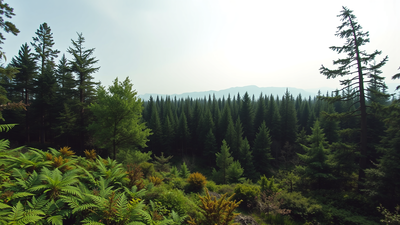
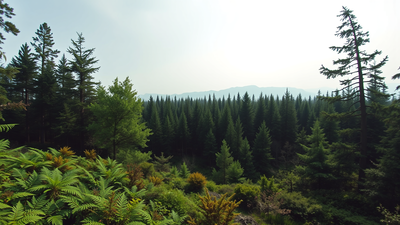
In the 1930s, under Mussolini’s fascist regime, Italy launched a sweeping reforestation drive across the northern Alps. The goal was to practically prevent soil erosion, secure timber, and project an image of national productivity. The chosen tree was Norway spruce (Picea abies), a fast-growing conifer prized for its straight trunk and reliable wood yield. Thousands of hectares of meadows and native forest were cleared to make way for these dense, uniform plantations. It seemed, at the time, like a reasonable solution to a real problem. Nearly a century later, a new study published in the journal Ecosystems has measured what that decision actually cost, and the numbers are striking. Plant diversity in these spruce monocultures is more than 50% lower than in native forests, and nearly 75% lower than in the region’s natural grasslands.
Norway spruce monocultures and the long-term collapse of alpine plant diversity
The research was conducted by a team from the University of Lausanne and the University of Milan, led by ecologist Gianalberto Losapio. They studied two sites in the Italian Prealps near Lake Como, Mount Bisbino and Alpe del Vicerè, both of which were reforested with Norway spruce in the early 1930s. The plantations at Alpe del Vicerè were installed between 1930 and 1935 as part of an “Alpine Village” project built under the fascist regime.Across five months of field surveys during the 2023 growing season, the team tracked plant species, soil-dwelling arthropods, and soil chemistry in three types of habitat side by side: the spruce monocultures, native deciduous forests, and traditional mountain grasslands. In total, they identified 136 plant species and 201 arthropod species and morphospecies.The contrast in plant life was hard to ignore. The median number of plant species per plot was just 7 in the spruce plantations, compared to 18.5 in deciduous forests and 37 in grasslands. According to the published findings, plant diversity was 50.3% lower in the tree plantations than in native forests and 74.5% lower than in grasslands, figures that held up after nearly 100 years.These findings highlight that not all reforestation activities can be expected to provide a desired ecological value. Overpopulation of one kind of species of trees in an area, as often been promoted worldwide as a solution for conservation, can in fact harm the complex ecosystem. When there is only a single species prevalent in an area, it may lead to reduced resilience to diseases, pests, and even extreme weather. In the case of the Alps, diverse natural landscapes were replaced with uniform spruce stands. It significantly altered light availability, soil chemistry, and habitat, which ultimately limited species recovery over time. The study highlights the need to adapt a restoration strategy that retains the native biodiversity instead of a one-size-fits-all approach.
Why spruce plantations suppress alpine biodiversity: Light, litter, and soil acidification
The mechanisms behind this biodiversity loss aren’t mysterious once you understand how Norway spruce actually behaves. Unlike the deciduous trees that naturally dominate these Italian Prealps, beech, maple, and chestnut, spruce is an evergreen. It keeps its needles year-round, which means the forest floor beneath it stays dark all the time.This matters enormously for what can grow underneath. Many of the plant species that thrive in native deciduous forests are geophyte plants like wood sorrel that emerge and flower in early spring, before the tree canopy has fully closed and while sunlight can still reach the ground. In a spruce plantation, that window of light never arrives. The canopy is permanently dense, and these early-flowering species simply can’t establish.The soil tells a parallel story. Spruce needles are acidic, and as they accumulate on the forest floor over decades, they alter the chemistry of the soil beneath them. The study found that soil organic carbon was around 25% higher in the spruce plantations than in native forests, not because the ecosystem was healthier, but because the litter was decomposing more slowly. The spruce needle buildup creates conditions where organic matter accumulates rather than cycling back into nutrients a sign of reduced biological activity in the soil. The carbon-to-nitrogen ratio was also significantly higher in the plantations, further confirming that nutrient turnover had slowed.
Functional evenness down 30%: What it means for ecosystem stability in reforested areas
Beyond raw species counts, the researchers also measured what ecologists call functional evenness, essentially, how evenly different ecological roles are filled within a plant community. A community with high functional evenness uses available resources efficiently and tends to be more resilient to disturbance. One with low functional evenness has gaps in ecological jobs that aren’t being done, niches that aren’t being occupied.In the spruce plantations, functional evenness was 30% lower than in native forests. That’s not just a biodiversity statistic. It suggests that the spruce monocultures, even after 90 years, are functioning as ecologically impoverished systems that are more vulnerable and less stable than the habitats they replaced.What makes this more telling is the community composition analysis the team ran. Using a technique called Partial Least Squares Discriminant Analysis, they found that the plant species found in spruce plantations aren’t a distinct boreal community that moved in alongside the spruce. They’re essentially a stripped-down subset of what you’d find in a native deciduous forest the same species pool, but thinner and less complete. The spruce didn’t create a new ecosystem. It degraded an existing one.
Arthropods showed partial recovery, but the picture for soil fauna isn’t fully reassuring
One area where the damage was less severe, at least by the numbers, was soil arthropods. The median arthropod diversity per plot was 25 in the spruce plantations versus 28.5 in deciduous forests, a difference that was not statistically significant. The researchers suggest this may reflect the mobility of arthropods, which can move between adjacent habitats more easily than plants, as well as their ability to exploit a wider range of food sources. It’s also possible that nearly a century is enough time for at least some arthropod populations to partially stabilise, even when the vegetation above them hasn’t recovered.But the researchers are careful not to read this as good news for the soil ecosystem. The higher organic carbon accumulation and slower decomposition rates in the spruce plots point to reduced biological activity overall. Microbial communities and the finer web of soil life weren’t directly measured, but the chemical signatures suggest they, too, have likely been altered.
What this means for today’s global reforestation targets and monoculture plantation policy
The Italian Alps case isn’t a historical curiosity. It’s a direct cautionary tale for current global reforestation commitments, many of which are being fulfilled through exactly the same approach: fast-growing monocultures of a handful of species, planted at scale.Half of all areas pledged for forest restoration globally consist of monoculture plantations of non-native species, according to prior research cited in the study. The appeal is obvious: monocultures are easier to manage, cheaper to establish, and grow fast enough to satisfy short-term carbon accounting targets. But this research, drawing on 90 years of real-world evidence, shows that the ecological bill eventually comes due.“These findings highlight the need for monitoring reforestation interventions, suggesting strategies that incorporate diverse tree species rather than planting tree monocultures to support functional and resilient ecosystems,” the authors write in the Ecosystems paper. The science is increasingly clear that multi-species plantations outperform monocultures in terms of productivity, stability, and biodiversity. Planting with diversity upfront requires more planning and more initial investment, but the long-term outcome, measured in a functioning ecosystem rather than a timber stand, is a different thing entirely.The Italian Prealps are still waiting for that lesson to arrive.