
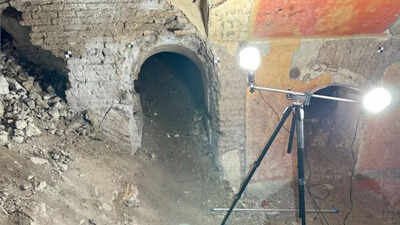
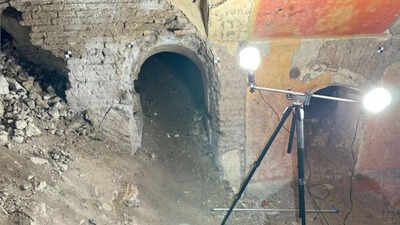
For years, the existence of underground rooms beneath a secondary school in central Rome was treated more as local lore than documented history. Beneath the gymnasium of Liceo Scientifico Cavour, only a short distance from the Colosseum, a network of buried spaces sat largely out of view, known to a handful of curious visitors but never fully examined.That changed after reports from within the school drew the attention of heritage authorities. What has emerged is evidence of a substantial Roman residence dating to the middle of the second century AD. According to official information released through the Cantieri Narranti heritage project, the remains belong to a large domus preserved beneath the modern building, with decorative elements surviving in remarkably good condition despite centuries of change above ground.
Who owned the ancient Roman house under the school gym
The site occupies a historically important part of the city between the Carinae district and the Esquiline Hill. Ancient literary sources associate the wider area with some of the best-known political figures of the late Roman Republic and early Empire. Yet modern development has left archaeologists with only fragmented opportunities to investigate what once stood there.As per the Cantieri Narranti project description, earlier construction work in 1895 uncovered part of the same residential complex during the opening of Via degli Annibaldi. Records from those nineteenth-century investigations documented a water pipe carrying the name of a member of the Umbrius family, providing one of the few clues about the property’s possible owners. The newly examined rooms suggest the residence formed part of a sizeable and prosperous urban household rather than a modest dwelling. Much of the structure remains concealed beneath the school grounds, meaning the full extent of the complex is still unknown.
Ancient Roman painted walls and stucco ceilings were found remarkably intact
One of the most striking aspects of the discovery is the survival of interior decoration. According to Cantieri Narranti, several rooms retain painted surfaces and stucco ornamentation extending to the vaulted ceilings. Such details are often among the first features lost when buildings collapse, are remodelled or become buried over long periods.The underground spaces had gradually filled with later debris and accumulated material. Work carried out in early 2026 focused on clearing these deposits and preparing the area for archaeological investigation. The preserved decorative programme is expected to provide valuable evidence about domestic architecture and artistic tastes in imperial Rome. Researchers are also undertaking surveys, diagnostic studies and conservation work designed to stabilise both the structures and their decorative surfaces. These efforts form part of a broader programme intended to safeguard the remains before wider public access becomes possible.
The multi-million euro plan to restore and open Rome’s buried Roman domus
The intervention is being funded through the Caput Mundi programme under Italy’s National Recovery and Resilience Plan. According to Cantieri Narranti, the project includes archaeological investigations, restoration, structural consolidation, infrastructure upgrades and public engagement initiatives.Work officially began in September 2025 and continued into 2026. The programme was conceived not only as a conservation effort but also as a way of bringing an otherwise inaccessible archaeological site into public view. Unlike many excavations hidden behind barriers, this project places considerable emphasis on communication. Printed materials, digital content and educational activities are planned as part of the long-term presentation of the site.
How Rome’s high school students are being taught inside a 1,800-year-old Roman house
The connection between the Roman house and the school above it is expected to remain central to the site’s future. As per official information published by Liceo Cavour High School, the archaeological remains are being developed through a collaborative approach involving heritage authorities, teachers and students.Plans envision making the domus accessible once conservation work progresses sufficiently. The intention is not simply to display the remains but to integrate them into educational activities linked to the school itself. For now, much of the ancient residence remains hidden beneath the modern campus. Yet each stage of excavation is adding detail to a chapter of Rome’s urban history that had largely disappeared from view. What survives under the gym floor is more than an isolated collection of rooms; it is part of a residential landscape that once stood at the heart of imperial Rome and is only now beginning to re-emerge.