
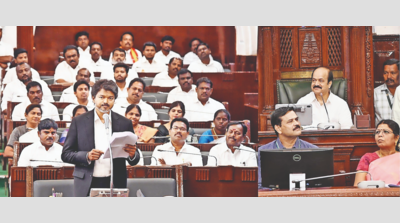
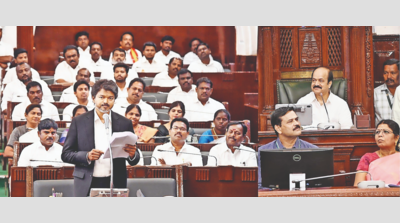
Richardson WilsonOn May 12, a faction of AIADMK MLAs led by S P Velumani and C Ve Shanmugam announced their decision to defy the decision of party general secretary Edappadi K Palaniswami and support chief minister C Joseph Vijay’s govt. They have publicly stated that they are quitting the NDA alliance. Will these MLAs incur disqualification under anti-defection laws or does the law permit them to split AIADMK if they have the support of two-thirds of the MLAs?Anti-defection laws were introduced in India to curb the deplorable conduct of legislators switching parties after being elected on the ticket of one party, often in lieu of personal gratification – known colloquially in India as ‘horse trading’. In 1967, an MLA named Gaya Lal switched parties three times in 15 days in Haryana – one switch even happening within a span of nine hours – leading Congress leader Rao Birender Singh to comment “Aaya Ram, Gaya Ram” (Ram comes and Ram goes). Parliament inserted the Tenth Schedule to the Constitution in 1985, which provides for disqualifications of legislators in case they voluntarily give up membership of the political party from which they were elected or vote or abstain contrary to a direction issued by the political party.In AIADMK’s case, the issues have started right from the get-go. EPS had written to the pro-tem speaker of the assembly requesting recognition as leader of the AIADMK legislature party and Agri S S Krishnamoorthy as party whip. The rival faction requested the speaker to recognize Velumani as legislature party leader and C Vijayabaskar as whip. Media reports claim that about 24 AIADMK MLAs have expressed written support to Palanisami whereas the rest are with Velumani. Speaker J C D Prabhakar is yet to take a decision on appointing a leader. The question is: Will the dissident faction be disqualified if it votes for TVK in the assembly and what happens thereafter?First, the question of recognition of the legislature party leader and the whip. The leader of the legislature party is defined under Rule 2 (f) of the Tamil Nadu Legislative Assembly (Disqualification on Ground of Defection) Rules, 1986, as the person appointed by the party and communicated to the secretary of the assembly in Form – I under Rule 3.Only the party can authorize a set of MLAs to communicate with the speaker of the assembly. Under AIADMK’s constitution, its general secretary alone has the power to take these decisions. In the 2023 Subhash Desai vs Principal Secretary, Governor of Maharashtra case, Supreme Court held that the speaker must appoint the leader of the legislature party and whip chosen by the political party only and not a majority faction of the legislative party. Therefore, the Speaker has no option but to appoint EPS as leader of the legislature party and the people nominated by him as the deputy leader and the whip.The rules of legislative assemblies of other states and Parliament are similar to prevent MLAs/ MPs from forming their own faction and revolting against their political party’s wishes.The MPs/MLAs are elected on the symbol allotted by the political parties and this ‘umbilical cord’ cannot be severed after election. They are still bound by the decisions of their party.A popular misconception is that if two-thirds of the MLAs belonging to a political party defect or support another party, they are saved from disqualification by the merger exception contained in para 4 of the Tenth Schedule. However, the merger exception requires satisfaction of twin conditions: the merger of the original political party – not the legislature party – of the defecting group with the new political party; and the acceptance of this merger by not less than two-thirds majority of the legislature party. Para 1(b) and (c) of the Tenth Schedule makes a clear distinction between legislature party and political party. AIADMK as a political party must merge or be subsumed by TVK and such merger must then be approved by not less than two-thirds of AIADMK MLAs. Merger of political parties is governed by Rule 16 of the Election Symbols (Reservation and Allotment) Order, 1968, and the parties must apply to the Election Commission of India.In the absence of a merger between AIADMK and TVK, even if two-thirds MLAs from AIADMK support TVK, their act of defection would not be saved by the merger exception in para 4 of the Tenth Schedule and they would incur disqualification and lose their seats.Velumani and the MLAs in his camp have already incurred disqualification by giving a press conference on Tuesday expressing their intention to break from AIADMK’s stance on alliance formation and supporting TVK as it amounts to ‘voluntarily giving up membership of the political party’. The same goes for MLA S Kamaraj of AMMK who has gone against the wishes of his party and expressed support to TVK.Irrespective of whether they cast their votes in the floor test tomorrow in favour of TVK, they are liable to be removed as MLAs. In Ravi S Naik vs Union of India (1994), the SC has held that a formal resignation is not required. A member’s conduct against his party’s wishes can lead to the inference that he has voluntarily given up his membership.In Mayawati vs Markandeya Chand (1998), SC held that a majority faction of the legislature party cannot be construed as the political party. Thus, the very act of going against the party’s wishes in appointing the leader of the legislature party and defying its decision on alliance formation incurs disqualification as it amounts to voluntarily giving up membership of the AIADMK party. If they cast their votes in defiance of their party’s whip, then they are certainly liable to be disqualified.The course open to EPS now is to file petitions for defection against the MLAs who have defied his directions before the Speaker. In similar cases across the country we have seen that Speakers sit over these petitions till they are nudged by constitutional courts to do their duties within a time frame. If the dissident MLAs are disqualified, byelections will have to be held for their seats. (The writer is an advocate in madras high court)(The writer is an advocate in madras high court)Email your feedback with name and address to southpole.toi@timesofindia.com