
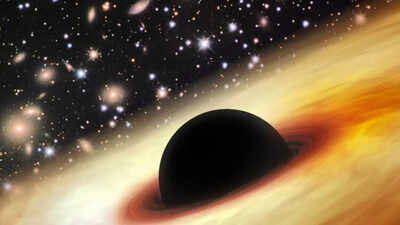
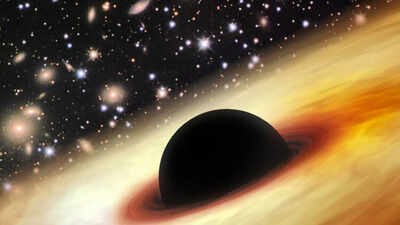
For years now, astronomers have been witnessing what seems like an ever-growing puzzle regarding the early formation of the universe. According to recent findings, some supermassive black holes, with masses ranging up to one billion times larger than the sun’s, were formed within less than a billion years following the formation of the universe itself. This phenomenon is hard to understand according to current scientific explanations for the evolution of black holes. Normally, black holes are created when stars collapse and gradually increase in size. This is because the entire process requires time. However, recent findings made through the use of the James Webb Space Telescope point toward the opposite. There might be an unknown force behind their quick formation, and dark matter could be the answer.
Scientists explore the hidden impact of decaying dark matter
According to the IOP Science study published titled, ‘Direct collapse black hole candidates from decaying dark matter’, the existence of dark matter refers to the concept of an invisible substance making up most of the matter in the universe. This dark matter neither reflects nor emits light and interacts with other substances in a negligible way; however, it influences galaxies due to its gravity. In their recent research, scientists took another direction in exploring dark matter. Decay means releasing some energy into space. However, initially, this process does not seem to have much influence on anything. The amount of energy that each particle emits can be regarded as negligible. Nonetheless, scientists believe that minimal energy input may have had an impact on the initial state of the universe because it was mainly composed of hydrogen.
Dark matter decay could trigger direct black hole formation
According to scientific studies under regular circumstances, gas clouds lose heat and end up in fragmentation, resulting in the formation of stars. In other words, this is the normal pathway. However, based on the current research, if some amount of energy due to the decay of dark matter is released in the gas clouds, then cooling is impeded.As a result, there will be no fragmentation in the clouds. Instead of fragmentation, there will be a direct collapse into massive black holes. This phenomenon is referred to as direct collapse, where there is no creation of stars.Scientists have theorised that this method may contribute to the creation of supermassive black holes very soon after the universe started its existence. It has been found that this process may occur when the particles of dark matter have a mass ranging between 24 and 27 electronvolts, as reported by Space.com.
Insights from the James Webb Space Telescope
Indeed, the James Webb Space Telescope has been vital in posing these queries. The discoveries by the telescope include the identification of galaxies and black holes that seem to have developed further than anticipated, considering their age. It challenges our current theories about the formation of the universe.Direct collapse black holes had already emerged as a plausible explanation but seemed to depend on extraordinary circumstances. For instance, the surrounding stars should emit intense radiation that affects the gases in the clouds around the black holes in a certain manner. However, the proposed dark matter theory posits that these exceptional occurrences may not be as uncommon as previously thought.
How small dark matter effects may have had massive consequences
One of the most striking aspects of the study is the scale of energy involved. Each decaying dark matter particle releases an extremely small amount of energy, far less than everyday energy sources. Despite this, the cumulative effect across vast regions of space could be meaningful.Early universe gas clouds were not stable systems. Their behaviour depended on a delicate balance between heating and cooling. Even a slight shift in this balance could determine whether stars formed or whether a black hole emerged directly. Researchers suggest that these early environments may have acted like natural detectors for dark matter activity. While the idea remains speculative, it offers a new way to connect particle physics with cosmic evolution.
New research adds another piece to the supermassive black hole puzzle
The theory on dark matter decay causing the development of supermassive black holes is still being studied. This theory has not been confirmed yet, and more studies need to be conducted both observationally and theoretically. One thing that is certain is that there are many unanswered questions about the early universe. The presence of very large black holes during this period contradicts existing theories.