


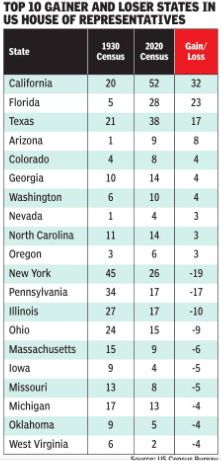
As the debate on size and composition of the Lok Sabha continues, the United States offers an interesting contrast. It does not keep enlarging its lower house every time population shifts. The United States House of Representatives has been capped at 435 seats since 1929, but after every decennial census those seats are redistributed among the states according to population, with each state guaranteed at least one seat. Over time, that has changed the balance quite a bit: states such as California, Florida and Texas have gained representation, while New York, Pennsylvania and Illinois have lost it.
.
But the real American safeguard lies in the other chamber. Every state — big or small — gets two Senators, regardless of the population. That arrangement emerged from the 1787 constitutional compromise between the large and small states. Since the Seventeenth Amendment, Senators have been directly elected by the people.India’s system is different. The Lok Sabha is population-based, and the Rajya Sabha too is only partly federal: bigger states still get a much larger voice there than smaller ones. That is why any future delimitation here can reopen not just the question of voter equality, but also the federal balance between states.There is also a separate political question. If the immediate goal is women’s representation, why must it require a 50% jump in Lok Sabha seats? Could 33% reservation be accommodated within the present ceiling, or better still, could major parties simply commit to giving half their tickets to women?