
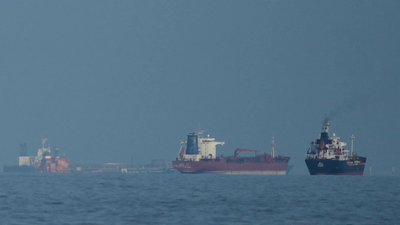
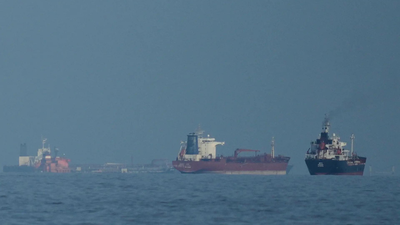
A US Navy destroyer on Tuesday intercepted two oil tankers attempting to leave Iran, a day after US President Donald Trump announced a blockade aimed at pressuring Tehran, according to a US official cited by Reuters.The official, speaking on condition of anonymity, told Reuters that the vessels had departed Chabahar port in the Gulf of Oman and were contacted by radio by the warship, which instructed them to turn back. It is not known whether additional warnings were issued.The incident marks the initial phase of Washington’s blockade enforcement, aimed at compelling Iran to end what US officials describe as the effective closure of the Strait of Hormuz, a vital energy chokepoint through which roughly one-fifth of global oil supplies flow.The move comes after talks collapsed aimed at ending hostilities in the ongoing Iran–US–Israel conflict, which erupted on February 28, is now in its second month, and is currently under a two-week ceasefire. Trump has linked the reopening of the Strait of Hormuz to a temporary ceasefire agreement set to expire next week. A US Central Command statement said six merchant vessels complied with instructions to “turn around to re-enter an Iranian port on the Gulf of Oman”, adding that no ships have passed through the blockade since it began on Monday.However, maritime tracking data indicates that at least three vessels departing Iranian ports managed to cross the Strait of Hormuz despite a US-declared naval blockade, though some ships later turned back, according to Kpler data cited by AFP.The vessels identified include the Liberia-flagged bulk carrier Christianna, the Comoros-flagged tanker Elpis, and the bulk carrier Argo Maris, which reportedly moved through the chokepoint after cargo operations at Iranian ports. The movements are also believed to be part of a wider group of at least seven Iran-linked vessels that transited the strait after the blockade came into force on Monday .The operation involves more than 10,000 US personnel, over a dozen warships and multiple aircraft, according to the military. Washington says it will continue to ensure freedom of navigation for vessels not travelling to or from Iran.Experts, however, have urged caution over its effectiveness. “We just don’t know yet how effective it is. We are still in day two,” said Noam Raydan of The Washington Institute for Near East Policy, noting that some Iran-linked ships disable tracking systems.If sustained, analysts say the blockade could escalate tensions and provoke retaliation from Tehran. It may also strain the fragile ceasefire and further destabilise regional security.Iranian threats to shipping have already driven global oil prices up by around 50%. Roughly 5,000 people have died in the hostilities, while thousands of US strikes have weakened Iran’s military infrastructure.However, analysts warn that Tehran still poses a challenge for Washington, citing a more hardline leadership and a concealed stockpile of highly enriched uranium. Raydan warned retaliation remains likely if pressure intensifies, adding, “We’re in the testing period.